Kilz vs Zinsser Mold Primer: A Practical Comparison
Compare kilz and zinsser mold primer for mold remediation: odor, coverage, dry time, and safety. Mold Removal Lab analyzes practical differences for DIY and pro projects in 2026.


Kilz and Zinsser mold primers serve different priorities. According to Mold Removal Lab, Kilz typically emphasizes stronger seal and stain blocking, while Zinsser focuses on low odor and faster dry times. For mold-prone spaces, balance coverage, ventilation, and surface type to minimize future remediation steps.
Kilz vs Zinsser Mold Primer: The Big Picture
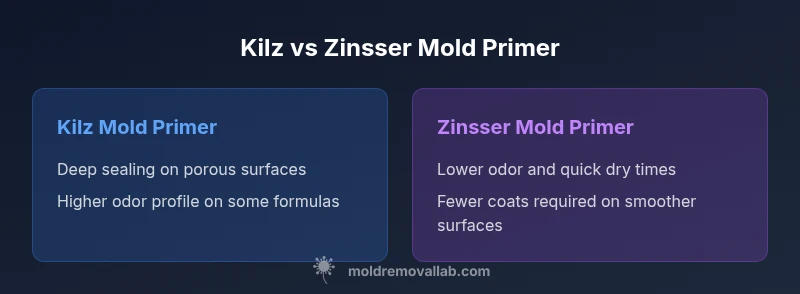
The kilz vs zinsser mold primer decision sits at the intersection of surface chemistry, moisture control, and indoor air quality. At a glance, Kilz primers are often seen as the stronger sealers—formulated to block stubborn stains and guard porous substrates against moisture seeping in behind paint. Zinsser products, by contrast, emphasize user comfort: lower odor profiles, easier cleanup, and quicker readiness for top coats. From the Mold Removal Lab perspective, this distinction matters because mold remediation projects hinge on durable sealing, safe sheltering of occupants, and efficient project timelines. A successful choice minimizes follow-up work and reduces the risk of mold regrowth, especially in basements, crawl spaces, and bathrooms where humidity remains high.
When homeowners weigh kilz vs zinsser mold primer, they should consider the surface to be sealed (wood, drywall, plaster, concrete), the level of contamination, the ventilation available during application, and the planned repaint window. Our team’s 2026 analysis finds that neither brand is universally “better” in all scenarios; instead, the best choice depends on the project’s priorities: aggressive sealing and stain-blocking or low odor and ease of use. In the sections that follow, we dive into performance metrics, real-world use cases, and practical guidelines to help you select the right product for your mold remediation project.
-1
Comparison
| Feature | Kilz Mold Primer | Zinsser Mold Primer |
|---|---|---|
| Odor and ventilation | Kilz: stronger odor potential | Zinsser: lower odor |
| Drying speed | Kilz: moderate drying | Zinsser: faster drying |
| Coverage and opacity | Kilz: high coverage/opacity | Zinsser: good coverage, slightly lower opacity |
| Mold-inhibition claims | Kilz: mold-blocking claims vary by product | Zinsser: mold-primer variants emphasize mold resistance |
| VOC levels | Kilz: mid-to-high VOC depending on line | Zinsser: low-to-mid VOC options |
| Best for | Kilz: heavy staining and moisture-prone surfaces | Zinsser: low-odor projects and quick turnarounds |
Upsides
- Kilz primers offer strong seal and blocking for porous substrates
- Zinsser primers provide low odor and faster recoat times
- Both brands have lines designed for mold remediation projects
- Wide availability and product diversity help fit different budgets
The Bad
- Kilz can have stronger odors and longer recoat times on some formulas
- Zinsser may be less forgiving on surfaces with heavy staining
- Results depend on correct surface prep and ventilation
- Claims about mold resistance vary by specific product line
Kilz provides stronger sealing for mold-prone surfaces; Zinsser offers lower odor and faster handling.
Choose Kilz when you need robust sealing on porous surfaces or heavy staining. Choose Zinsser when odor control and a quicker project pace matter more, especially in tight indoor spaces.
FAQ
Which primer blocks mold better, Kilz or Zinsser?
In general, Kilz is renowned for stronger stain blocking and sealing on porous substrates. Zinsser mold primers focus on low odor and user-friendly handling. Always test on a small area to confirm performance for your surface and moisture level.
Kilz is usually stronger at blocking stains, but test first, especially on damp surfaces.
Can I apply primer directly on moldy surfaces?
No. Address visible mold growth with containment, cleaning, and drying before priming. After the surface is dry and mold-free, apply primer to seal and prepare for paint.
Do not prime over mold. Clean, dry, and treat first.
Are Kilz and Zinsser mold primers safe for indoor use?
Both brands offer low-odor options and products labeled for indoor use. Always ventilate, wear a mask as needed, and follow manufacturer safety data sheets for ventilation and curing times.
Choose low-odor options and ventilate well.
Do these primers require a second coat before painting?
Many surfaces benefit from one coat, but heavily porous surfaces or stubborn stains may require a second coat. Follow manufacturer guidelines and allow complete cure between coats.
Often one coat is enough, but moisture-heavy surfaces may need two.
Is one primer better for concrete versus drywall?
Kilz and Zinsser primers can work on concrete and drywall, but surface prep matters more than the brand. Kilz may provide stronger sealing on concrete with porous textures; Zinsser can be easier to handle on drywall due to lower odor.
Both can work, prep matters more than the brand.
The Essentials
- Match primer to surface porosity and moisture
- Kilz excels at stain blocking; Zinsser for odor control
- Drying times depend on formula; plan for ventilation
- Always prep mold-affected areas before priming
- Verify VOC compliance for indoor use