Black Mold vs White Mold: Practical Health Guide for Homeowners
Compare black mold and white mold, understand health risks, detection, and remediation steps. Practical guidance for homeowners and renters from Mold Removal Lab with tested insights and safe cleanup strategies.


In most homes, black mold vs white mold signals different risk levels and remediation priorities. Black mold, often linked to toxic growth in persistently damp spaces, generally demands rapid containment and professional assessment. White mold is typically less aggressive but still warrants moisture control and careful cleaning to prevent spread. Always treat visible growth as a moisture problem first and verify with testing if questions persist.
Understanding black mold vs white mold
When people talk about mold in homes, two color-based categories often come up: black mold and white mold. While color alone isn’t a definitive test of danger, it commonly aligns with distinctive growth conditions and health considerations. Black mold (often Stachybotrys chartarum in damp environments) tends to appear in sustained moisture zones such as flooded basements or areas with chronic leaks. White mold, encompassing species like Trichoderma or Aspergillus varieties, frequently grows on damp, porous surfaces and may look powdery or fluffy. According to Mold Removal Lab, color cues should guide initial risk assessment, but confirming species and exposure risk requires moisture history and, when appropriate, testing. This guide uses practical, home-focused guidance to help you decide when to clean, when to call a pro, and how to reduce recurrence.
Visual cues and growth contexts
Seeing black or dark-greenish growth in bathrooms, basements, or under sinks often signals a moisture issue that needs attention beyond surface cleaning. White mold can appear on drywall, cardboard, or fabric after a minor spill or in poorly ventilated spaces. The key is moisture: if the area stays damp, growth will likely continue. The Mold Removal Lab Team emphasizes that not all dark molds are dangerous, but sustained growth in living spaces should be treated with caution and an appropriate response plan.
Health implications and vulnerable populations
Exposure to mold can trigger sneezing, coughing, skin irritation, or asthma-like symptoms in sensitive individuals. Black mold has historically been associated with more severe reactions in some people due to mycotoxins produced by certain strains, while white mold can also cause allergic responses and respiratory irritation. The goal is to minimize indoor moisture, limit human contact with growing colonies, and pursue professional evaluation if symptoms persist or if growth is extensive. Mold Exposure guidance from Mold Removal Lab stresses that health risk depends on exposure duration, allergen load, and individual susceptibility rather than color alone.
Moisture management: the root cause of both molds
Mold growth is fundamentally a moisture problem. Leaks, roof intrusion, high humidity, or condensation create the environment mold needs to thrive. Black mold often signals long-standing moisture issues, while white mold can take hold after a single spill in a poorly ventilated space. Mitigation strategies start with fixing leaks, improving ventilation, and controlling humidity levels. In many cases, addressing the moisture source is more important than the color of the mold. Mold Removal Lab Analysis, 2026, highlights moisture control as the most impactful step toward long-term prevention.
Detection and testing: when to test and what to test for
Visual inspection is helpful but not definitive for species identification. For homeowners, moisture mapping, surface swab tests, and air sampling can provide clarity on whether a broader remediation is warranted. Tests should be conducted by qualified professionals when growth covers non-trivial areas, or when members of the household have chronic symptoms. While tests can confirm the presence of mold, they rarely determine the exact health risk without considering exposure duration and the environment. Balance testing with moisture reduction actions.
Cleaning vs remediation: practical approaches
Small, non-porous surfaces with light mold growth can sometimes be cleaned with appropriate protective equipment and cleaning agents. Porous materials, hidden growth, or large infestations typically require professional remediation to prevent regrowth and to ensure containment. Always follow safety protocols: wear gloves, eye protection, and a respirator rated for mold, seal affected areas, and dispose of contaminated materials properly. The distinction between cleaning and remediation is critical for preventing reoccurrence and for protecting occupant health.
Containment and safety during remediation
Containment minimizes the spread of spores during cleanup. Use negative-air machines if advised by a pro, seal off the area, and avoid dry brushing or high-pressure cleaning that can aerosolize spores. For black mold, professionals may establish controlled containment and perform HEPA-filtered cleanup to ensure safety. White mold cleanup, while often less invasive, still benefits from controlled ventilation and thorough drying to reduce moisture rebound. Following a professional assessment, you’ll have a clear, enforceable plan for safe remediation.
When to hire professionals and what to expect
Professional remediation is typically recommended for large, porous, or toxic-mold concerns, including suspected black mold. Expect a moisture assessment, containment measures, removal of contaminated materials, HEPA air filtration, and a post-remediation verification to confirm that mold is gone and moisture has been resolved. Costs vary with extent and location, but the emphasis should be on safety, effectiveness, and long-term moisture control rather than speed or price alone.
Practical steps for homeowners: inspections and remediation basics
A practical approach starts with a written moisture plan: identify leaks, fix them, and use dehumidifiers or exhaust fans to maintain humidity below 50-60%. Inspect hidden spaces (under sinks, behind walls, basements) for signs of moisture damage. Document growth with photos, set a remediation goal, and maintain a clean, dry environment during and after cleanup. Regular inspections help prevent recurrence and support a healthier living space.
Prevention: long-term moisture management and mold resistance
Maintaining a dry indoor environment is the best defense against both black and white mold. Regularly vent bathrooms and kitchens, fix roof and plumbing leaks promptly, insulate cold surfaces to reduce condensation, and use mold-resistant products where appropriate. Keep interior humidity low, clean up spills quickly, and consider air purification and filtration devices designed to reduce spores in the air. Mold Removal Lab’s preventative guidance emphasizes proactive moisture management as the cornerstone of healthy homes.
Comparison
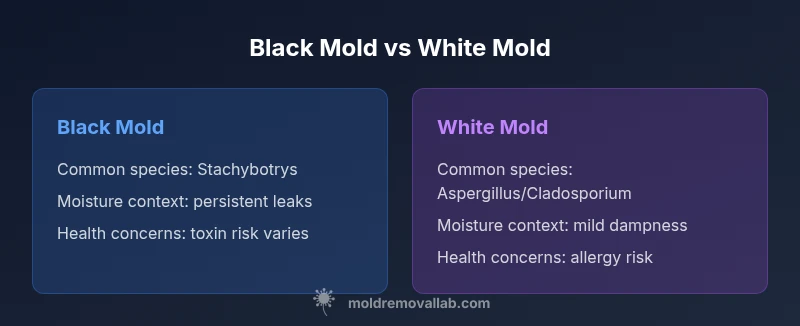
| Feature | Black Mold | White Mold |
|---|---|---|
| Common species | Often associated with Stachybotrys chartarum in damp spaces | Includes Aspergillus, Penicillium, and Cladosporium varieties |
| Typical moisture context | Persistent moisture from leaks or floods | Moderate dampness or recent water exposure |
| Health concerns | Historically linked to toxin exposure in some strains; risk varies by exposure | Allergic reactions and irritation; toxin risk varies by species |
| Remediation difficulty | Often requires professional containment for safety | Can be addressed with careful cleaning for small, non-porous areas; larger cases may require professionals |
| Cleanup cost range | Varies by extent and region; can be higher for containment and testing | Varies by extent; typically lower for small, surface-level growth |
| Best for | High toxin risk or widespread growth; urgent containment needed | Milder contamination or surface growth; humidity control is key |
Upsides
- Helps prioritize safety and remediation actions
- Clarifies when to involve professionals
- Highlights environment moisture issues
- Supports informed decision-making for homeowners
The Bad
- Mold color alone is not a definitive indicator of danger
- Assessment may require testing and specialized equipment
- Remediation costs can vary widely based on extent
Black mold generally requires quicker professional assessment; white mold can be managed with targeted cleaning in smaller areas.
If you encounter black mold, prioritize safety and professional evaluation. For white mold in limited areas, careful cleaning and moisture control may suffice, but monitor for recurrence and re-test if symptoms persist.
FAQ
How can I tell black mold from white mold just by looking?
Color is a helpful clue but not definitive. Growth patterns, moisture history, and testing are needed to confirm species and risk. If growth is widespread or in living areas, treat it as a potential hazard and seek professional assessment.
Color helps, but you should get a professional test if you’re unsure. Don’t assume safety based on appearance alone.
Is black mold more dangerous than white mold?
Black mold can be more concerning due to reported toxin-producing strains, but health risk depends on exposure duration and individual susceptibility. Both types can affect sensitive people, so addressing moisture and containment is essential.
Black mold can be riskier, but exposure and health impact vary. Better to address any mold growth promptly.
Should I test for mold, and what should I test for?
Testing can confirm presence and help guide remediation scope. Tests typically identify mold species and spore levels, but a professional interpretation is crucial for proper action.
Testing can clarify what you’re dealing with, but a pro should interpret results.
Can I clean mold myself, or do I need a pro?
Small, non-porous areas can sometimes be cleaned safely with proper gear. Large, porous, or toxin-associated growth generally requires professional remediation to prevent spread and ensure thorough cleanup.
For big or porous areas, call a pro. For tiny spots on solid surfaces, careful cleaning may be okay.
How long does remediation take?
Time varies with extent, location, and whether containment is needed. A typical project ranges from a few days to a couple of weeks for extensive cases, including verification testing.
Duration depends on size and severity; expect a range from days to a couple of weeks.
Is black mold always toxic?
Not all black mold strains produce toxins, but many can trigger health symptoms. Treat any mold growth seriously and address moisture and containment promptly.
Not every black mold strain is toxin-producing, but it can still affect health—address it carefully.
The Essentials
- Act on moisture issues first to prevent mold growth
- Don’t rely on color alone to gauge danger
- Engage professionals for widespread or toxin-associated growth
- Document growth and monitor moisture to prevent recurrence
- Prioritize long-term moisture management to keep homes safe