Baking Soda for Mold Smell: A Practical Guide for Homeowners
Learn how baking soda helps neutralize mold odors at home. This educational guide covers how it works, best practices, safety tips, and when to seek professional remediation for persistent mold odor.


Using baking soda to combat mold smell is a practical, at-home deodorizing method. It won't remove active mold growth but can absorb moisture and odors in air, fabrics, and porous surfaces. For best results, use baking soda in combination with ventilation, targeted cleaning, and professional mold assessment if odor persists.
What baking soda can and can't do for mold smell
According to Mold Removal Lab, baking soda can help neutralize odors by absorbing moisture and restricting the spread of musty smells in enclosed spaces. It does not kill active mold, nor does it replace proper remediation in damp environments. This section explains what to expect and how to set realistic goals when using baking soda as a deodorizer in kitchens, bathrooms, basements, and laundry areas. When homeowners notice a persistent odor, stepping back to evaluate moisture sources and airflow is essential. Baking soda's deodorizing effect is most noticeable on soft surfaces like fabrics and carpets, in closets, and in small, closed rooms where air exchange is limited. The Mold Removal Lab team found that combining baking soda with good ventilation and timely cleaning can reduce perceived odor by a meaningful margin, but results vary with room size, humidity, and prior moisture events.
How baking soda works as a deodorizer
Baking soda is a mild alkali that can neutralize acidic odor compounds and absorb moisture. When placed in open containers, it creates a microenvironment that helps trap volatile organic compounds responsible for musty smells. While baking soda can reduce the intensity of odor, it does not destroy mold spores or address the moisture source that supports mold growth. For best results, pair baking soda with improved ventilation, temperature control, and moisture management. Mold Removal Lab analysis shows that the strongest odor reductions occur in rooms with direct airflow and limited porous surfaces. In larger spaces, multiple containers spaced across the area provide better coverage than a single bowl in a corner.
Situations where baking soda shines
Storage closets and laundry rooms: open bowls in corners can help absorb odors coming from damp fabrics or detergents.
Carpets, rugs, and upholstery: sprinkle lightly on affected areas after thorough cleaning, then vacuum the powder after 24 hours.
Basements and crawl spaces: place several bowls along walls to create a deodorizing barrier.
Fabrics and textiles: treat curtains, cushions, and clothing by leaving baking soda in breathable bags or in small fabric sachets; then shake out or vacuum. In all cases, ensure you monitor humidity and provide airflow. The Mold Removal Lab team notes that baking soda is most effective when used as part of a broader odor-control plan rather than a stand-alone solution.
Step-by-step deodorizing workflow (non-bleach, odor-focused)
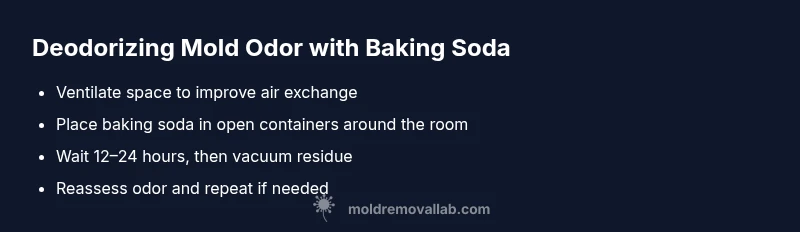
Begin with a quick scan for moisture sources and ensure the space is ventilated. Then place baking soda in open containers around the odor source. Let the powder sit for 12-24 hours, returning after the period to vacuum and wipe surfaces. Finally, reassess the odor; repeat if necessary and consider additional measures like dehumidifiers or air purifiers. This approach maximizes odor absorption while keeping safety in mind.
When to escalate: signs you need professional remediation
If the musty smell persists after applying baking soda, if you notice ongoing moisture problems (visible leaks, damp walls, or persistent condensation), or if mold growth is visible, seek a professional assessment. Persistent odors across rooms or odors that return after cleaning may indicate hidden mold or structural moisture. In these cases, professional remediation and moisture control strategies are recommended to protect health and home value.
Proper use: containers, application, duration
Use plain, unscented baking soda and place it in open containers or shallow bowls spaced throughout the affected area. A typical guideline is 1–2 cups per odor-prone space, with more containers for larger rooms. Leave containers undisturbed for 12–48 hours, then vacuum or wipe surfaces to collect residue. Replace with fresh baking soda if odors linger. Always ensure adequate ventilation during this process to improve effectiveness.
Common mistakes and safety considerations
Do not rely solely on baking soda for active mold remediation; address moisture sources and consider professional help for health-safe outcomes. Avoid using scented or dyed baking soda, which can stain fabrics or leave lingering residues. Wear gloves and a mask when handling dusty mold-prone areas and vacuum with a HEPA-filtered cleaner to minimize dust dispersion. Finally, do not expect baking soda to kill mold; treat it as a deodorizing aid within a broader mold-management plan.
Integrating baking soda into a broader odor-remediation plan
Baking soda works best when integrated with moisture control (dehumidifiers, proper ventilation), targeted cleaning (detergent, quaternary cleaners if appropriate), and air exchange improvements (fans and open windows). For rooms with severe odor, consider a professional assessment to identify hidden moisture sources and potential structural remediation needs. This approach ensures long-term results and healthier indoor air.
Tools & Materials
- baking soda (sodium bicarbonate)(Plain, unscented; use 1–2 cups per odor-prone area; place in open containers)
- open containers or shallow bowls(Scatter around room corners and near odor sources)
- protective gloves and mask(Protect hands and lungs when handling dusty areas)
- cleaning supplies (mild detergent)(For spot-cleaning surfaces after odor absorption)
- microfiber towels(Wipe surfaces after odor absorption; helps remove residue)
- HEPA-filter vacuum (optional)(Use after powder has settled to minimize dust)
- ventilation options (fans, open windows)(Improve air exchange during deodorizing)
Steps
Estimated time: Total time: 12-48 hours
- 1
Identify odor sources and secure ventilation
Scan the space for damp areas, hidden leaks, or condensation that could be fueling odor. Open windows or position fans to create airflow across the room, which helps carry moisture and odor away from the area.
Tip: A simple airflow pattern (one fan blowing in, one pulling out) is often effective. - 2
Place baking soda in open containers around the space
Distribute 1–2 cups of baking soda in shallow bowls or trays in corners, along walls, and near suspected odor sources. Avoid piling baking soda in one spot; maximize surface area exposure to air.
Tip: Place containers at multiple heights (shelves and floor) to catch rising odors. - 3
Let it sit for 12–24 hours, then assess
Leave the baking soda undisturbed for the recommended period. Return to check odor intensity and feel of the space. If odors persist, consider extending the duration or adding more containers.
Tip: In humid spaces, odor reduction may take longer; patience pays off. - 4
Vacuum or wipe away powder and recheck
Carefully vacuum the area with a HEPA-filter vacuum or wipe surfaces with a damp cloth to remove any powder residue. Reassess odor after cleaning; if needed, repeat the process in stages.
Tip: Vacuum slowly to prevent scattering dust; use a gentle attachment for fabrics. - 5
Combine with other deodorizing methods as needed
If odors linger, pair baking soda with additional measures such as improved humidity control, fabric airing, or targeted cleaning of affected fabrics and surfaces.
Tip: Avoid over-reliance on baking soda; odor control is multi-faceted.
FAQ
Can baking soda kill mold?
No. Baking soda helps absorb moisture and neutralize odors, but it doesn’t kill mold or stop growth. For active mold, remediation is required.
Baking soda won't kill mold; it helps with odor, but you still need proper remediation.
How long should baking soda sit to deodorize a room?
Let it sit for about 12 to 48 hours, depending on odor strength and humidity. Check and replace if odors persist.
Usually, 12 to 48 hours.
Is baking soda safe to use on fabrics and carpets?
Yes, generally safe, but test a hidden area first and avoid staining. Vacuum or wipe residue after deodorizing.
Yes, but test first and avoid staining.
Can baking soda replace professional mold remediation?
No. Baking soda is a deodorizing aid and moisture-control measure, not a substitute for professional remediation in cases of active mold.
No, it's not a replacement for professionals.
Should I mix baking soda with vinegar for odor control?
Avoid mixing directly in closed spaces. You can use vinegar for cleaning separately, then baking soda for deodorizing. Do not combine in one container.
Use them separately; don’t mix at once.
What are signs that mold odor persists after baking soda attempts?
If the musty smell remains after deodorizing, if moisture symptoms persist, or you see new mold growth, seek professional assessment.
If the smell sticks around, get a professional check.
Watch Video
The Essentials
- Ventilation and moisture control are essential for odor reduction
- Baking soda deodorizes but does not kill active mold
- Use open containers strategically across the space
- Pair baking soda with other odor-control strategies for best results