Moss vs Mold vs Mildew: Key Differences for Homes
Learn to tell moss, mold, and mildew apart, why it matters for health and structure, and how to safely remove and prevent future growth in damp spaces. Practical steps, moisture control, and when to call Mold Removal Lab.


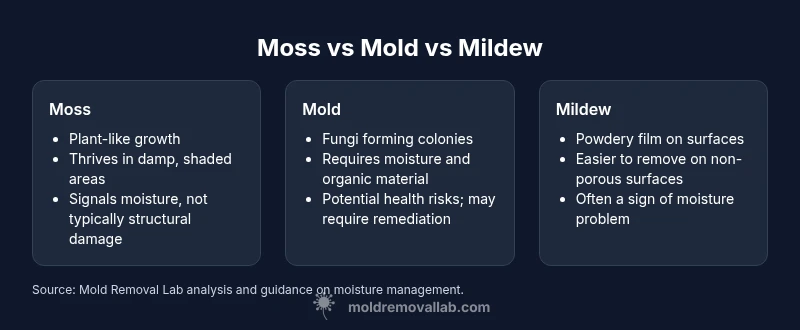
Moss, mold, and mildew are distinct organisms with different growth habits and remediation needs. Moss is a non-vascular plant-like growth that thrives in damp, shaded areas; mold and mildew are fungi that require moisture and organic substrates, with mold often appearing fuzzy and mildew powdery. Correctly identifying moss vs mold vs mildew helps target moisture control and choose safe, effective cleanup and prevention steps.
Moss vs Mold vs Mildew: Definitions
Moss, mold, and mildew appear in damp spaces, but they are not the same thing. Moss is a non-vascular plant-like organism that forms dense mats on soil, rocks, and shaded surfaces. It does not feed on building materials in the same way fungi do, but it signals persistent moisture and poor drainage. Mold and mildew are fungi; mold colonies are often fuzzy or leathery and can come in colors ranging from black to green to orange, depending on the species. Mildew, historically considered a subtype of mold, usually presents as a powdery white or gray film on surfaces. For homeowners, moss vs mold vs mildew matters because it informs not only cleanup methods but also long-term moisture-management strategies. According to Mold Removal Lab, accurate identification allows targeting damp sources and selecting appropriate remediation steps, reducing the risk of recurring growth.
How They Grow and Spread
Growth depends on moisture, temperature, substrate, and light. Moss needs steady moisture and shade; it can colonize exterior surfaces such as stone, wood, or soil and rarely causes material damage, but it does indicate sustained dampness. Mold thrives on organic substrates like wood, drywall, and fabric when moisture penetrates, and it can cause staining, odors, and potential health concerns. Mildew tends to grow on flat surfaces with consistent moisture, often on bathroom tiles, windowsills, and basement walls, and is usually easier to remove than mold. Distinguishing moss vs mold vs mildew helps you tailor moisture-control tactics and cleaning approaches, as each has different implications for indoor air quality and structural integrity. Mold Removal Lab notes that the fastest way to stop regrowth is to address the moisture source and improve ventilation.
Visual Clues and Common Locations
Moss most often appears on exterior surfaces or shaded ground covers, where moisture is persistent but ventilation may be limited. Mold can appear anywhere with moisture: ceilings, walls, behind appliances, and within basements or crawl spaces; it often forms fuzzy patches or irregular colonies. Mildew shows up on smooth, non-porous surfaces like tile, glass, metal, or plastic, presenting as powdery powder or flat sheets. Recognizing these patterns helps homeowners prioritize cleaning and moisture-control steps. Early detection is key to preventing material damage and health issues, particularly in areas with high humidity, leaks, or poor ventilation.
Health and Structural Impacts
Exposure to mold and mildew can trigger allergies, coughing, wheezing, and eye irritation in sensitive individuals, while moss generally poses less direct health risk but indicates chronic dampness that can promote mold growth if left unchecked. Structural concerns arise when mold penetrates porous materials like drywall or wood, potentially compromising integrity over time. Mildew on walls or tiles is mostly cosmetic and easier to remediate, but persistent dampness that encourages mildew often means you have a moisture-management problem. Mold Removal Lab emphasizes that long-term damage is tied to humidity and water intrusion rather than the mere presence of these organisms.
Removal and Prevention: Practical Steps
Start with moisture control: fix leaks, improve ventilation, and reduce indoor humidity with dehumidifiers. For moss, removals are typically exterior tasks or non-porous surfaces with gentle brushing and rinsing, followed by drying. Mold and mildew require cleaning with appropriate products and thorough drying; always wear protective gear and consider spot-testing on inconspicuous areas first. Porous materials showing mold growth may need professional remediation or replacement due to microscopic pores trapping spores. Prevent recurrence by sealing entry points, ensuring gutters and downspouts direct water away from your home, and maintaining consistent indoor humidity below common thresholds. Mold Removal Lab’s approach centers on moisture-first remediation and durable prevention measures.
DIY vs Professional Remediation: When to Call the Pros
Small, surface-level mildew on non-porous surfaces can often be managed with household cleaners, but mold growth on porous substrates, or any growth larger than a few square feet, warrants professional assessment. If you see widespread staining, a persistent musty odor, or symptoms like headaches or respiratory irritation in household members, contact a licensed mold remediation specialist. The key decision factor is moisture control: if the source isn’t identified or cannot be resolved quickly, professional help is recommended to prevent re-growth and ensure safe containment.
Cleaning Agents and Methods: What Works
For mildew on non-porous surfaces, routine cleaners (soap and water) or diluted vinegar can be effective. For mold on non-porous surfaces, hydrogen peroxide or commercial mold cleaners may work, while porous materials (drywall, wood) often require professional remediation due to spore penetration. Bleach is not always recommended, especially on porous materials where it may fail to reach embedded spores. Always ventilate the area and wear gloves, eye protection, and a mask. After cleaning, dry thoroughly and recheck for moisture sources. The goal is not only removal but also lasting moisture control to prevent recurrence.
Case Studies: Real-World Scenarios
Case 1: A damp utility room shows white, powdery mildew along a tile seam. The surface is non-porous, and a routine cleaner plus improved ventilation resolves the issue within days. Case 2: A crawl space exhibits fuzzy dark mold on wooden beams after a roof leak. A professional remediation team packages containment and treatment to prevent spore spread, followed by structural drying. Case 3: Exterior stone steps show moss growth due to chronic shade and poor drainage. Moss removal and drainage improvements stop further growth, but monitoring is recommended after rainy seasons.
Quick Diagnostics Checklist
- Do you notice a fuzzy, irregular growth (mold), a powdery film (mildew), or a carpet-like plant (moss)?
- Is the growth on organic substrates (wood, drywall) or on non-porous surfaces (tile, metal)?
- Is there a history of leaks, high humidity, or poor ventilation in the area? If yes, moisture control becomes the top priority.
- Are there health symptoms among occupants tied to the affected areas? If so, seek professional assessment.
- Have you addressed the moisture source and retested the space after cleaning? Regular monitoring reduces recurrence.
Feature Comparison
| Feature | Moss | Mold | Mildew |
|---|---|---|---|
| Definition | Non-vascular plant-like organism on damp surfaces | Fungi forming colonies on organic substrates | Powdery fungal growth on surfaces |
| Typical Growth Conditions | Shade, consistent moisture; exterior or ground surfaces | Moisture + organic substrate (wood, drywall) | Flat, moist surfaces with humidity |
| Appearance | Greenish carpet-like mats | Fuzzy, leathery colonies; varied colors | Powdery white/gray film |
| Impact on Materials | Usually non-damaging to hard surfaces | Can degrade organic materials over time | Primarily surface-level staining; may indicate moisture |
| Removal Considerations | Gentle brushing; moisture control | Targeted cleaners; may require containment | Scrubbing on non-porous surfaces; moisture control |
| Health Considerations | Low direct risk; mainly moisture indicator | Allergic or respiratory reactions possible | Usually mild; correlate with humidity and cleaning |
| DIY Feasibility | Low risk; many homeowners handle moss | Moderate risk; follow safety guidelines | High feasibility with household cleaners |
| Best For | Exterior damp areas; landscaping | Indoor damp zones with organic material | Bathrooms, basements, windows |
Upsides
- Clarifies what you are dealing with for targeted action
- Supports moisture-management decisions to prevent recurrence
- Helps prioritize safe cleanup and maintenance
- Reduces misuse of harsh chemicals by targeting the organism
- Improves planning for inspections and remediation
The Bad
- Classification errors can delay decisive action if moisture remains
- Some homeowners may over-focus on identification rather than remediation
- Misidentification can lead to unnecessary concern or missed issues
Correct identification and moisture control are the cornerstones of effective remediation.
Accurately distinguishing moss, mold, and mildew guides appropriate cleaning and prevention. Prioritize moisture reduction to stop recurrence and protect indoor air quality.
FAQ
What is the main difference between moss, mold, and mildew?
Moss is a plant-like organism that grows in damp places, primarily indicating moisture rather than damage. Mold and mildew are fungi; mold tends to form fuzzy colonies on organic materials, while mildew appears as a powdery film on surfaces. Correct identification guides how you clean and prevent recurrence.
Moss is plant-like and signals dampness; mold and mildew are fungi with different shapes. Identifying which one you have helps you clean safely and stop it from coming back.
Can moss grow indoors?
Yes, moss can grow indoors in very damp, shaded areas such as basements or bathrooms if moisture is consistently elevated. It is generally less hazardous than mold but indicates a moisture problem that should be addressed.
Moss can appear indoors where it’s very damp, but it points to a moisture issue that needs fixing.
Is mold always dangerous?
Mold exposure can cause allergic reactions and respiratory symptoms in some people, especially with prolonged exposure. The level of risk depends on the species, amount present, and individual sensitivity. Proper cleanup and moisture control reduce risk.
Mold can be harmful, especially for sensitive people, but addressing moisture and cleaning properly lowers the risk.
How can I safely remove mold and mildew?
For small, non-porous areas, use soap and water or a mild cleaner; for mold on porous material or larger areas, consider professional remediation. Always wear protection, dry the area thoroughly, and fix the moisture source to prevent recurrence.
Clean small non-porous spots with soap and water, use professionals for larger or porous areas, and fix moisture to prevent return.
What moisture level fosters mold growth?
High humidity and persistent moisture foster mold growth. Keep indoor humidity in a comfortable range and promptly repair leaks to reduce mold risk.
Keep humidity down and fix leaks promptly to prevent mold growth.
When should I call a professional remediation service?
Call a professional if you notice large areas, persistent growth after cleaning, or growth on porous structural materials. Professionals can contain contamination and ensure thorough drying and remediation.
Call a pro when growth is widespread or on porous materials to ensure proper containment and drying.
The Essentials
- Identify the growth to choose the right action
- Moss signals persistent moisture, not immediate structural damage
- Mold and mildew require moisture control and careful remediation
- Address leaks, ventilation, and humidity first
- Re-test spaces after cleanup to verify success