Is It Mold or Mildew? Practical Identification Guide
Learn to distinguish mold from mildew, assess health risks, and choose safe cleanup steps. Mold Removal Lab provides expert guidance for homeowners and renters on visual cues, growth patterns, and remediation choices.


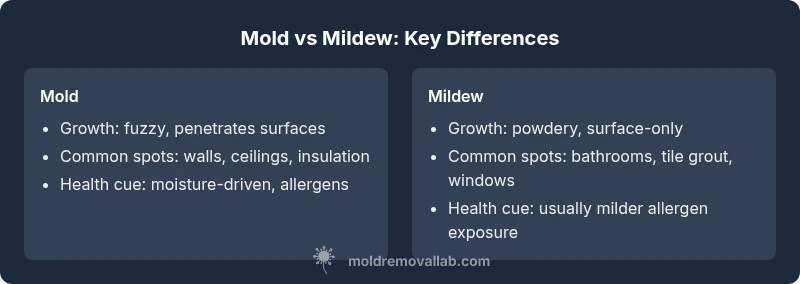
Mold and mildew are not the same. Mildew is a superficial, powdery growth on surfaces, while mold tends to be fuzzy and can penetrate materials. Distinguishing them early helps prioritize remediation and moisture control. According to Mold Removal Lab Analysis, 2026, the main health concerns align with moisture, allergens, and indoor air quality.
What is the Difference Between Mold and Mildew?
When homeowners ask, "is it mold or mildew?" they’re asking about two common fungi that share a space but differ in growth, threat level, and cleanup. Mildew typically appears as a flat, powdery coating on surfaces like tiles, wallpaper, or shower doors. Mold usually presents as a fuzzy, often multicolored growth that can penetrate porous materials such as drywall, wood, or fabric. For many people, the distinction matters because mildew is generally superficial and easier to clean, while mold can signal ongoing moisture problems and may require more thorough remediation. The Mold Removal Lab team emphasizes that a quick, careful assessment of moisture sources, surface type, and the extent of spread is the first step in answering is it mold or mildew. By understanding the difference, you can set realistic expectations for cleaning, safety precautions, and whether a DIY approach is sufficient or professional help is needed for deeper contamination.
Comparison
| Feature | mold | mildew |
|---|---|---|
| Growth pattern | Fuzzy, spread through porous materials, may invade depth | Powdery, superficial, primarily on surfaces |
| Common locations | Dark, damp areas like walls, basements, around leaks | Bathrooms, shower stalls, windowsills, and tile grout |
| Health concerns | Can indicate ongoing moisture problems and allergen exposure; potential for deeper remediation | Typically milder allergen exposure, easier to clean, surface-focused |
| Removal difficulty | Often requires moisture control and, in many cases, professional remediation for contamination | Usually manageable with household cleaners for nonporous surfaces |
| Cleaning approach | Containment, moisture source repair, possible structural intervention | Surface cleaning with approved cleaners; ventilation and drying are key |
Upsides
- Helps prioritize cleanup and moisture control
- Improves indoor air quality when addressed promptly
- Guides whether DIY or professional remediation is appropriate
- Aids in identifying moisture sources to prevent recurrence
- Supports safer, targeted cleanup actions
The Bad
- Misidentification can lead to inadequate remediation
- Underestimating mold visibility can delay necessary structural fixes
- DIY removal on large or porous growth can risk spreading spores
- Relying on surface cleaning alone may miss hidden growth
Mold poses a tougher remediation challenge than mildew; treat surface mildew promptly, but investigate and address moisture for mold.
If growth is shallow and moisture is controlled, DIY cleaning may suffice for mildew. If growth is fuzzy and expanding into porous materials, expect mold and possible moisture remediation. In all cases, address humidity to prevent recurrence.
FAQ
Is mildew dangerous to health in typical homes?
Mildew can trigger allergies and irritations in sensitive individuals, but it is generally less hazardous than mold. Prompt cleaning and reducing humidity reduces risk. If symptoms persist, consult a clinician or professional.
Mildew can irritate some people, but it’s usually less risky than mold. Clean it up and fix humidity to stay safe.
Can I remove mildew with bleach or vinegar?
Yes, both can be effective on nonporous surfaces. Use proper dilution, ensure good ventilation, avoid mixing cleaners, and test a small area first. For textured or porous materials, consult guidance before applying stronger cleaners.
Bleach or vinegar can work on nonporous surfaces if you use them carefully and ventilate well.
What visual cues help distinguish mold from mildew?
Mildew appears as a flat, powdery or chalky film, usually white or gray. Mold is typically fuzzy or velvety and can be black, green, or brown. Texture, color variety, and depth into the surface are key clues.
Look for fluffy or fuzzy growth versus powdery, flat film to tell mold from mildew.
When should I test for mold professionally?
If growth recurs after cleaning, signs of moisture persist, or large areas are affected, professional testing helps assess depth, hidden growth, and containment needs.
If it keeps coming back or covers a big area, get a professional test to know how bad it is.
Does mold always require professional remediation?
Not always. Small, contained, easy-to-clean mold on nonporous surfaces may be managed DIY if moisture is controlled. Large infestations or porous materials usually require professionals.
Not always, but big or deep mold growth usually needs pros.
Can high humidity create mold without leaks?
Yes. Persistent high humidity can support mold growth even without visible leaks. Controlling indoor humidity and improving ventilation reduces risk.
Even without leaks, humidity can feed mold if it’s not controlled.
The Essentials
- Identify mildew as a superficial, surface issue first
- Inspect for moisture sources when mold is suspected
- Prioritize drying and moisture control to prevent recurrence
- Know when to escalate to professional remediation
- Keep surfaces clean and dry to reduce growth opportunities