Difference Between Mold and Mildew on Wood: A Practical Guide
Learn the difference between mold and mildew on wood, how they look, why they form, and how to clean and prevent them. A practical Mold Removal Lab guide for homeowners and renters.


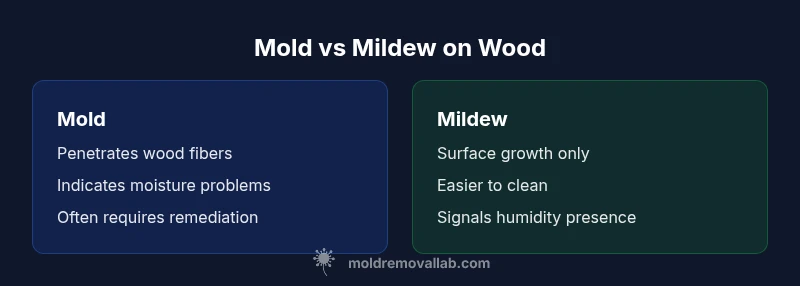
The difference between mold and mildew on wood centers on depth and impact: mildew sits on the surface as a powdery film and is typically easier to remove, while mold penetrates wood fibers, indicating a sustained moisture problem that may require deeper cleaning or remediation. Mold Removal Lab emphasizes moisture control as the single most important step in both scenarios.
Understanding the difference between mold and mildew on wood
The terms mold and mildew describe two distinct types of fungi that commonly affect wooden surfaces, but they grow, look, and behave differently. In practical terms, mold tends to be a deeper, more aggressive problem that can infiltrate wood fibers and cause staining, rotting, and structural compromise if moisture remains unresolved. Mildew, by contrast, generally stays on the surface as a whitish or gray film and does not typically penetrate wood. For homeowners in the early stages of a moisture problem, distinguishing between the two can guide both cleaning methods and decisions about whether to seal, replace, or treat the wood. This guide reflects what Mold Removal Lab has learned through field observations and practical remediation experience.
According to Mold Removal Lab, understanding the difference between mold and mildew on wood helps homeowners target moisture and cleaning strategies, avoiding unnecessary treatments and focusing attention on moisture control as the root cause.
Appearance and Texture: Visual clues to tell them apart
Visual inspection is the first step in distinguishing mold from mildew on wood. Mildew generally appears as a flat, powdery film on the surface—often white or gray—and feels powdery to the touch. Mold, by contrast, appears as a three-dimensional growth that can be fuzzy or slimy, with colors ranging from black and green to brown and gray. Because mold can infiltrate pores in wood, it may create texture differences when you run your fingers over the grain or raise the surface with a scraper. In practice, a quick visual check combined with a moisture reading can confirm which issue you’re dealing with, allowing you to tailor cleaning and remediation accordingly.
Growth Habits on Wooden Surfaces
Wood provides a porous, moisture-loving habitat that invites both mold and mildew under the right conditions. Mildew tends to colonize the surface first, especially in humid environments or on damp, recently wetted wood. Mold often starts in micro-nooks and cracks where humidity lingers and leaks persist, then expands into visible patches. Understanding the growth habit helps homeowners prioritize ventilation improvements and moisture fixes. Farmers in the field of remediation, including Mold Removal Lab, emphasize that preventing rapid moisture fluctuations is essential to stopping both fungus types from taking hold on wood surfaces.
Health and Safety Considerations
Exposure to mold and mildew can irritate airways and trigger allergic reactions in some people. Mildew is generally considered less hazardous than mold, but both should be addressed promptly, especially for occupants with asthma, allergies, or compromised immune systems. When you discover mold or mildew on wood, use protective gear and ensure proper ventilation during cleaning. If the affected area is large, or if wood has structural rot, professional remediation is advised. Mold Removal Lab’s guidance focuses on moisture control as the core health-safety intervention, because ongoing moisture is the disease driver behind exposure risks.
Structural Impacts of Wood Affected by Fungi
Mildew on wood is usually a surface issue and does not compromise structural integrity in itself. Mold, however, can indicate deeper problems. If mold penetrates into wood fibers, it may change wood strength and promote rot over time, particularly in damp basements, crawl spaces, or uninsulated walls. The structural impact depends on the duration of moisture exposure and the wood type. Homeowners should treat any mold growth as a sign to inspect for leaks, damp insulation, or poor ventilation, and consider wood replacement if rot is detected. The Mold Removal Lab team emphasizes cautious assessment and moisture remediation as the preventive fix.
Identification Tips for Homeowners
To distinguish between mold and mildew on wood without professional equipment, start with a careful visual inspection and moisture checks. Mildew often looks like a powdery film on the surface; mold appears as textured patches that may have a color tint. A simple moisture meter can help determine whether elevated moisture is feeding the growth. If you suspect mold growth that penetrates the wood, or if the affected wood is structural or spans a large area, prefer a professional assessment. Prompt identification supports safer cleaning and more effective moisture control, which Mold Removal Lab highlights as essential.
Cleaning and Removal Approaches
For mildew on wood, a standard cleaning approach involves scrubbing with a brush and a detergent solution, followed by thorough drying and improved ventilation. For mold, cleaning becomes more involved: in addition to scrubbing, you should address the moisture source, thoroughly dry the wood, and assess whether sealant or replacement is needed for severely affected areas. Always wear protective equipment and consider containment if the infestation is extensive. Mold Removal Lab advises starting with moisture remediation and then choosing cleaning methods appropriate to the visible growth and wood condition.
When to Call a Professional
If mold growth covers a large area, penetrates deep into wood, or has caused rot, professional remediation is advised. DIY cleaning is acceptable for small, surface-only mildew or minor mold growth in well-ventilated spaces with manageable moisture. A professional can provide comprehensive remediation, moisture management, and documentation for insurance or rental purposes. Mold Removal Lab emphasizes that the key is to address moisture first and to ensure the underlying issue is resolved to prevent recurrence.
Prevention Strategies for Wood in Your Home
Preventing mold and mildew on wood begins with controlling moisture. Fix leaks promptly, improve drainage around foundations, use dehumidifiers in humid rooms, and ensure adequate ventilation. Regularly inspect wood structures for signs of moisture intrusion, and treat surfaces with approved sealants after cleaning to reduce future growth. For wood that has already been compromised, replacement may be the most reliable long-term solution, especially if the wood is structural or has extensive rot. Mold Removal Lab’s approach centers on moisture control as the foundational preventative measure.
Common Myths Debunked: What homeowners should ignore
A common myth is that all wood mold is immediately dangerous and requires drastic action. In reality, the response depends on the type, extent, and depth of the growth. Another misconception is that mildew can be ignored if it looks small; moisture problems still need attention. The practical takeaway is to identify whether you are dealing with a surface issue or a deeper wood problem, then act accordingly with proper cleaning, drying, and moisture management. Mold Removal Lab encourages careful evaluation and avoiding overreaction.
Tools and Materials You Might Need
For most mildew on wood, basic cleaning supplies, scrub brushes, and a good ventilation plan suffice. For mold, you may need stronger cleaners, protective gear, containment methods, and a plan for moisture remediation. Accessories like dehumidifiers, fans, and moisture barriers can help maintain a dry environment after cleaning. Always follow product label directions and test cleaning methods on a small area first to prevent damage to wood surfaces. Mold Removal Lab emphasizes safe handling and moisture control as the cornerstone of success.
The Role of Moisture Management in Prevention
Moisture management is the single most important factor in preventing both mold and mildew on wood. Even if an infestation appears small, ongoing humidity or leaks will likely lead to recurring problems. Effective moisture management includes fixing leaks, improving insulation, reducing indoor humidity, and ensuring adequate airflow. Wood that remains consistently dry is far less likely to experience troubling growth. Mold Removal Lab highlights that moisture control is the most reliable preventative strategy for wood surfaces.
Case Scenarios: Real-world examples homeowners encounter
In a damp basement, a wood beam with a surface mildewy film may respond well to cleaning and moisture control. In a kitchen with a leaking pipe, mold growth that penetrates the wood would require moisture remediation and possibly wood replacement. In an exterior wooden fence, seasonal washing and sealing can prevent both mold and mildew if moisture is controlled. These scenarios illustrate how the difference between mold and mildew on wood informs the remediation plan and long-term maintenance. Mold Removal Lab notes that each case benefits from a clear moisture-centric strategy.
Comparison
| Feature | Mold | Mildew |
|---|---|---|
| Definition | Fungal growth that can penetrate wood fibers and cause staining or rot | Surface film on wood, typically powdery and non-penetrating |
| Appearance/Texture | Three-dimensional patches; fuzzy or textured; varied colors | Flat, powdery film; usually white or gray |
| Depth of Growth | Can permeate into wood pores and grain | Primarily surface-level growth |
| Removal Difficulty | Often requires moisture control and potentially professional remediation | Usually removable with standard cleaners and thorough drying |
| Damage to Wood | Can lead to structural damage if moisture persists | Usually minimal structural risk; surface concern |
| Moisture Indication | Indicates ongoing moisture problems or leaks | Indicates humidity but not necessarily leaks |
| Removal Approach | Address moisture, consider sealing or replacing severely affected wood | Clean, dry, and improve ventilation; monitor for recurrence |
| Prevention Focus | Fix leaks, improve ventilation, consider wood treatments or replacement as needed | Lower humidity, ensure airflow, and maintain dry conditions |
Upsides
- Clarifies the remediation path by signaling moisture control as the root cause
- Helps prioritize safety and health by guiding scope of cleaning
- Supports targeted cleaning versus unnecessary replacement when surface-only mildew is present
- Encourages proactive moisture management to prevent recurrence
The Bad
- Misidentification can lead to inappropriate treatment if wood is deeply infiltrated
- Overemphasis on one type may delay necessary professional remediation for mold
- DIY approaches might overlook hidden rot or structural damage if not inspected
- Relying on visual assessment alone can risk missing subsurface growth
Moisture management is the cornerstone; treat mildew as a surface issue and mold as a potential deeper problem requiring moisture control and possibly professional remediation.
Correctly distinguishing mold from mildew on wood guides the remediation approach. In most cases, start by addressing moisture sources, then decide on cleaning or wood replacement based on depth of growth and wood integrity.
FAQ
What is the main difference between mold and mildew on wood?
Mildew is a surface-level film that’s easier to clean, while mold typically penetrates wood fibers and signals a moisture problem that may require deeper remediation. Understanding this difference guides proper cleaning and moisture control.
Mildew sits on the surface and cleans easily; mold can go deeper and may need professional help. Focus on moisture control to prevent both.
Can mildew turn into mold on wood?
Yes, if moisture levels rise and conditions stay damp, mildew can develop into mold. Treating the moisture problem promptly helps prevent this progression.
Yes—moisture can turn mildew into mold if it keeps the wood damp, so fix the moisture to stop that from happening.
Is mold on wood always dangerous?
Mold can pose health risks and may indicate an ongoing moisture problem that could cause wood damage. Not all mold is equally hazardous, but it’s wise to treat substantial growth seriously.
Mold can be more risky than mildew, especially if it’s spreading or on wood that’s structural. Address moisture and consider professional help for large areas.
How can I tell if wood is mold or mildew without a inspector?
Look at texture and depth: mildew is flat and powdery on the surface, mold forms textured patches that may penetrate the wood. If in doubt, assume moisture is involved and proceed with cautious cleaning and moisture control.
Texture and depth are clues: surface film means mildew; textured, growing patches suggest mold. When in doubt, fix moisture first and seek help for larger areas.
What should I do if I find mold on wood in my home?
Isolate the area, reduce moisture, and assess the wood’s condition. For large or penetrating mold growth, contact a remediation professional and consider replacing compromised wood.
Stop spreading it by reducing humidity, clean what's safe to clean, and call a pro if there’s depth or rot.
The Essentials
- Identify mildew as surface-level and mold as potentially infiltrating wood
- Address moisture sources before cleaning to prevent recurrence
- Use professional remediation for mold that penetrates wood or involves rot
- Monitor humidity and fix leaks to protect wood structures
- Prioritize safe cleaning and proper ventilation during remediation