Difference Between Mold and Mildew: Key Differences, Health Risks, and Remediation
Learn to tell mold from mildew, why the distinction matters for health and home, and practical steps to identify, test, and remediate growth. Mold Removal Lab analyzes common patterns to help homeowners and renters act confidently.


Mold and mildew are both fungi, but they differ in appearance, growth depth, and health implications. Mildew typically forms superficial, powdery patches on nonporous surfaces and is easier to remove, while mold often appears fuzzy or colored, can penetrate porous materials, and signals a sustained moisture problem. Recognizing these differences helps you decide when to clean, test, or call a professional.
What are mold and mildew? A practical distinction for homeowners
Mold and mildew are both fungi, but they differ in growth habits, appearance, and health implications. Mildew typically forms superficial, powdery patches on nonporous surfaces and is usually easier to wipe away with household cleaners. Mold, by contrast, often appears fuzzy or velvety, can change color (green, black, gray, yellow), and may grow into porous materials like drywall, wood, or fabric. The growth environment also matters: mildew tends to appear when moisture levels are elevated but not extreme, while mold signals sustained moisture problems that require more thorough remediation. According to Mold Removal Lab, recognizing these differences early helps target the right steps, protect indoor air quality, and prevent hidden damage.
Visual cues: how to tell them apart at a glance
Visual inspection is the first line of defense. Mildew appears as flat, powdery patches on surfaces such as bathroom tiles, windowsills, or shower enclosures, typically white or gray. Mold tends to be fuzzy or colony-like, with colors ranging from green and black to brown or reddish hues, and it often grows on walls, wood, or fabrics. Smell can provide a clue; mold growth may produce a musty, earthy odor that persists as the infestation expands. Note that color alone is not a reliable indicator—growth can change color as it dries or ages. Practical observation, combined with moisture checks, helps guide cleaning and remediation decisions.
Growth conditions and moisture signals in your home
Mildew thrives on consistent moisture but lacks the depth of growth seen with mold. It commonly appears in damp bathrooms, laundry areas, or around leaky pipes where humidity remains elevated but surfaces remain relatively intact. Mold, however, signals more serious moisture problems and can colonize wood, drywall, insulation, and fabrics, often hidden behind walls or under wallpaper. Environmental factors such as warmth, poor airflow, and high humidity contribute to both, but the presence of mold generally indicates sustained moisture and potential structural damage if left unaddressed. Because molds can penetrate porous materials, their removal often requires replacing affected materials to prevent re-growth. Moisture control—finding and fixing the water source plus improving ventilation—is the underlying defense for both issues, and Mold Removal Lab emphasizes this as the foundation of effective remediation.
Health implications and safety considerations
Exposure to mold and mildew can trigger allergic reactions, asthma symptoms, coughing, and skin or eye irritation in sensitive individuals. The risks vary by species and exposure level, with mold growth in particular associated with stronger health concerns when large areas are involved or when individuals have compromised immune systems. For homeowners, practical safety steps include wearing gloves, a mask with a filter, and eye protection when cleaning visible growth, keeping children and pets away, and avoiding disturbing the growth to prevent spore spread. Mold Removal Lab’s guidance also notes that certain mold types may produce irritants or toxins in enclosed spaces, making prompt, careful remediation essential.
Testing and diagnosis: when DIY tests help and when to call in the pros
Most minor, surface-level growth can be assessed by visual inspection combined with moisture measurements, such as a hygrometer to monitor humidity and a leak check. DIY mold test kits exist, but their reliability is variable and often do not distinguish mold from mildew. If you suspect hidden mold behind walls, inside HVAC ducts, or after water damage, professional testing and remediation are recommended. Mold Removal Lab notes that a moisture-based approach—finding and fixing the water source plus cleaning visible growth—is usually more reliable than DIY swab tests.
Cleaning strategies for mildew: practical, safe steps
Surface mildew on nonporous surfaces (tiles, glass, enamel) can often be cleaned with a disinfectant solution or a mixture of water and vinegar. For surfaces prone to mildew, keep them dry and well-ventilated, wipe down regularly, and address the moisture source. Do not mix cleaners with bleach on unsealed porous materials, as fumes can be hazardous. Always wear gloves and a mask during cleaning, and avoid sanding or scraping mold growth from porous materials, which can release spores. If mildew is extensive or recurs after cleaning, escalate to professional assessment.
Cleaning strategies for mold: when to escalate
Because mold growth on porous materials like drywall, wood, or insulation may penetrate deeper, cleaning is not always sufficient. Start by isolating the area to prevent cross-contamination, turn off HVAC in the affected zone, and use a HEPA-filter vacuum for cleanup. Porous materials showing extensive mold should be removed and discarded and replaced after ensuring the moisture source is addressed. Nonporous surfaces can be cleaned with detergent and water or commercial mold cleaners, followed by drying to below the moisture threshold. For larger infestations or mold in ductwork or behind walls, professional remediation is advised. The Mold Removal Lab approach emphasizes moisture control and verifiable moisture reduction as key outcomes.
When to call a professional remediation service
If you encounter mold growth that covers more than a small area, or if growth recurs after cleaning, consult a licensed remediation specialist. In cases involving suspected toxic mold, complex moisture issues, or growth in HVAC systems, professional services are essential to ensure safe removal and to prevent re-growth. A pro will assess structural damage, contain the area, and implement strategies such as controlled removal and air filtration. The goal is not only to remove visible growth but to correct the moisture source and improve indoor air quality.
Prevention: keep moisture in check to reduce mold and mildew risk
Prevention focuses on moisture control: repair leaks promptly, improve ventilation in kitchens, bathrooms, and laundry areas, use exhaust fans, and monitor humidity with a hygrometer. Regular cleaning and prompt attention to spills help keep both mold and mildew at bay. Consider protective measures such as mold-resistant products in high-humidity areas and maintaining a clean, dry environment behind wallpaper or stored items. These steps create a less hospitable environment for fungi and contribute to healthier indoor air.
Quick decision guide: mold vs mildew at a glance
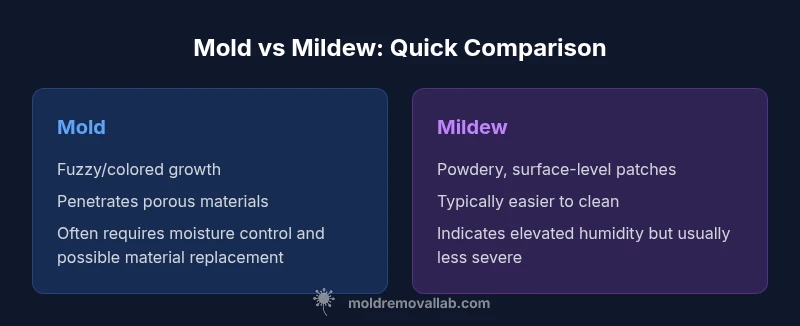
Mildew and mold share a moisture-dependent origin, but their practical implications differ. Mildew is usually surface-level, powdery, and white to gray, whereas mold is often deeper, fuzzy, and multi-colored, with a higher likelihood of causing structural damage if unchecked. A mildew problem is commonly resolved with surface cleaning and moisture control, while mold may require material removal and professional remediation to address underlying moisture sources.
Final checklist and maintenance plan
Create a simple, action-oriented maintenance plan: fix leaks promptly, run exhaust fans during moisture-generating activities, monitor humidity levels, inspect known hotspots monthly, and schedule seasonal cleanings. Keep a record of any growth you observe and actions taken. If consistent signs appear, consult Mold Removal Lab’s remediation guidance to ensure your plan remains effective and aligned with health and safety best practices.
Comparison
| Feature | Mold | Mildew |
|---|---|---|
| Appearance | Fuzzy or velvety texture; colors include green, black, brown | Powdery patches on surfaces; typically white or gray |
| Texture | Mold often appears fuzzy or cottony | Mildew appears powdery and flat |
| Growth Location | Can colonize porous and nonporous materials (walls, wood, fabric) | Usually on surfaces like tile, paint, wallpaper, and other nonporous areas |
| Growth Conditions | Requires sustained moisture; can penetrate porous substrates | Thrives in damp surfaces with high humidity; surface-level growth |
| Color Range | Multi-colored, often green, black, or brown | White to gray, occasionally yellowed with age |
| Health Risk | Can cause serious allergic and respiratory issues; broader health concerns with large infestations | Typically milder, but can irritate sensitive individuals |
| Remediation Difficulty | Often requires removal of affected materials and moisture control | Usually easier to clean and dry out with proper ventilation |
| Common Locations | Walls, insulation, wood, behind wallpaper | Bathrooms, sinks, shower doors, windowsills |
| Odor | Musty, persistent odor often accompanies mold growth | Mildew can have a milder odor or none |
| Prevention Focus | Address moisture sources, proper sealing, material replacement when needed | Keep surfaces dry, improve ventilation, and regular cleaning |
Upsides
- Clarifies health risk and remediation priorities
- Highlights surface cleaning vs material removal needs
- Encourages moisture control as the core solution
- Helps homeowners decide when to test or call a pro
The Bad
- Mold often requires more extensive remediation than mildew
- Misidentification can delay proper treatment
- DIY testing can be unreliable and lead to false reassurance
- Porous materials damaged by mold may need replacement
Mold requires more attention than mildew; treat promptly and address moisture
Mildew is usually a surface issue and easier to manage with improved ventilation and cleaning. Mold signals deeper moisture problems and may necessitate material removal and professional remediation. Prioritize moisture control to prevent both.
FAQ
What is the difference between mold and mildew?
Mold and mildew are both fungi, but mold tends to be deeper, colored, and more invasive, while mildew is surface-level and easier to remove. The distinction guides whether you clean or call a professional. Always consider moisture control as the主 remediation priority.
Mold is usually more serious than mildew and often needs professional help; mildew is typically easier to handle with cleaning and moisture control.
Is mildew harmful to health?
Mildew can irritate sensitive individuals and may trigger allergies, but it generally poses less risk than mold. If symptoms persist, test or consult a professional, especially in damp environments.
Mildew can irritate people who are sensitive, but it’s usually less hazardous than mold.
Can I remove mold myself?
Small, non-porous mold growth can sometimes be cleaned with household cleaners, but mold on porous materials or larger infestations usually require professional remediation to prevent spread and structural damage.
You can clean small nonporous mold yourself, but big or porous mold should be handled by a pro.
When should I test for mold or mildew?
Testing is typically not necessary for minor, surface-level growth. If the growth recurs after cleaning, or you suspect hidden mold behind walls or in ducts, professional testing is advised.
If it keeps coming back or you suspect hidden mold, call in a professional for testing.
What surfaces are most prone to mold and mildew?
Mildew often appears on bathrooms and laundry areas. Mold can infest walls, wood, insulation, and fabrics where moisture is present for extended periods.
Mildew shows up on damp, flat surfaces like bathrooms; mold can appear on walls and wood where moisture lingers.
How can I prevent mold and mildew growth?
Control moisture sources, improve ventilation, fix leaks promptly, and keep surfaces dry. Regular cleaning and checks in high humidity areas reduce both mold and mildew risks.
Keep areas dry, fix leaks, and improve ventilation to prevent growth.
The Essentials
- Identify growth type by texture and depth of color
- Prioritize moisture source and ventilation to prevent recurrence
- Mildew is more surface-level; mold may require material replacement
- Employ PPE and cautious cleaning; seek pro help for large infestations