Bleach vs Vinegar for Mold: A Practical Comparison
An objective guide comparing bleach and vinegar for mold remediation, covering effectiveness, safety, surface compatibility, and step-by-step guidance for homeowners and renters.


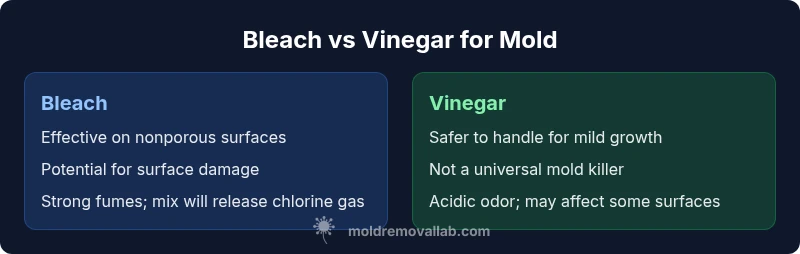
Bleach vs vinegar for mold isn't a simple yes or no. Bleach effectively kills surface mold on nonporous surfaces when used correctly, but it can fail on porous materials and may worsen moisture issues. Vinegar is milder and safer on many surfaces and can reduce surface spores, yet it isn't a registered mold killer and may require longer remediation steps.
Understanding the bleach vs vinegar for mold debate
Mold cleanup is rarely a one-size-fits-all task. When homeowners ask about bleach vs vinegar for mold, they’re really weighing trade-offs among surface type, depth of contamination, timing, and safety. The Mold Removal Lab team emphasizes that moisture control is the foundation of any remediation effort, and chemical cleaners are only one piece of a broader strategy. In practice, you evaluate surface porosity, choose a cleaner with reasonable safety margins, and plan for thorough drying and monitoring. Public-health guidance from EPA and CDC consistently stresses moisture management and proper ventilation as keys to long-term success. By framing the task this way, you’ll understand where bleach shines, where vinegar is a safer option, and where neither option substitutes for addressing leaks, humidity, and hidden growth behind walls.
How bleach works and where it fits in a mold plan
Bleach is a strong oxidizing agent that can destroy visible mold on nonporous surfaces such as tile, glass, and sealed countertops when applied with adequate dwell time and airflow. On these surfaces, it can produce a bright, clean appearance and can help reduce surface staining. However, bleach has notable limitations: it often fails to penetrate porous materials like drywall or wood where mold colonies can embed themselves below the surface. It can also degrade finishes, adhesives, and paint if used aggressively. A crucial safety note: never mix bleach with acids (including vinegar) or ammonia, as this can release toxic gases. If you choose to use bleach, follow product label directions, provide ventilation, wear PPE, and ensure surfaces are thoroughly dried afterward.
Vinegar as a milder option—and its boundaries
Vinegar contains acetic acid and can inhibit some surface mold growth, especially in mild cases and on certain nonporous surfaces. It is generally safer to handle and has a lower risk of producing harsh fumes than concentrated bleach. However, vinegar is not a registered disinfectant for mold in many jurisdictions, and it may not kill deeper or more established colonies, particularly in porous materials. It can also leave a noticeable odor and, over time, can interact with certain surfaces (for example, marble or stone) in ways that dull finish or etch the surface. For households dealing with light growth or routine maintenance, vinegar offers a safer, lower-risk option, but expect it to be part of a broader approach rather than a complete cure.
Porous vs nonporous surfaces: why it matters for bleach and vinegar
Nonporous surfaces tend to respond more predictably to chemical cleaners, with bleach providing rapid surface mold removal when applied correctly and dried promptly. Porous materials, on the other hand, are less responsive to chemical killers because mold can root deeper into fibers and crevices. In these cases, mechanical removal, moisture control, and sometimes replacement of damaged materials are necessary. Understanding surface type helps you decide where to use bleach, where vinegar might suffice for surface treatment, and where to pursue alternative strategies like containment and remediation by professionals.
Safety first: ventilation, PPE, and handling tips
Cleaning mold with any chemical carries risk. Ensure good ventilation, wear gloves, eye protection, and a mask appropriate for inhalation of fumes. Never mix cleaners, especially bleach and vinegar, due to chlorine gas production. Keep pets and children away during cleaning, and avoid staining or dispersing mold spores into other parts of the home. After cleaning, dry the area thoroughly and monitor for dampness that could indicate ongoing moisture problems. Your safety practices are as important as the chemical choice in preventing recurrence.
Step-by-step cleaning guidelines for typical spots
Before you begin, identify the extent of the growth and ensure there is a source of moisture control. For nonporous surfaces, you can apply a cleaner (bleach or vinegar) to a small area, allow it to dwell, then scrub with a non-abrasive brush and rinse with clean water. Dry completely and recheck the area after 24–48 hours. For porous materials, focus on removing the visible growth with mechanical means, address moisture sources, and consider replacing damaged material rather than relying on chemical cleaners alone. Keep a log of areas cleaned and monitor humidity levels to reduce the chance of regrowth.
When to avoid chemical cleaners and pursue professional help
If mold covers large areas, is spreading behind walls, or recurs after repeated cleaning, professional remediation is advised. Professional teams can identify moisture sources, perform controlled containment, and use proven remediation methods beyond household cleaners. For cosmetic stains on nonporous surfaces, a chlorine-based cleaner might provide a quick fix, but for structural or hidden mold, moisture-control strategies and expert assessment are essential. Mold growth is a sign of a moisture problem, and addressing that problem is central to long-term remediation.
Alternatives and safety-conscious enhancements
In addition to or instead of chemical cleaners, consider moisture-control measures such as dehumidification, improved ventilation, and prompt repair of leaks. Physical removal of mold-contaminated materials may be necessary in some cases. Natural drying methods, HEPA-filtered vacuums, and sealed containment can help reduce airborne spores during remediation. While bleach and vinegar each have contexts where they are used, many homes benefit from a layered approach that combines cleaning with moisture management, air filtration, and ongoing monitoring to prevent recurrence.
Real-world scenarios: bathrooms, basements, and kitchens
Bathroom grout and tile joints, basement concrete walls, and kitchen backsplashes present common, manageable challenges that illustrate the bleach vs vinegar decision. In bathrooms, nonporous surfaces often respond to careful cleaning with either product, provided ventilation is strong and surfaces are dried promptly. Basements with moisture intrusion complicate remediation, and porous walls may require material replacement rather than cleaning. Kitchens with sealed countertops and metal fixtures can tolerate bleach more readily, but always test a small area first and avoid harsh solvents on sensitive finishes. The goal is to reduce growth while preventing regrowth by addressing humidity.
How moisture control drives success: evidence-informed conclusions
Across many cases, persistent mold is driven by moisture. While bleach and vinegar can remove or reduce visible growth, the underlying humidity must be controlled to prevent recurrence. The Mold Removal Lab team emphasizes moisture management as a foundational step, supported by EPA and CDC guidance that highlights dampness as a major risk factor for mold in homes. This consensus underlines that chemical cleaners are not stand-alone solutions; they are temporary aids within a broader remediation plan that prioritizes drying, leak repair, and air quality improvements.
Authoritative guidance you can rely on
To inform high-level decisions, consider established guidance from reputable agencies. The EPA's mold guide stresses moisture control and surface-specific cleaning practices. The CDC outlines health considerations related to damp environments and mold exposure. University extension resources provide practical, surface-specific cleaning tips and caution against using harsh chemicals as a sole strategy. See the sources linked in the article for more details and context.
How Mold Removal Lab guides readers: our practical approach
According to Mold Removal Lab Analysis, 2026, practical mold guidance combines surface assessment, material considerations, and moisture-control strategies with careful use of cleaners to minimize exposure. The Mold Removal Lab team recommends prioritizing moisture management, testing on inconspicuous areas, and integrating professional assessment for larger or recurring problems. This approach aligns with public-health best practices while offering homeowners clear, actionable steps.
Comparison
| Feature | Bleach | Vinegar |
|---|---|---|
| Effectiveness against mold (surface) | High on nonporous surfaces with correct dwell time | Moderate on some surface mold; not a universal killer |
| Porous materials performance | Poor penetration; limited impact on embedded mold | Limited; not reliable for deep root mold |
| Material compatibility | Can damage finishes/adhesives; may discolor some surfaces | Generally gentler but acidic can dull stone or metal |
| Safety risks | Fumes; avoid mixing with ammonia or acids; strong odor | Lower risk but still irritant; never mix with bleach |
| Residue and odor | Chlorine odor; potential brightening effect on some surfaces | Acetic odor; mild residue possible |
| Ease of use | Rapid action on suitable surfaces; requires ventilation | Safer handling; easier for occasional use |
| Best for | Nonporous surfaces and small, bounded growth | Mild growth on nonporous surfaces; not a universal cure |
Upsides
- Bleach provides quick surface cleaning on nonporous surfaces
- Vinegar offers a safer, milder cleaning option
- Both are widely available and inexpensive
- In some cases, both can reduce surface odor and visible growth
The Bad
- Bleach is ineffective for deeply rooted mold in porous materials
- Bleach can cause surface damage and should not be mixed with acids or ammonia
- Vinegar is not a registered mold killer and may not eradicate hidden growth
- Relying solely on cleaners without moisture control invites regrowth
Moisture control is foundational; use bleach on nonporous, small areas and trust vinegar for milder cases, while seeking professional remediation for persistent mold.
Chemical cleaners are tools, not cures. Prioritize drying, leak repair, and monitoring. Use bleach or vinegar selectively based on surface type and mold severity, and escalate to professionals for larger, hidden, or recurring growth.
FAQ
Can bleach effectively remove mold on porous surfaces?
Bleach is generally not effective at removing mold embedded in porous materials like wood or drywall. It can address surface mold on nonporous surfaces but won’t reach mold roots inside porous substrates. For porous materials, remediation often requires mechanical removal and moisture control.
Bleach works best on nonporous surfaces, not deep mold in porous materials. For those, consider mechanical cleaning and moisture control, then consult a pro if needed.
Is vinegar effective against mold?
Vinegar can help reduce mild surface mold and is a safer option for some surfaces. It is not a guaranteed mold killer for all species or depths and should not replace moisture control and proper remediation for significant growth.
Vinegar is safer and may help with light surface mold, but it isn’t a guaranteed cure and won’t fix moisture problems alone.
Should I mix bleach with vinegar or other cleaners?
Never mix bleach with vinegar or ammonia. Mixing acids with bleach releases toxic gases that can irritate the eyes, lungs, and skin. Use one cleaner at a time and ensure proper ventilation.
Don’t mix cleaners. Bleach and vinegar together create dangerous gases. Use one cleaner at a time with good airflow.
What safety steps should I take before cleaning mold?
Wear appropriate PPE, ventilate the area, and protect occupants. Identify moisture sources and plan to dry the area thoroughly after cleaning. If mold is extensive, hidden, or growing behind walls, consider professional assessment.
Put on gloves and a mask, ventilate well, and plan to dry the area completely after cleaning. For larger problems, call a pro.
When should I call a professional for mold?
Professional remediation is advised when mold covers a large area, recurs after cleaning, or is hidden behind walls, in insulation, or within structural components. A professional can assess moisture sources, contain the area, and safely remove contaminated materials.
If mold keeps coming back or is behind walls, call a mold remediation professional for a proper assessment and safe removal.
The Essentials
- Prioritize moisture control to prevent mold recurrence
- Use bleach on nonporous surfaces for small, clearly bounded areas
- Avoid mixing cleaners to prevent toxic gas formation
- Vinegar is milder but not a universal mold killer
- Call a professional for large, hidden, or persistent mold