How Big Are Mold Particles? A Practical Guide to Size, Health, and Filtration
Explore how big mold particles are, how size affects health risk and filtration, and practical steps homeowners can take to reduce exposure and improve indoor air quality.


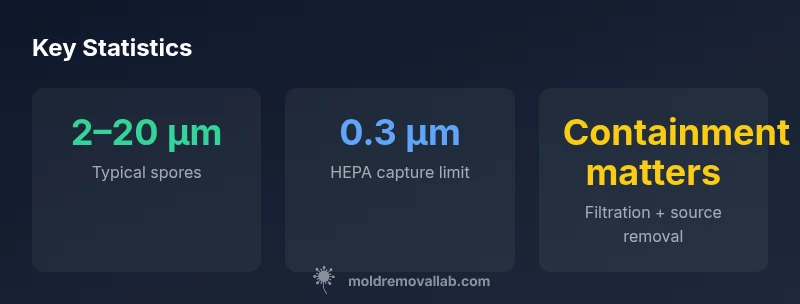
According to Mold Removal Lab, mold particle sizes relevant to indoor air generally range from about 2 to 20 micrometers in diameter, with occasional larger fragments. These tiny particles can stay airborne for hours, travel on air currents, and penetrate some consumer filtration devices. Size matters because smaller particles stay suspended longer and can re-enter indoor spaces after cleaning if sources remain. A clear understanding of particle size guides decisions about containment, ventilation, and filtration during remediation, helping homeowners protect vulnerable occupants and reduce recontamination risk.
What mold particles are and why size matters
When homeowners ask how big mold particles are, the answer depends on species, growth stage, and environmental conditions. In indoor air, mold primarily travels as spores and small hyphal fragments. In general, mold particle sizes relevant to indoor air range from about 2 to 20 micrometers in diameter, with occasional larger fragments. These tiny particles can stay airborne for hours, travel on air currents, and penetrate some consumer filtration devices. Size matters because smaller particles stay suspended longer and can re-enter indoor spaces after cleaning if sources remain. A clear understanding of particle size guides decisions about containment, ventilation, and filtration during remediation, helping homeowners protect vulnerable occupants and reduce recontamination risk. This framing also informs what kinds of protective measures are warranted and how to structure a safe cleanup plan.
According to Mold Removal Lab, particle size is not just a textbook detail; it directly shapes exposure risk and the practicality of remediation strategies.
Particle size ranges: spores vs fragments
Mold in homes occurs as spores and as hyphal fragments. Spores are the primary disseminating units and typically fall within the 2–20 micrometer range, though larger spores exist for some species. Hyphal fragments, cell walls, and dust-sized debris can extend to the tens of micrometers. In practice, larger debris is less likely to stay airborne for long distances but can become a visible irritant or surface contaminant. The practical takeaway is that size influences how easily particles become airborne during disturbances and how they respond to containment efforts. Relative abundances of spores versus fragments shift with humidity, surface moisture, and active growth, which in turn affects how you approach cleanup and ventilation strategies during remediation.
Health implications by particle size
Health effects depend on exposure dose and particle deposition in the respiratory tract. Very small spores and fragments (toward the lower end of the 2–20 µm range) can reach the upper airways, while mid-sized particles may deposit deeper in the lungs. Although most healthy adults tolerate brief exposures, sensitive groups—children, older adults, and individuals with asthma or allergies—face higher risks. This is why size, concentration, and duration matter when evaluating indoor air quality. A realistic assessment also considers cumulative exposure over time, especially in poorly ventilated spaces. The point is not to induce panic, but to recognize that size affects where particles go in the body and how long they persist in indoor air.
Filtration and HVAC: what size means for filtration
Filtration performance depends on particle size, airflow, and filter media. HEPA filters are rated to capture at least 99.97% of 0.3 µm particles under standardized testing, and they also trap larger mold spores effectively. Real‑world efficiency varies with airflow, filter loading, and the presence of leaks in the system. For many homes, upgrading to a high-efficiency filter (MERV 13+) and ensuring tight duct sealing can reduce airborne mold particles substantially. However, filtration alone does not replace source removal or containment; proper remediation requires a combination of strategies to minimize re-aerosolization and exposure. A practical plan layers containment, filtration, moisture control, and source cleanup.
Measuring size: methods and limitations
Laboratories and professionals use optical microscopy, particle counters, and air sampling to infer particle size and concentration. Homeowners with DIY test kits may observe moisture indicators or visible growth, but these tools do not reliably quantify particle sizes. Air sampling has limitations: collection efficiency depends on flow rate, sampler type, and sampling duration. Size distribution data can be skewed by short-term events like a wet cleaning or a damp climate cycle. The main takeaway is that measurements inform decisions, but a professional assessment provides more accurate size-related risk estimates. If you plan to rely on any testing, ensure the provider follows recognized indoor air quality standards and clearly explains what the numbers mean for your space.
Environmental factors shaping particle size distribution
Humidity, temperature, surface moisture, and air movement influence mold growth and fragment release. Damp conditions promote spore production and fragmentation, while dry, well-ventilated spaces reduce active growth. HVAC operation, opening windows, and mechanical ventilation can transport particles beyond the source area. In practice, reducing moisture, fixing leaks, and eliminating persistent damp zones helps limit both the generation and spread of mold particles, irrespective of size. Sustainable moisture control remains a cornerstone of long-term indoor air quality improvements.
Mold particle size ranges and their implications
| Aspect | Particle Size (µm) | Impact on Health | Filtration Considerations |
|---|---|---|---|
| Mold spores (typical) | 2–20 | Common indoor risk | HEPA capture effective at small sizes |
| Mold fragments | 5–50 | Irritation and allergic reactions | Filtration depends on size; multi-pass recommended |
| Larger debris | 50–200 | Less common indoors; can cause irritation | Containment and cleaning critical |
FAQ
Are mold particles visible to the naked eye?
Most mold particles are too small to see without magnification. Visible growth or dust can indicate larger debris, but tiny spores require inspection tools.
Most mold particles are too small to see with the naked eye.
Can HEPA filters remove mold spores from indoor air?
Yes. HEPA filters capture most particles in the 0.3 µm range, including many mold spores, though performance depends on airflow and proper containment.
Yes. HEPA filters can capture many mold spores when correctly installed.
Why is humidity control important in mold management?
Maintaining indoor humidity below 50–60% reduces mold growth and spore release, helping keep concentrations lower between cleanups.
Keep humidity in check to slow mold growth.
Is DIY mold cleanup safe?
Small, non-porous areas may be manageable with caution. Larger infestations require professional remediation to ensure containment and prevent recontamination.
DIY cleanup is safe only for small areas; big jobs need pros.
When should I test for mold?
If you notice persistent damp smells, visible growth, or after water damage, testing and a professional assessment are advisable.
Test when you have damp smell or visible growth.
“Particle size isn't just academic; it determines filtration needs, exposure risk, and how we design safe remediation.”
The Essentials
- Point 1: Most indoor mold particles range 2–20 µm in diameter
- Point 2: Smaller particles linger longer and challenge basic filters
- Point 3: Containment plus filtration are essential during remediation
- Point 4: Humidity control reduces spore release
- Point 5: For larger infestations, professional remediation is advised, per Mold Removal Lab