How Big Are Mold Spores? Size, Measurement, and Home Remediation
Learn how big mold spores typically are, what factors influence their size, and why spore dimensions matter for filtration, testing, and remediation in homes.


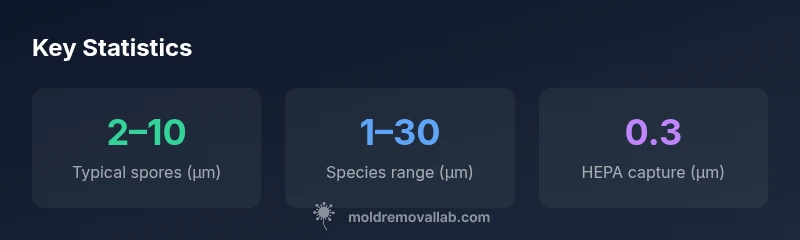
How big are mold spores? Most common indoor mold spores range from about 2 to 10 micrometers in diameter, depending on species. That size lets spores become airborne and pass through many household filters, yet makes them technically larger than many bacteria. Filtration, sampling, and remediation decisions hinge on understanding this micron-scale range in real-world settings.
How size varies by mold species
Understanding spore size starts with species, environment, and life stage. When we answer how big are mold spores, we must acknowledge a range rather than a single number. Most common indoor spores measure in the micron scale, typically around 2–10 micrometers in diameter, but some species produce spores smaller than 2 micrometers or larger than 10 micrometers. Variation arises from genetic factors and reproductive strategies (ascomycetes vs. basidiomycetes), growth conditions, and moisture available during sporulation. The size can influence settling velocity and how long spores stay suspended in air. In practice, this means that two neighboring rooms with different moisture profiles can harbor spores of slightly different sizes, though the majority will still congregate within the same general micron range. For homeowners, this emphasis on size helps explain why simple surface wipe-downs are insufficient and why you should consider air-based remediation approaches as part of a comprehensive mold program.
- Size is not a single fixed value; it is a spectrum that depends on species and environmental conditions.
- The micron-scale nature of most indoor spores explains why they can travel in air currents and infiltrate ventilation systems.
- Remediation strategies should address both moisture control and particulate removal, not just surface cleaning.
–
How spore size influences filtration and indoor air quality
The tiny dimension of mold spores allows them to become airborne and traverse typical home barriers. Filtration systems are chosen with size in mind: most household air filters target particles down to about 1–3 micrometers in practice, while true HEPA filtration captures 0.3 micrometer and larger particles with high efficiency. Therefore, spores in the 2–10 µm range are generally within the capture zone of reputable HEPA systems and many HVAC filters, though effectiveness depends on airflow, filter loading, and proper installation. Size also affects how spores interact with surfaces: larger spores settle faster, while smaller ones can remain suspended longer in still air. Homeowners should pair filtration with moisture control, prompt cleanup of damp areas, and regular maintenance to reduce spore loading in living spaces.
- HEPA filters are most effective when airflow is correctly balanced and filters are replaced as recommended.
- Moisture control reduces ongoing sporulation, cutting the source of new spores.
- Regular cleaning should include both filtration and ventilation improvements to limit airborne concentrations.
How scientists measure mold spore size
Measuring spore size requires microscopy and calibrated instrumentation. In most research and testing settings, light microscopy combined with calibrated eyepieces estimates diameter for a large set of spores, while electron microscopy provides high-resolution images for rare or unusual species. Aerodynamic particle sizing and laser diffraction can quantify the distribution of particle sizes in air samples. When preparing samples, technicians typically collect air or surface samples, mount spores on slides, and measure multiple fields to determine a representative size distribution. Because spores are non-spherical in many cases, reporting is often given as a range or as an equivalent spherical diameter. The key takeaway for practical remediation is that you should rely on accredited testing results rather than assuming a single size for all spores in your home.
- Size distribution data helps interpret air testing results accurately.
- Different instruments measure different aspects of the particle, so cross-checking methods is common practice.
- Accreditation matters when translating lab data into actionable remediation steps.
Practical tips for homeowners
To manage mold spores effectively, start with moisture control: fix leaks, reduce humidity, improve ventilation, and dry damp areas promptly. Use a high-quality HEPA air purifier in key rooms, and ensure HVAC filters are rated for fine particles and installed correctly. When testing, choose accredited laboratories and request size distributions if possible so you can interpret results in context. For remediation, follow a structured plan that addresses the moisture source, removes contaminated materials safely, and validates outcomes with post-remediation testing.
- Prioritize moisture control as the cornerstone of mold prevention.
- Use HEPA filtration in tandem with moisture management for best results.
- Ensure testing is performed by accredited labs to guide remediation decisions.
Common misconceptions about spore size
Many homeowners assume that all spores are the same size or that visible mold means large spores; neither is accurate. Size is a spectrum that depends on species and environmental conditions during sporulation. Believing that bigger spores are the primary threat can misguide remediation choices. In reality, even tiny spores can trigger allergies and asthma in sensitive individuals, and larger spores can carry viable fragments that seed new growth. Emphasize moisture control, testing, and professional guidance rather than relying on surface cleaning alone.
- Size variation is normal across mold species.
- Visible mold is not a sole indicator of spore size or risk.
- Comprehensive remediation combines moisture control, testing, and professional oversight.
Representative spore sizes for common indoor mold types
| Category | Typical size (µm) | Notes |
|---|---|---|
| Basidiospores | 2–5 | Common indoor molds; mid-range size |
| Ascospores | 1–15 | Widely variable by species |
| Zygospores | 4–20 | Larger spores; less common indoors |
FAQ
What sizes do mold spores come in?
Mold spores vary by species, but indoor spores commonly fall in a micron-scale range of roughly 1–15 micrometers. Size influences how easily spores travel in air and how they respond to filtration.
Spores vary by species, but most indoor spores are a few micrometers wide and can travel in air flows.
Can mold spores be seen with the naked eye?
Most mold spores are too small to see without magnification. Visible mold colonies indicate surface growth, not necessarily the full spore distribution in air.
Usually not visible without a magnifying tool.
Does spore size affect cleaning strategies?
Yes. Larger spores tend to settle faster, while smaller ones stay airborne longer. Cleaning should address moisture, air filtration, and source removal rather than only surfaces.
Size changes how spores behave, so use both moisture control and filtration.
How should I test for mold spores at home?
Professional air testing by accredited labs provides size distributions and concentration data that surface observations alone cannot. Follow-up testing confirms remediation success.
Get testing from an accredited lab to understand spore sizes and levels.
Are all mold spores dangerous?
All spores can affect sensitive individuals, with varying potency. Risk depends on exposure duration, concentration, and individual susceptibility.
All spores can impact health depending on exposure and sensitivity.
“Size alone doesn't determine danger; exposure, duration, and ventilation shape risk.”
The Essentials
- Know the typical spore size range to guide filtration.
- Use HEPA filters for particles down to 0.3 µm and larger.
- Moisture control is essential to reduce spore loading.
- Rely on accredited testing for accurate size distributions.
- Share remediation steps with a professional for thorough cleanup.