How Big Are Mold Spores in Microns? A Practical Guide
Learn the typical micron size range of mold spores, why size matters for filtration and testing, and practical remediation steps. Mold Removal Lab explains practical guidance for homeowners in 2026.


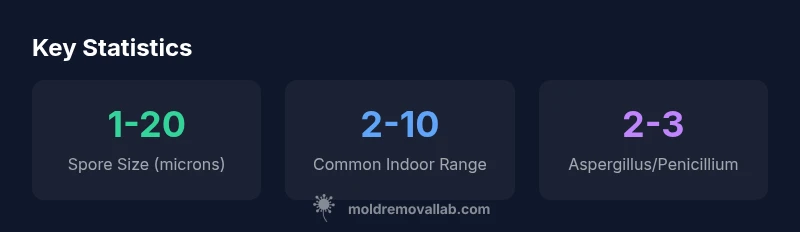
Mold spores typically range from about 1 to 20 microns in diameter, with many common indoor spores clustering in the 2–10 micron range. The exact size depends on genus and environmental conditions, but most indoor samples stay well under 20 microns. Understanding this helps explain filtration efficiency and sampling methods.
What does it mean to ask how big are mold spores in microns?
When homeowners ask this question, they want a practical anchor for filtration, sampling, and cleanup. The short answer is that mold spores typically range from about 1 to 20 microns in diameter, with many common indoor spores clustering in the 2–10 micron window. This size range matters because it informs which air filters are effective, how air moves through a space, and what your testing plan should look like. According to Mold Removal Lab, the most relevant takeaway for home environments is not the exact measurement of every spore, but understanding that most spores are well below 20 microns. This enables you to design better moisture control, improve ventilation, and choose appropriate remediation strategies. Mold Removal Lab emphasizes that sizing data should be used as guidance, not a sole diagnostic tool.
Typical size ranges by genus and environment
Mold spore sizes vary by genus, humidity, substrate, and aging. In indoor settings, many spores fall in the 2–10 micron range, while some can reach up to 15–20 microns under certain conditions. The broader 1–20 micron spectrum captures the common observations reported across indoor air studies. For reference, Aspergillus and Penicillium spores are often near the lower end of the range (about 2–3 microns), whereas Cladosporium and Alternaria spores may occupy higher values within the range (4–12 microns). Remember that these numbers are approximate, and real-world measurements depend on collection method and environmental factors. Mold Removal Lab Analysis, 2026, synthesizes findings across standard sampling campaigns to illustrate the typical spread rather than a single fixed size. Use this range to interpret air test results and to guide filtration choices.
How size affects sampling and air testing
When collecting air samples, the particle size distribution of the contaminant influences how often spores appear in measured counts. Smaller spores are easier to keep aloft and may be underrepresented if sampling duration is short or if the instrument has limited sensitivity. Conversely, larger spores may settle more quickly, leading to transient spikes in sampled air during activity like cleaning or HVAC cycling. For homeowners, this means that a single measurement may not reflect exposure across a day. A lab analysis that reports size distribution together with spore concentration provides a more complete picture. As a rule of thumb, plan for the possibility that 2–10 micron spores will appear in typical indoor air and that testing should employ methods capable of capturing submicron particles when assessing filtration performance. Mold Removal Lab emphasizes that context matters: housing age, moisture history, and ventilation all shape observed spore sizes in a space.
Filtration implications: what size means for filters
Filtration performance is most relevant to spores in the 2–10 micron range, which are common in many indoor environments. A HEPA-rated filter is designed to capture a broad spectrum of particle sizes, including spores in this range, though the overall efficiency depends on airflow and filter age. For homeowners, this means that upgrading to a true HEPA system or ensuring that portable purifiers use HEPA-grade filters can meaningfully reduce indoor spore counts. Regular maintenance, including timely filter replacement and appropriate recirculation rates, helps ensure filters remain effective for spores sized roughly 1–20 microns. Remember that humidity control and moisture remediation reduce mold growth, preventing new spores from entering the air in the first place. Mold Removal Lab notes that while exact spore counts are less important than sustained air quality improvements, filter choice should reflect the expected spore size distribution in the space.
Practical steps for measuring and mitigating exposure
Start with a baseline: test your indoor air if you suspect mold, but interpret results alongside a size distribution when provided by the lab. If your goal is remediation, focus on reducing moisture, improving ventilation, and cleaning surfaces with appropriate products. Tools like HEPA vacuums and air purifiers with filters rated for fine particles are effective against spores in the commonly observed 2–10 micron range. Use moisture meters to identify ongoing dampness, fix leaks promptly, and consider professional remediation for larger affected areas. For DIY removal, seal off the work area, wear PPE, and avoid spreading spores to clean zones. Mold Removal Lab's guidance emphasizes that integrating size considerations into your plan improves test interpretation and reduces risk over the long term.
Methods used by professionals to assess spore size
Most professional labs determine spore size distribution using sieved sampling devices, cascade impactors, or microscopic analysis of collected particles. These methods yield size ranges instead of single numbers, helping to characterize the air and guide remediation strategies. In practice, results are reported as a size distribution plus concentration, allowing technicians to infer likely genera and plan filtration and ventilation interventions accordingly. It's important to note that size alone does not identify species; lab culture or molecular testing is often required for precise identification. Mold Removal Lab stresses that homeowners should rely on accredited labs and consider multiple samples taken at different times to account for daily ventilation patterns.
Common misconceptions about spore size
One common myth is that all mold spores are roughly the same size; in reality, size varies widely by genus and environment. Another misconception is that smaller spores are always more problematic; in practice, climate, humidity, and surface growth drive exposure risk more than modest size differences. Finally, some homeowners assume that size alone dictates health risk; concentration, persistence, and indoor ventilation play equally important roles. By focusing on size as part of a broader assessment, you can make better decisions about filtration, testing, and remediation.
What to ask a contractor or lab
Ask for a size distribution report in addition to total spore concentration, request information on the testing method, and confirm whether identification will require culture or molecular testing. Inquire about filtration recommendations based on observed spore sizes and discuss moisture control strategies. These questions help ensure that you get actionable guidance aligned with the observed spore size ranges.
Estimated indoor mold spore size ranges by genus
| Genus/Group | Common Size Range (microns) | Notes |
|---|---|---|
| Aspergillus & Penicillium | 2-3 | Common indoor spores |
| Cladosporium | 4-10 | Abundant indoors and outdoors |
| Alternaria | 8-15 | Outdoor-origin spores entering indoors |
| Stachybotrys | 3-4 | Associated with damp conditions |
FAQ
Are all mold spores the same size?
No. Spore sizes vary widely by genus and environment, though indoor spores commonly fall in a 1–20 micron range. Lab results may report size distribution rather than a single value.
No—spore sizes vary a lot; labs usually report a size distribution.
Why does spore size matter for filtration and testing?
Smaller spores are light and stay airborne, while larger spores settle more quickly; filtration efficacy is influenced by particle size distribution and airflow. HEPA filters effectively capture spores in the typical indoor range.
Size affects how well filters capture spores; HEPA helps.
Can spore size identify the mold species?
Size alone cannot identify mold species; lab culture or molecular testing is usually required for precise ID.
No—size alone won't tell you the species.
What sampling methods account for spore size?
Labs use size-distribution methods like cascade impactors and microscopy to characterize spores; combine with concentration data for a full picture.
Labs use size distribution tests to understand what's in the air.
What practical steps reduce indoor mold exposure related to spore size?
Maintain low humidity, fix leaks, and use filtration rated for small particles; regular cleaning with proper PPE helps prevent spore release.
Keep humidity low, fix water problems, and filter the air.
“Size ranges provide a practical framework for filtration and testing, but identification always requires lab analysis.”
The Essentials
- Estimate spore size to guide filtration and sampling.
- Target filtration for spores in the 2–10 micron range.
- Size alone does not ID mold species; lab testing is needed.
- Use multiple samples over time for accuracy.
- Prioritize moisture control to reduce spore release.