Is Mold Armor Better Than Bleach? A Practical Mold Cleanup Comparison
A balanced, evidence-based comparison of bleach vs Mold Armor for mold cleanup, focusing on effectiveness, safety, and best-use scenarios for homeowners.


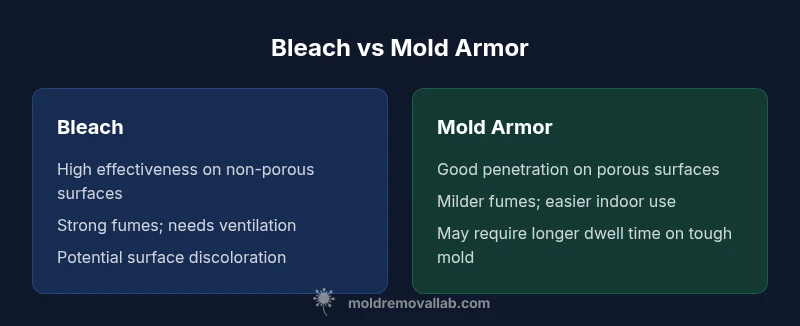
Bleach and Mold Armor both kill visible mold, but is mold armor better than bleach in typical home cleanup? In most cases, Mold Armor performs better on porous surfaces and is safer for indoor use due to milder fumes, while bleach remains strongest on non-porous materials and can cause color changes. Choice depends on surface type and safety needs.
What’s at Stake in the Mold Cleanup Debate
Choosing the right cleaner shapes safety, surface integrity, and long-term mold control. When homeowners ask is mold armor better than bleach, they are weighing safety and practicality against stubborn mold on common household materials. The Mold Removal Lab team emphasizes that there is no one-size-fits-all answer; the best choice depends on surface type, mold extent, ventilation, and whether you’re treating a small patch or a recurring issue. In this guide, we compare two widely used options—bleach and Mold Armor—in a way that helps you tailor your approach to your home’s specific needs. We’ll look at real-world performance, what to expect during treatment, and how to minimize health risks. Mold Removal Lab analysis, 2026, suggests that method selection should align with surface compatibility and safety priorities.
How Bleach Works and Its Limitations
Bleach is a common go-to for mold cleanup, especially on non-porous surfaces like ceramic tiles, glass, and some plastics. Its active chlorine can kill surface mold and whiten materials. However, bleach struggles to penetrate porous materials such as drywall, wood, and fabric where mold roots and hidden growth live. Fumes from bleach can irritate eyes, lungs, and skin, particularly in small or poorly ventilated spaces. Additionally, color-fast surfaces may experience fading or discoloration. In terms of residue, bleach can leave a film on surfaces that feels slippery or appears shiny long after cleaning, which may require rinsing. Practical takeaway: bleach excels in fast, surface-level cleaning on solid, non-porous materials but isn’t a universal solution for mold embedded in porous substrates.
What Mold Armor Is and How It Works
Mold Armor is a consumer mold-cleaning product line designed for home use. It is marketed for mold on a variety of surfaces, with emphasis on practical, everyday remediation. For many homeowners, Mold Armor provides a less caustic option with milder fumes and shorter setup times. The product is typically applied via spray and wiped away after a dwell time as directed on the label. Its performance tends to be strong on porous surfaces that harbor mold behind the surface layer, such as wood, drywall, or fabric cushions, where bleach struggles to penetrate. However, outcomes depend on concentration, surface type, and the extent of mold growth. The Mold Removal Lab Team notes that, while Mold Armor can be effective for routine maintenance and light to moderate contamination, severe or widespread mold scenarios may require additional steps or professional remediation.
Porous vs Non-porous Surfaces: Where Each Shines
Surface porosity dramatically influences cleaning outcomes. On non-porous materials (tile, glass, metal), bleach can quickly kill surface mold and lighten stains, provided users handle ventilation properly. But on porous surfaces (wood, drywall, fabric, wallpaper), mold can hide within tiny channels, where cleaning agents need to penetrate and sustain antimicrobial action. Mold Armor generally demonstrates better penetration on porous surfaces due to its formulation and dwell-time tolerance, while bleach tends to sit on the surface and may not reach embedded colonies. For homeowners with mixed surfaces, a targeted plan—limiting bleach to non-porous areas and reserving Mold Armor for porous zones—often yields the best overall results.
Safety, Fumes, and Ventilation Considerations
Ventilation is critical when using any mold-cleaning product. Bleach releases chlorine fumes that can irritate the eyes, nose, and throat, especially in enclosed bathrooms or basements. Always wear gloves, eye protection, and a mask rated for chemical fumes, and never mix cleaners. Mold Armor products generally emit milder fumes, but still require ventilation and protective gear. Some users report a residual odor after cleaning; if odor persists, re-ventilate and consider a follow-up wipe-down. For households with pets or children, selecting a product with fewer volatile compounds can reduce risk while maintaining mold control.
Practical Application: Steps and Best Practices
- Identify the mold extent and surface type. 2) Choose the product that matches your surface (Bleach for non-porous, Mold Armor for porous). 3) Pre-clean the area to remove loose debris. 4) Apply as directed, allowing sufficient dwell time. 5) Rinse or wipe, and dry thoroughly. 6) Reassess after 24–48 hours for any signs of regrowth. Remember to clean and dry adjoining spaces to minimize humidity-driven return. Remember: label directions are essential for both products.
Real-World Effectiveness: What to Expect
In real homes, results depend on how thoroughly the process is followed, the surface type, and the mold species involved. Bleach can remove surface stains and visible mold quickly on non-porous surfaces, but it often fails to reach hidden mold inside porous materials. Mold Armor shows promise on porous surfaces with careful dwell times and repeated applications, yet it may require more effort on large areas or materials with complex textures. Expect to spend time on prep, ventilation, and post-cleanup drying to reduce recurrence.
Cost, Accessibility, and Long-Term Value
Bleach is widely available and inexpensive per bottle, making it appealing for small, quick spot treatments or first-aid style cleanup. Mold Armor products typically cost more per bottle but may offer better long-term value on porous surfaces due to improved penetration and lower odor risk. When evaluating cost, consider not only the bottle price but also coverage area, dwell time, and the potential need for protective equipment and ventilation. For larger projects, the time and materials can influence overall value more than the sticker price.
Decision Framework: Choosing Between Bleach and Mold Armor in Your Home
A practical decision framework begins with surface type, mold extent, and safety priorities. For non-porous surfaces with limited growth, bleach may offer rapid disinfection and whitening benefits, assuming proper ventilation and PPE. For porous surfaces or areas with ongoing moisture, Mold Armor generally provides better penetration and usability with lower fumes. If you want a balanced approach, use bleach on non-porous patches and reserve Mold Armor for porous sections, then monitor for signs of regrowth and adjust as needed. The key is to test in an inconspicuous area and follow label directions closely.
Comparison
| Feature | Bleach | Mold Armor |
|---|---|---|
| Effectiveness by surface type | High on non-porous; limited on porous | Strong penetration on porous; variable on non-porous |
| Safety and fumes | Strong chlorine fumes; requires ventilation | Milder fumes; generally safer indoors |
| Residue/appearance | Possible whitening on colors; can leave film | Less whitening; may leave a light residue depending on product |
| Surface compatibility | Can discolor fabrics/colors; may corrode some metals | Generally gentler on finishes; check label |
| Cost range | Low upfront cost per bottle | Moderate to higher upfront per bottle |
| Ease of use | Simple spray/wipe; quick for small patches | Similar process; dwell time may vary by product |
| Odor | Strong odor during use | Milder, more tolerable |
| Best for | Non-porous mold cleanup; quick disinfecting | Porous surfaces and routine maintenance |
Upsides
- Bleach is inexpensive and widely available
- Bleach works quickly on non-porous surfaces
- Mold Armor offers safer indoor use with milder fumes
- Mold Armor is effective on porous surfaces with proper dwell time
The Bad
- Bleach can damage colors and materials
- Bleach fumes require ventilation and PPE
- Mold Armor may be more expensive per cleanup
- Effectiveness varies by surface and mold type
Mold Armor generally wins for porous surfaces; bleach remains best for non-porous, but use the right tool for the job
Choose Mold Armor for porous materials and indoor use with safer fumes; reserve bleach for non-porous areas and quick disinfecting when color retention and surface integrity matter.
FAQ
Is bleach effective against mold on all surfaces?
Bleach is effective on non-porous surfaces like ceramic, glass, and some plastics for surface mold. It is less reliable on porous materials where mold roots live. Always follow label instructions and ensure adequate ventilation.
Bleach works well on non-porous surfaces but isn’t reliable for porous materials.
Is Mold Armor safe for indoor use?
Mold Armor products are designed for indoor home use with milder fumes than bleach. Always ventilate well, wear PPE, and follow the label. For households with children or pets, verify the product’s safety claims on the label.
Yes, but follow the label and ventilate well.
Can I mix bleach with Mold Armor?
Never mix chemical cleaners. Combining cleaners can release toxic gases and irritants. If you’re switching products, rinse the area and allow it to dry before applying a different cleaner.
Do not mix cleaners under any circumstances.
When should I hire a professional?
DIY is often suitable for small, contained mold with accessible surfaces. Large, hidden, or recurring mold problems, or mold in HVAC systems, may require professional remediation to prevent health risks.
Consider a pro for large or persistent mold problems.
What safety steps should I take during cleanup?
Wear PPE (gloves, goggles, and a mask), ensure ventilation, avoid mixing cleaners, and keep children and pets away during treatment. After cleanup, thoroughly dry the area to reduce moisture for mold prevention.
Wear PPE and ventilate; don’t mix cleaners.
How can I prevent mold from returning after cleaning?
Address moisture sources, fix leaks, improve ventilation, and monitor humidity levels. Regular cleaning and prompt remediation of new moisture can reduce recurrence.
Fix moisture to keep mold from returning.
The Essentials
- Match cleaner to surface type for best results
- Ventilate well and wear PPE with any mold cleaner
- Mold Armor is advantageous on porous materials; bleach for non-porous
- Test in an inconspicuous area before full use
- Evaluate cost per cleanup, not just bottle price