Pink Mold vs Soap Scum: A Practical Comparison for Home Safety
Learn to distinguish pink mold from soap scum, understand health risks, and apply practical removal and prevention strategies for bathrooms and kitchens.


Pink mold and soap scum are not the same; pink mold is a moisture-loving mold that can indicate ongoing damp conditions, while soap scum is mineral and soap residue buildup. In practice, pink mold often requires deeper cleaning and disinfection, while soap scum is primarily a surface film. Understanding the difference helps target cleaning, health risk assessment, and prevention in bathrooms.
Pink Mold vs Soap Scum: Quick Definitions
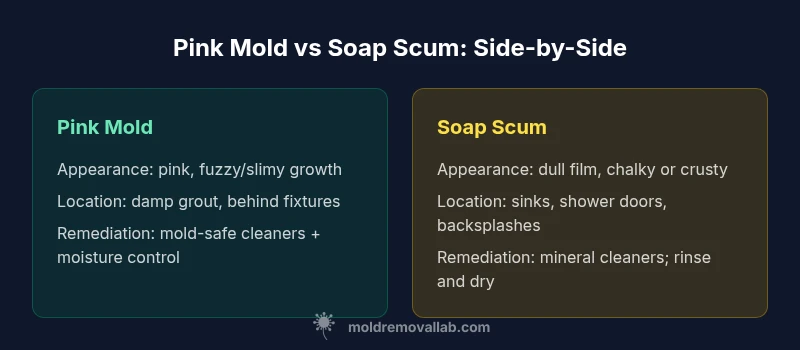
In this guide, we distinguish pink mold from soap scum to help homeowners identify what they’re dealing with and choose the right remediation steps. Pink mold is a biological growth that thrives in damp, nutrient-rich environments. It can appear as pink, orange, or coppery hues on grout, caulk, and damp surfaces. Soap scum, by contrast, is a mineral and soap residue film that forms when soap, shampoo, and minerals from water accumulate over time. The key to effective cleaning is recognizing the fundamental difference: a biological growth versus a mineral-based buildup. According to Mold Removal Lab, identifying pink mold early is crucial because it signals persistent moisture, while soap scum reflects routine cleaning cycles and mineral deposition. This distinction matters not only for cleaning strategies but also for addressing moisture sources and health considerations in the home.
Visual Cues: Color, Texture, and Growth Patterns
Seeing pink mold often triggers concern because color can indicate different mold species, including those that occasionally produce mycotoxins. The texture is typically fuzzy or slimy, and it tends to spread along grout lines, behind fixtures, or in shaded corners where humidity lingers. Soap scum, by comparison, forms a crusty or chalky film that adheres to sinks, tiles, and glass surfaces. It dulls surfaces and is relatively easy to scrub away with an abrasive cleaner or a homemade solution. When distinguishing visually, pay attention to color stability and edge behavior: pink mold tends to spread, while soap scum remains as a uniform film unless disturbed. The Mold Removal Lab team notes that moisture-rich zones encourage mold persistence, a factor not present in ordinary soap scum buildup.
Common Surfaces and Locations in the Home
Pink mold often appears in bathrooms and kitchens where constant moisture is present—around shower curtains, on grout lines, under sinks, and behind bathroom fixtures. It may also appear on window sills in damp climates. Soap scum typically accumulates on shower doors, tile backsplashes, faucets, and the interior surfaces of bathroom sinks. Kitchens are not immune to soap scum, especially around sinks and soap dispensers where hard water minerals mix with soap residues. Surface porosity matters: tile grout and caulk absorb moisture and nutrients that support mold growth, whereas smooth, sealed surfaces primarily collect mineral buildup that can be scrubbed away more easily. Recognizing the difference helps you tailor cleaning products and safety precautions accordingly.
Health Implications and Safety Considerations
Biological growth like pink mold can pose health risks, particularly for people with allergies or asthma. Inhalation of mold spores may trigger coughing, runny nose, or other respiratory symptoms in sensitive individuals. Soap scum itself is largely an irritant rather than a biological threat, but it often harbors bacteria and can contribute to slippery surfaces. Safety steps include wearing gloves and a mask when cleaning, ensuring good ventilation, and avoiding mixing bleach with ammonia or products containing ammonia, which can release hazardous gases. Mold exposure warrants more cautious handling and thorough moisture control. Mold Removal Lab emphasizes that correcting moisture sources—such as fixing leaks and improving ventilation—has a larger effect on long-term health outcomes than scrubbing alone.
Causes, Moisture, and Growth Conditions
Pink mold thrives where moisture meets organic nutrients. In bathrooms, this means damp grout, damp towels, and poorly vented showers. A leaky pipe or a consistently humid bathroom can sustain pink mold growth for weeks or months if not addressed. Soap scum forms where minerals in hard water combine with soap residues. Hard water can accelerate mineral buildup, especially on shower doors and faucet corners. The difference in cause informs prevention: pink mold requires moisture control (ventilation, dehumidification, prompt leak repair), while soap scum prevention centers on diligent cleaning and routine mineral management. Understanding these drivers helps homeowners focus maintenance tasks where they matter most.
Cleaning and Removal: Step-by-Step for Each Issue
Cleaning pink mold safely requires a targeted approach. Begin by ventilating the area and wearing protective gloves and a mask. Remove surface moisture, then apply a mold-safe cleaner or a hydrogen peroxide solution (3%) or commercially labeled mold-remediation products. Scrub with a stiff brush, rinse, and dry thoroughly. For stubborn growth, consider professional remediation to ensure mold is properly contained and the moisture source is eliminated. Soap scum removal focuses on mineral buildup and soap residues. A non-abrasive cleaner, vinegar solutions, or baking soda pastes work well on most surfaces. Rinse and dry to prevent further buildup. A note from Mold Removal Lab: never mix cleaners without checking compatibility and always prioritize removing the moisture source for lasting results.
Hygiene, Safety, and When to Escalate
If cleaning results are inconsistent—areas reappear within days or weeks—it’s likely that moisture control is insufficient or an underlying leak exists. In such cases, a professional mold remediation service may be warranted. For soap scum, if buildup returns rapidly despite regular cleaning, you may have hard water minerals or recurring moisture at the source, such as a leaky faucet or a dripping shower head. Documenting patterns helps professionals diagnose root causes more accurately and tailor remediation plans. The goal is not only to remove visible material but to break the cycle of moisture and mineral deposition that sustains future recurrence, a principle Mold Removal Lab stresses as essential for long-term home health.
Prevention Strategies: Moisture Control and Routine Maintenance
Prevention hinges on moisture management. Use exhaust fans during and after showers, fix leaks promptly, and consider a dehumidifier in damp spaces. Seal grout and caulk to reduce porous surfaces that harbor mold growth. For soap scum, establish a regular cleaning routine using mild cleaners or vinegar-based solutions to minimize residue buildup. Routine maintenance includes inspecting for damp patches, testing for hidden leaks behind walls when persistent mold is suspected, and cleaning high-humidity areas more frequently. Together, these measures reduce both pink mold growth and soap scum accumulation, supporting healthier indoor air quality and easier upkeep. Mold Removal Lab’s research underscores that prevention beats remediation when it comes to long-term outcomes in moisture-prone rooms.
mainTopicQuery":"pink mold"},
comparisonTable
prosCons
verdictBox
keyTakeaways
faqSection
mainTopicQuery
Comparison
| Feature | Pink mold | Soap scum |
|---|---|---|
| Appearance | Often pink/red or salmon hue, may appear fuzzy or slimy | Dull white, gray, or yellow film; smooth or crusty surface depending on minerals |
| Composition | Biological growth (mold) | Mineral and soap residue (calcium, magnesium, oils) |
| Common Locations | Grout lines, behind Fixtures, shower corners | Sinks, shower doors, tile backsplashes |
| Removal Difficulty | Requires moisture control; may need mold-specific cleaners; potential professional remediation | Usually removable with standard cleaners; risk of re-deposit if not cleaned and dried |
| Health Considerations | Allergies/asthma risk; spores can affect indoor air quality | Irritation risk from residues; generally less severe but not ideal for sensitive individuals |
| Prevention | Fix moisture sources, improve ventilation, seal porous surfaces | Regular cleaning, manage hard-water deposits, wipe surfaces dry |
Upsides
- Clear identification helps target cleaning and prevention
- Highlights moisture issues that could indicate broader mold problems
- Encourages proactive bathroom maintenance
- Soap scum often responds quickly to routine cleaning
The Bad
- Mold remediation can require professional services and moisture control
- Ongoing moisture management can be time-consuming
- Misidentification risk if moisture is hidden or surfaces are not inspected
- Regular cleaning for soap scum may need stronger products on mineral-heavy surfaces
Treat pink mold and soap scum as distinct problems to prevent missteps in cleaning.
Accurate identification leads to effective remediation and moisture control. Prioritize addressing moisture sources for pink mold; routine cleaning suffices for soap scum, with prevention focused on mineral buildup and surface maintenance.
FAQ
What immediately differentiates pink mold from soap scum in the bathroom?
Pink mold is a biological growth that requires moisture control and mold-specific cleaning. Soap scum is a mineral-soap residue film removed by regular cleaners. Recognizing the difference guides proper remediation and moisture management.
Pink mold is alive; soap scum is residue. Clean with mold-safe products and fix moisture sources to prevent recurrence.
Can pink mold be dangerous to health?
Yes, some pink molds can affect indoor air quality and trigger allergies or respiratory symptoms in sensitive individuals. It’s important to vent spaces, wear protection when cleaning, and address persistent moisture.
Yes, mold can affect breathing for some people; address moisture and clean with care.
Is soap scum dangerous the same way mold is?
Soap scum is generally an irritant rather than a mold hazard, but it can harbor bacteria and contribute to slippery surfaces. Regular cleaning reduces risk.
Soap scum irritates surfaces but isn’t typically a mold health hazard.
When should I call a professional for pink mold?
If mold growth is extensive, recurs after moisture fixes, or you have health concerns, a professional remediation team can assess and treat the issue safely.
If in doubt or if it keeps coming back, call a pro.
What moisture-control steps reduce pink mold risk?
Improve ventilation, fix leaks promptly, run a dehumidifier in damp spaces, and seal porous surfaces. These steps reduce mold-sustaining conditions.
Ventilate, fix leaks, and manage humidity to keep mold away.
Does tile and grout cleaning remove pink mold completely?
Thorough cleaning helps, but if grout remains damp, mold can persist. Re-seal grout after cleaning and ensure area dries completely.
Clean, dry, and seal grout to prevent regrowth.
Can soap scum cause health problems like mold?
Soap scum itself is typically not a health hazard, but poor cleaning can encourage bacteria buildup and surface slipperiness. Regular cleaning helps.
Soap scum is usually a surface issue, but keep areas clean for safety.
The Essentials
- Distinguish pink mold from soap scum before cleaning
- Eliminate moisture sources to prevent recurrence
- Use mold-safe cleaners and proper ventilation for pink mold
- Regular cleaning is effective for soap scum but monitor mineral buildup
- Consider professional help if mold growth recurs after moisture fixes