Yeast vs Mold vs Dimorphic Fungi: A Practical Home Guide
Explore yeast, mold, and dimorphic fungi—definitions, growth, health risks, and remediation guidance. Mold Removal Lab summarizes key distinctions to help homeowners identify risks and decide when to seek professional help.


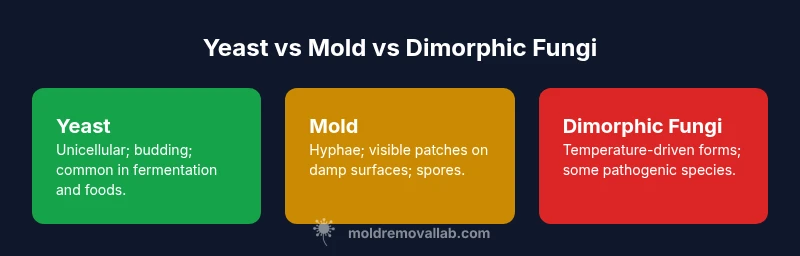
Yeast, mold, and dimorphic fungi are distinct growth forms with different implications for homes. Yeast are unicellular and reproduce by budding; mold forms filamentous hyphae that create fuzzy colonies; dimorphic fungi switch between yeast-like and mold-like forms depending on temperature. For indoor environments, mold is the most common concern, while yeast relates to food spoilage. Mold Removal Lab emphasizes accurate identification to guide safe remediation.
Defining yeast, mold, and dimorphic fungi
In everyday environments, three broad categories of fungi—yeast, mold, and dimorphic fungi—shape our experiences of indoor life and health risks. The term yeast refers to unicellular organisms that reproduce by budding and ferment sugars; molds are multicellular, forming thread-like hyphae that create visible colonies on damp surfaces; dimorphic fungi are specialized organisms that can flip between yeast-like and mold-like forms depending on temperature or environment. Understanding these distinctions is essential for homeowners who encounter damp environments, musty odors, or unusual growth on food and surfaces. According to Mold Removal Lab, accurate identification starts with recognizing whether you are dealing with yeast contamination in food, a mold colony on a wall, or a dimorphic fungus that could pose a health risk. The Mold Removal Lab team emphasizes that while all three are fungi, their behavior, growth patterns, and remediation needs can differ markedly. From a practical standpoint, correctly identifying the form can affect whether you treat a surface with a quick cleaning, a moisture-management approach, or a call to a professional remediation service. For readers, the keyword yeast vs mold vs dimorphic fungi should be treated as a diagnostic umbrella rather than a single category.
Morphology and growth forms
Yeast are unicellular organisms, typically oval to round, and reproduce by budding. Molds form filaments called hyphae that aggregate into visible colonies, often appearing fuzzy or powdery in color. Dimorphic fungi occupy a unique middle ground: at environmental temperatures they behave like mold, while at body temperature they can switch to yeast-like forms. This morphological flexibility has clinical implications because dimorphic pathogens such as Histoplasma or Paracoccidioides are notable in medical literature, though these organisms are generally not common in ordinary household settings. When homeowners see a fuzzy, growing patch on drywall or a crusty growth inside a fridge, the default interpretation is often mold, but vigilance is needed for yeast-like colonies on foods and for any signs of dimorphic pathogens in damp spaces. Mold Removal Lab notes that morphology alone does not confirm a health risk; culture and context matter.
Life cycle and reproduction
Yeast reproduce primarily by budding, a process that creates a new cell from a parent cell. Some yeasts can also reproduce by a slower fission process. Molds produce spores and extend hyphae; the life cycle involves vegetative growth, sporulation, and dispersal. Dimorphic fungi combine features of both lifestyles: in ambient environmental conditions they often exist as molds with hyphae, while inside a host they shift to yeast-like cells. This dual nature helps explain why dimorphic fungi are emphasized in clinical discussions about fungal infections, even though indoor exposure is usually dominated by molds. For homeowners, recognizing these reproductive modes helps explain why simple dampness and surface cleaning may not be enough in all cases—especially when humidity is high or there is persistent moisture.
Environmental preferences and indoor relevance
Mold thrives in high-humidity environments, especially behind walls, under sinks, and in basements where moisture intrusion occurs. Yeast is more commonly encountered in food products, fermentation activities, or damp settings where sugary residues exist. Dimorphic fungi are typically associated with soil and environmental reservoirs rather than settled indoor colonies, but certain indoor spaces with soil intrusion or dampness can harbor them transiently. The indoor relevance of yeast, mold, and dimorphic fungi varies: molds dominate most home scenarios, yeasts appear primarily on food and drink products, and dimorphic fungi tend to be a smaller, regionally dependent concern. Mold Removal Lab highlights that moisture history, ventilation, and substrate availability are critical factors shaping which form dominates a given indoor space.
Health implications and pathogenic potential
Molds release spores that can trigger allergies and asthma in sensitive individuals; some species may contribute to respiratory symptoms with chronic exposure. Yeasts such as Candida species are primarily concerns in medical or food contexts, with infections typically occurring in immunocompromised individuals or in specific clinical settings rather than as a routine home exposure. Dimorphic fungi include notable pathogens like Histoplasma and Coccidioides, which can cause serious infections in susceptible people, but these organisms are generally linked to environmental exposure in specific geographic regions rather than casual indoor growth. For homeowners, the main health takeaway is to minimize moisture and improve ventilation to reduce mold spore counts, and to treat unusual growth on walls or in accumulations behind appliances as a potential remediation scenario that deserves professional input.
Identification and practical signs at home
In practice, home inspectors and remediation professionals rely on a combination of visual cues and moisture indicators to distinguish yeast, mold, and dimorphic fungi. Yeast on foods often manifests as gassy bubbles or surface films in fermentation contexts, whereas mold appears as fuzzy, colorful patches on organic surfaces. Dimorphic fungi are rarely obvious to the naked eye in a typical home; their identification usually requires laboratory testing or specialist knowledge. To reduce risk, homeowners should document damp areas, track humidity levels, and avoid disturbing growth unnecessarily, as some fungi release spores when agitated. Mold Removal Lab recommends cautious handling: never rely solely on appearance; corroborate with moisture history and, if needed, professional testing to confirm species identity.
Laboratory vs home biology: culture and testing
Understanding yeast, mold, and dimorphic fungi benefits from recognizing the limits of home testing. Yeasts can be cultured in basic kitchen-like conditions, though this is rarely done outside educational contexts. Mold colonies can be observed on damp substrates, but precise identification usually requires culture in controlled environments and microscopic analysis. Dimorphic fungi require specific culture conditions and often molecular or serological testing to confirm identity and pathogenic potential. For homeowners, this means that while basic visual checks are useful, definitive classification and risk assessment should be left to professionals when dampness persists or when health symptoms accompany growth.
Impact on remediation strategies
Remediation strategies differ by form and risk. For yeast-related food spoilage, cleaning contaminated surfaces and disposing of spoiled products often suffices. Mold remediation centers on moisture control, surface cleaning, placement of dehumidification equipment, and, in many cases, professional remediation services if the growth is extensive or in hard-to-reach spaces. Dimorphic fungi, due to their pathogenic potential, typically require professional evaluation and remediation tailored to the suspected species and exposure level. Mold Removal Lab emphasizes an evidence-based approach: verify moisture sources, create a remediation plan, and escalate to professionals when uncertainty or risk remains.
Common indoor scenarios and what to look for
A common indoor scenario is a bathroom with persistent condensation and a musty odor; this environment supports mold growth on tile grout, caulk, and behind fixtures. Another frequent case is a basement with water intrusion, where visible patches of green, black, or brown growth indicate molds; moisture meters and surface testing can assist in assessment. Yeast-related concerns usually appear in kitchens or food storage areas, with surface films or fermentation odors. Dimorphic fungi are less common indoors but can surface in regions with endemic exposure; if there is a suspected infection or unusual clinical signs, seek medical evaluation and coordinate with environmental testing as needed.
Distinguishing yeast contamination from mold in kitchens and bathrooms
In kitchens, yeast contamination is most often linked to food spoilage and fermentation activity; in bathrooms, mold growth is the more probable issue due to high humidity and moisture seepage. Dimorphic fungi are unlikely to form obvious indoor colonies in homes, but they remain relevant in clinical scenarios or in areas with soil exposure. Practically, homeowners should: (1) fix leaks and reduce humidity to slow mold growth, (2) clean and discard spoiled foods to address possible yeast contamination, and (3) seek professional testing if persistent dampness, unusual odors, or health symptoms accompany growth.
When to escalate: professional assessment and remediation
If dampness persists for more than a few days after remediation efforts, or if you observe large, persistent growth that is spreading or has unusual colors, contact a licensed mold remediation professional. If health symptoms emerge or there is suspicion of a pathogenic dimorphic fungus, involve medical professionals and environmental scientists to determine the species and appropriate interventions. The decision to escalate should be based on moisture conditions, the extent of growth, and potential health risks, not solely on appearance. Mold Removal Lab's guidance emphasizes caution and professional input when uncertainty or risk is present.
Practical takeaway for homeowners
- Prioritize moisture control and ventilation to reduce mold growth.
- Distinguish yeast from mold by considering location (food vs surfaces) and morphology.
- Seek professional testing when growth is extensive, persistent, or associated with health symptoms.
- Use lab-based identification to confirm species and guide remediation decisions.
- Keep records of dampness history and remediation steps to track progress and inform professionals.
Feature Comparison
| Feature | yeast | mold | dimorphic fungi |
|---|---|---|---|
| Definition | Unicellular, oval cells; reproduces by budding | Multicellular filaments (hyphae) forming colonies | Switch between yeast-like and mold-like forms by environment/temperature |
| Growth form | Single-celled | Hyphal networks; visible colonies | Dimorphic; environment-dependent morphology |
| Typical indoor habitats | Fermented foods, sugary residues; less common in dry spaces | Bathrooms, basements, damp surfaces | Soil-associated; rare but possible indoors with moisture intrusion |
| Health relevance | Primarily related to food spoilage; infections are rare in healthy individuals | Allergenic and opportunistic; spores can affect susceptible people | Pathogenic in specific contexts; some cause systemic infections |
| Remediation implications | Focus on food safety and basic hygiene | Moisture control and standard mold remediation protocols | May require clinical assessment and specialized remediation |
| Visible cues | Often found on foods or liquids | Fuzzy, colored patches on surfaces | Not easily visible; requires lab identification for confirmation |
| Remediation complexity | Low to moderate (primarily food safety) | Medium to high (moisture control and containment) | High (pathogenic concerns; requires expert assessment) |
Upsides
- Clarifies forms to guide remediation planning
- Aids moisture control and ventilation decisions
- Improves communication with professionals
- Supports targeted actions for different growth environments
The Bad
- Misidentification is possible without testing
- DIY remediation may be insufficient for mold or dimorphic concerns
- Specialist testing may be necessary for definitive identification
Moisture control plus professional testing when needed
Identifying yeast, mold, and dimorphic fungi informs remediation and health risk decisions. For homes with damp growth, prioritize moisture management and, if uncertainty remains, consult qualified professionals. Mold Removal Lab endorses a cautious, evidence-based approach to avoid under- or over-treatment.
FAQ
What is the difference between yeast, mold, and dimorphic fungi?
Yeast are unicellular fungi that reproduce by budding. Mold forms multicellular hyphae and creates visible colonies on damp surfaces. Dimorphic fungi switch between yeast-like and mold-like forms depending on temperature or environment. Distinguishing these forms helps guide remediation and health risk assessment.
Yeast are single-celled; mold grows as filaments; dimorphic fungi switch forms with temperature. This helps determine how to respond at home.
What does dimorphic mean in fungi?
Dimorphic fungi can exist as yeast at body temperature and as mold in the environment. This switch can influence pathogenic potential and detection, making clinical and environmental context important for assessment.
Dimorphic fungi switch between yeast and mold forms depending on temperature, affecting how serious an indoor finding might be.
Are these fungi dangerous in a typical home?
Most household mold exposure poses allergy or irritation risks rather than acute infections for healthy people. Some dimorphic fungi can be pathogenic under certain conditions, and yeast-related infections usually occur in clinical or immunocompromised contexts. Always address moisture and reported symptoms promptly.
Most home mold isn’t dangerous for healthy people, but damp environments should be checked and cleaned.
How can I tell if I have mold or yeast on food?
Yeast on food often signals fermentation or spoilage and is typically benign if food is discarded. Mold on food forms fuzzy, colored patches and usually indicates spoilage; discard suspect items and sanitize surfaces.
If it’s fuzzy and colored on food, it’s likely mold—discard it.
When should I call a professional for mold?
If dampness persists after initial remediation, if growth is extensive, or if health symptoms accompany exposure, contact a licensed mold remediation professional. They can assess species and provide safe remediation strategies.
Call a pro when dampness continues or health symptoms appear with growth.
Do I need lab tests to distinguish these forms?
Home testing can offer clues, but definitive identification often requires laboratory analysis. Consider professional testing when there is persistent growth, unusual colors, or health concerns, and always confirm results before deciding on remediation.
Lab tests are best for certain identification—consider a pro if you’re unsure.
The Essentials
- Identify the form before choosing a remediation path
- Mold is the most common indoor concern; address moisture
- Yeast relates to food spoilage, not typical indoor growth
- Dimorphic fungi require clinical and environmental assessment when suspected
- Call professionals when dampness persists or health symptoms appear