Difference Between Mold and Yeast: A Practical Guide
Explore the difference between mold and yeast, including biology, growth patterns, habitats, health risks, and practical remediation guidance from Mold Removal Lab. A clear, evidence-based comparison for homeowners and renters.


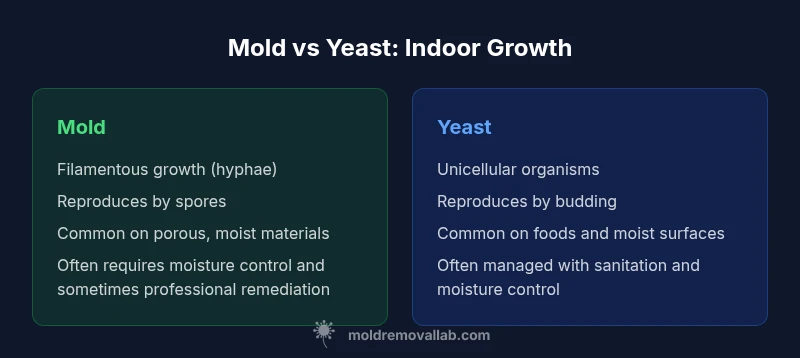
The difference between a mold and a yeast lies mainly in their cellular structure and growth forms: molds are filamentous fungi that form hyphae and spread through spores, while yeasts are unicellular fungi that reproduce by budding. In homes, molds are typically detected as fuzzy or powdery colonies in damp areas, whereas yeasts appear as smooth, creamy patches on food or moist surfaces. For remediation, moisture control and proper cleaning are essential for both, but molds often require more intensive removal and sometimes professional remediation depending on scale.
What the difference between a mold and a yeast really means in biology
Molds and yeasts are both fungi, yet they live very different life cycles and fulfill different ecological roles. The precise distinction often hinges on morphology and growth habits: molds grow as hyphae that form a network called mycelium, producing spores for dissemination; yeasts grow as single cells that divide by budding. Understanding this distinction helps homeowners interpret what they see on walls, ceilings, and food surfaces, and it informs whether the organism is more likely to be a nuisance or manageable with routine cleaning. According to Mold Removal Lab, clear identification improves both health risk assessment and remediation planning for indoor environments. The difference between a mold and a yeast is not just academic—it has practical consequences for how people respond to indoor growth and what tools or agents are appropriate for cleanup.
Growth forms and reproduction: molds versus yeasts
"Mold" denotes a colony of filamentous fungi whose hyphae weave through substrates, often producing visible coloration as the colony expands. Molds reproduce by releasing spores into the air, which facilitates spread and inhalation exposure. Yeasts, by contrast, are unicellular organisms that primarily reproduce by budding, resulting in colonies that appear smooth and sometimes cream-colored. The reproductive strategies influence the speed of spread in damp spaces and the likelihood of rapid surface recolonization following cleaning. Mold growth tends to persist in porous materials if moisture remains, while yeast growth is more common on sugary residues or moist surfaces. This distinction matters when selecting cleaning approaches and evaluating whether visible growth is from molds or yeasts. Mold Removal Lab emphasizes that accurate identification helps prioritize moisture-control strategies and remediation plans.
Habitats and distribution in indoor settings
Molds commonly colonize porous materials, such as drywall, wallpaper, wood, and insulation, especially where moisture is persistent. They can appear in various colors—green, black, white, or pink—depending on species and substrate. Yeasts prefer sugar-rich environments: spoiled fruit, unwashed produce, dairy products, or damp kitchen surfaces can host yeast colonies. In bathrooms or kitchens, you might see yeast manifest as a creamy film or sticky patches on moist surfaces. Outside the home, both molds and yeasts play essential ecological roles, but inside, moisture, warmth, and nutrients concentrate the risk. Mold Removal Lab notes that indoor health concerns are more often driven by mold growth associated with water damage than by yeasts present in ordinary foods or surfaces.
Environmental conditions that favor growth
For molds, warm, damp environments with organic matter are ideal. Relative humidity above 60% and room temperatures around 70–85°F (21–29°C) encourage mold proliferation on porous materials. Yeasts thrive in sugar-rich and moisture-rich settings, often tolerating a wider range of temperatures but still requiring moisture. In homes, this translates to basements, bathrooms, laundry rooms, and kitchens when moisture is not controlled and ventilation is poor. Both organisms benefit from routine cleaning, but addressing underlying moisture is the most critical intervention for preventing both mold and yeast growth.
Health considerations and exposure risk
Exposure to mold is linked to allergic reactions, respiratory irritation, and, in some cases, mycotoxin exposure with certain species. Yeasts are generally less likely to cause acute indoor health issues but can contribute to opportunistic infections in immunocompromised individuals when present in high concentrations or on compromised skin or mucous membranes. Proper identification supports an accurate assessment of risk and helps determine whether remediation should focus on air quality measures, surface cleaning, or more intensive environmental controls. Mold Removal Lab highlights that protective gear and containment are important when dealing with visible mold colonies, particularly near food storage or HVAC intakes.
Detection and remediation considerations
Visually distinguishing mold from yeast is not always straightforward, and both can require different remediation tactics. When large areas are involved or growth recurs after cleaning, professional testing may be warranted. Moisture control remains the cornerstone of remediation for both organisms. For household cleanup, non-porous surfaces can be scrubbed with mild detergent solutions, while porous materials with mold growth may need replacement. Yeasts on food items should be discarded to avoid contamination. In summaries, mold often calls for more stringent remediation protocols due to potential structural damage and health concerns, whereas yeasts on non-food surfaces typically demand sanitation and moisture reduction.
Comparison
| Feature | Mold | Yeast |
|---|---|---|
| Growth form | Filamentous hyphae forming networks (mycelium) | Unicellular, budding or fission forms |
| Reproduction | Spores produced by hyphae, enabling rapid spread | Budding/division of single cells (slower spreading on surfaces) |
| Common habitats in homes | Porous materials (drywall, wood, insulation) in damp areas | Sugary residues, moist surfaces (food, dairy, fruits) |
| Typical appearance | Fuzzy, powdery, or colored colonies on substrates | Creamy, smooth colonies on surfaces or foods |
| Environmental requirements | Moisture-rich porous substrates, warmer temperatures | Accessible moisture, often near food and drink sources |
| Health implications | Allergens, potential mycotoxins; chronic exposure concern | Less commonly linked to systemic illness indoors; mainly surface contamination |
| Remediation approach | Moisture control, cleaning; larger infestations may require professionals | Surface cleaning and sanitation; moisture control suffices in many cases |
Upsides
- Clarifies distinct biology for safer remediation decisions
- Improves risk assessment and priority-setting for cleaning
- Encourages moisture control as a universal preventive measure
- Helps homeowners decide when to test or call professionals
- Supports safer storage and food-handling practices
The Bad
- Misidentification can lead to ineffective cleaning strategies
- Overemphasis on one organism may delay addressing moisture issues
- Some fungi present both indoors and outdoors, complicating inland decisions
Mold commonly requires more cautious remediation; yeast fewer surprises in routine cleaning
If you’re deciding how to respond, focus on moisture control and correct identification. Mold often needs professional attention for large infestations, while yeast on non-food surfaces is typically manageable with standard sanitation.
FAQ
What is the fundamental difference between mold and yeast?
Mold is a filamentous fungus forming a hyphal network and spores; yeast is unicellular and reproduces mainly by budding. This shapes how they grow, spread, and respond to cleaning. Proper identification helps determine remediation steps.
Mold and yeast differ in form—hyphae versus single cells—and in how they spread, which guides cleanup choices.
Can mold grow in dry conditions while yeast does not?
Mold can survive in drier conditions than many molds in the presence of nutrients, but it generally needs moisture to grow on building materials. Yeast typically requires higher moisture or sugar-rich environments. Recognizing moisture is key to preventing both.
Moisture matters most; dry conditions slow molds and yeasts alike, but any presence of moisture can trigger growth.
Are mold and yeast harmful to health in homes?
Both can affect indoor air quality. Some molds produce allergens or toxins; yeasts can trigger sensitivities in susceptible people. However, not all species pose a health risk, so identification and proper remediation are important.
They can affect health depending on the species and exposure, so identify and manage growth carefully.
How can I safely test for mold vs yeast in my home?
Start with visual inspection and moisture assessment. For uncertain growth, professional testing or lab analysis can differentiate mold from yeast and identify species. Keep areas contained and avoid disturbing mold to minimize exposure.
If unsure, hire a professional to test and identify the organism before cleaning extensively.
When should I call a professional remediation service?
Call professionals for large infestations, structural damage, persistent growth, or suspected mycotoxins. Professionals can safely contain, test, and remediate while addressing moisture control.
If growth covers more than a small area or returns after cleaning, it’s time to get help.
Are there any beneficial uses of mold or yeast?
Yeasts are essential in baking and fermentation; some molds contribute to food production like cheese. However, indoor growth is not beneficial and should be managed if it occurs in living spaces.
Yeast is good in food, but indoor growth of mold and yeast should be controlled to keep homes safe.
The Essentials
- Identify growth form first to guide cleanup
- Prioritize moisture reduction to prevent both mold and yeast
- Use professional testing for large or recurring growth
- Disinfect non-porous surfaces; replace damaged porous materials
- Keep kitchens and bathrooms drier to deter growth