Mold vs Fungus: Key Differences and Practical Guidance
Explore the practical differences between mold and fungus, what it means for indoor health, and how to identify and remediate growth safely in your home. A Mold Removal Lab guide.


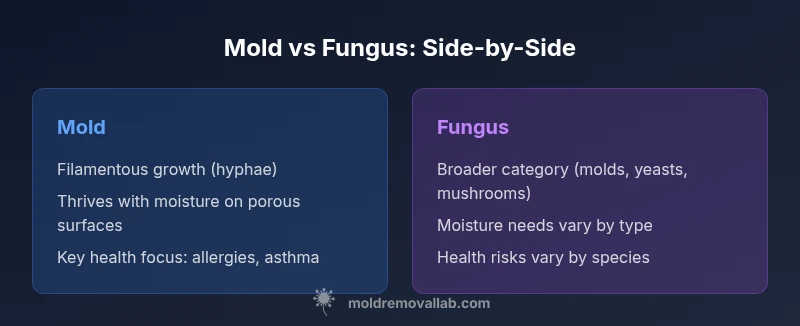
Mold versus fungus describes two related biological groups within the fungal kingdom. Mold refers to a filamentous, multicellular growth that forms visible colonies on surfaces, while fungus is the broader umbrella that includes molds, yeasts, and mushrooms. For homes, the remediation priority is mold growth driven by moisture, because it most directly affects indoor air quality and health. This TL;DR highlights why moisture control and visible growth remediation are essential first steps.
What mold versus fungus means in biology
In biology, mold versus fungus describes two related concepts within the fungal kingdom. Mold refers to a group of fungi that grow as multicellular filaments called hyphae and form visible colonies on surfaces. Fungus is the broader category that includes molds, yeasts, and mushrooms. For homeowners, the practical question is how this distinction affects health, indoor air quality, and remediation. According to Mold Removal Lab, understanding that mold is a subset of fungi helps clarify why moisture controls and surface cleaning are central to prevention and cleanup. This distinction matters because it shapes how people approach detection, testing, and remediation, especially in damp areas like basements, bathrooms, and kitchens where growth is most likely to occur.
Core differences: taxonomy, morphology, and growth
From a taxonomic perspective, mold and other fungi belong to the same kingdom, but molds are typically filamentous forms composed of hyphae that create visible colonies. Yeasts, another fungal group, grow as single cells and appear as powdery or creamy growths on surfaces or liquids. Morphologically, molds form networked structures that spread across surfaces, while yeasts cluster as liquid suspensions or colonies. Growth dynamics differ: molds thrive in moisture-rich environments with porous substrates that retain humidity, whereas yeast and other fungi may colonize damp materials differently. The practical implication for remediation is that moisture management is central across indoor fungi, and recognizing a fuzzy, branching colony on a wall should be treated with moisture reduction and surface cleaning as primary steps.
How mold grows in homes: moisture, substrates, and signs
Mold growth indoors is driven by persistent moisture, a food source (e.g., cellulose fibers in drywall, wood, fabric), and suitable temperatures. When damp conditions persist, hyphae extend and form a visible colony, often with color that hints at species, such as green, black, or white patches. Signs include musty odors, staining, and texture changes on walls, ceilings, and near leaks. Mold Removal Lab emphasizes that moisture control—fixing leaks, improving ventilation, and reducing humidity—has the biggest impact on halting mold growth. In contrast, fungi that are not classic molds may appear as yeasts or powdery films, but indoor remediation should still prioritize drying and cleaning to prevent further spread.
Fungus in indoor environments: yeasts and other fungi
While mold is the form most homeowners worry about, the fungal kingdom includes yeasts, mushrooms, and other filamentous fungi that can inhabit indoor spaces under the right conditions. Yeasts may appear as creamy colonies on kitchen surfaces or fermenting liquids, while other fungi can form spores that linger in dust. The practical implication is that not every fungus presents the same health risks or remediation needs. However, many indoor fungi share moisture requirements and respond to similar drying and cleaning strategies. For homeowners, recognizing that mold is a type of fungus helps set accurate expectations for inspection and remediation without conflating every fungal occurrence with the same risk level.
Health implications and exposure routes
Exposure to mold and other indoor fungi can trigger allergic reactions, nasal irritation, coughing, and asthma symptoms in sensitive individuals. Chronic exposure in damp homes often correlates with higher severity of respiratory issues. Based on Mold Removal Lab Analysis, 2026, damp environments heighten exposure risks and may amplify symptoms in vulnerable groups such as children and the elderly. The health impact is not uniform across all fungi; some species produce more potent allergens or irritants, while others have milder effects. Understanding the distinction helps you tailor mitigation—prioritize visible growth and moisture control, and limit dust intrusion where fungi settle.
Diagnostic approaches: when to test, what to test for
Testing for mold and other indoor fungi should be guided by observed growth, moisture indicators, and air quality concerns. Visual inspection remains a first step, but sampling (air, surface swabs, or bulk samples) can help identify species and guide remediation. The Mold Removal Lab Team recommends working with accredited labs and interpreting results in the context of moisture patterns and building layout. A key point: detection confirms presence, but remediation decisions should address moisture sources and cleaning efficacy. Nose-level steps you can take include sealing leaks, improving ventilation, and using HEPA filtration during cleanup.
Remediation mindset: safe cleanup vs professional remediation
For small, non-porous, readily accessible areas, homeowners can handle cleaning with approved cleaners following safety guidelines—wear gloves and a mask, ventilate the area, and dry thoroughly. But for widespread growth, mold on porous materials, or growth behind walls, professional remediation is often required. The Mold Removal Lab Team emphasizes moisture control as the foundation of remediation: fix the leak, remove or seal affected materials as necessary, and ensure the area is dried to prevent regrowth. This approach minimizes the spread of spores and reduces health risks for household members.
Common myths vs reality
A common myth is that any visible mold is equally dangerous and requires the same cleaning approach. In reality, health risk depends on species, exposure duration, and individual sensitivity. Another misconception is that bleach is a universal fix for all mold problems; while it can help on non-porous surfaces, it often fails on porous materials and does not address moisture sources. The reality is that effective remediation combines moisture control, safe cleaning practices, and, when necessary, professional assessment to determine whether structural damage warrants material removal.
Quick-start checklists for homeowners
Before you call a pro, perform a quick visual check for mold growth, leaks, and humidity signals. Create a simple action list: locate leaks, repair them, dry affected areas completely, improve ventilation, and use appropriate cleaners on non-porous surfaces. Keep a log of areas inspected and actions taken. This proactive habit reduces repeat growth and makes professional remediation faster and more cost-effective if needed.
Comparison
| Feature | mold | fungus |
|---|---|---|
| Definition | A filamentous group of fungi that forms visible colonies on surfaces | A broader kingdom including molds, yeasts, and mushrooms |
| Indoor growth cues | Thrives under persistent moisture on porous surfaces | Can occur with various moisture states; not all indoor fungi require high moisture |
| Typical health considerations | Primarily associated with respiratory and allergenic effects from molds | Health risk varies by species; some fungi cause infections or irritations |
| Detection approach | Visual signs, moisture assessment, and targeted mold testing | Fungal testing can identify yeast/molds and guide cleaning |
| Remediation focus | Moisture control, cleaning, and surface remediation of visible colonies | Species-specific remediation may be necessary for certain fungi |
| Common indoor forms | Green/black/brown fuzzy patches on walls, ceilings | Yeast-like films, powdery coatings, or mold-like colonies |
Upsides
- Clarifies terminology to improve communication with contractors
- Helps prioritize moisture control as the central remediation strategy
- Guides homeowners in testing and cleaning decisions
- Supports safer, targeted cleanup rather than blanket treatment
The Bad
- Terminology overlap can still cause confusion for non-specialists
- Not all indoor fungi pose the same health risks, which can mislead risk assessments
- Species-level testing and professional advice may be needed for complex cases
Mold is a specific growth form within the fungal kingdom; prioritize moisture control and visible growth for home remediation.
Mold is a subset of fungi and is most consistently linked to moisture-driven indoor health risks. Focus on moisture sources, visible colonies, and cleaning protocols first, then consider professional testing for ambiguous cases.
FAQ
What is the difference between mold and fungus?
Mold is a filamentous subset of the fungal kingdom that forms visible colonies; fungus is the broader category including molds, yeasts, and mushrooms. In homes, prioritize moisture control and cleaning for mold growth while recognizing that other fungi may behave differently.
Mold is a type of fungus. In homes, focus on moisture and cleaning for mold growth and understand that other fungi can act differently.
Can I treat mold myself, or should I hire a professional?
Small, non-porous areas may be cleaned safely with approved cleaners following safety guidelines. For large, porous, or hidden growth behind walls, professional remediation is recommended.
For big jobs, it’s best to hire a professional; small, cleanable areas can be DIY with proper precautions.
Are all molds dangerous to health?
Health risk depends on the species and individual sensitivity. Some people react strongly to certain molds, while others have minimal symptoms.
Not all molds affect everyone the same way; health risk varies by species and your sensitivity.
How can I prevent mold growth in my home?
Fix leaks promptly, improve ventilation, keep indoor humidity low, and dry damp areas within 24-48 hours of moisture exposure.
Keep moisture low, fix leaks fast, and ventilate rooms to stop mold from growing.
What should I test for if I suspect mold?
Testing can identify species and guide cleanup, but results must be interpreted with moisture context and building layout.
Tests help identify what’s growing, but moisture and cleanup strategy matter most.
Is mold the same as mildew?
Mildew is a surface-level form of mold, usually white or gray; it is a type of mold, not a separate fungus.
Mildew is a kind of mold, so it’s not a completely separate fungus.
The Essentials
- Identify moisture sources and fix leaks promptly
- Know that mold is a type of fungus; not all fungi are mold
- Use visual checks and moisture clues before testing
- Engage a pro for large or uncertain growth
- Address indoor humidity to prevent future growth