Toxic Black Mold vs Black Mold Pictures: A Practical Guide
This Mold Removal Lab guide compares toxic black mold vs black mold pictures, clarifies health risks, visual limits, and safe steps for homeowners and renters. Learn to interpret images, assess risk, and know when to seek professional remediation in 2026.


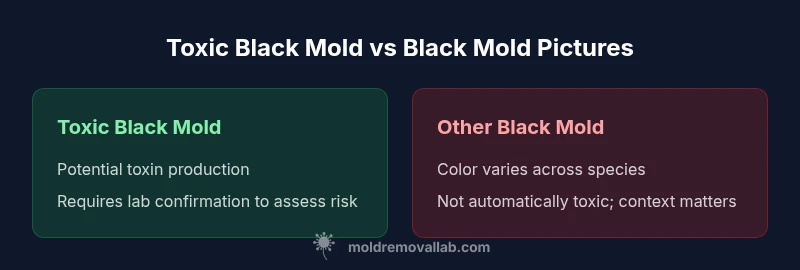
Toxic black mold vs black mold pictures highlights a critical distinction: toxic black mold refers to a specific mold species that can produce mycotoxins, while black mold pictures can show many species and conditions. Color alone cannot determine danger. Treat any apparent growth as a potential hazard and seek professional assessment for confirmation and remediation. Photos alone rarely reveal toxins, exposure history, or moisture sources. For quick action, use a professional mold assessment.
Understanding the Phrase: toxic black mold vs black mold pictures
The phrase toxic black mold vs black mold pictures shows up frequently in homeowner guides and news stories, but it can be misleading. Toxic black mold refers to a specific mold species that can produce toxins under certain conditions, while black mold pictures simply depict how mold looks in a given room. This distinction matters for safety, as visual cues alone cannot confirm toxin production or exposure risk. According to Mold Removal Lab, distinguishing toxic mold from other species requires more than color; context like moisture sources, symptom reports, and lab testing are essential. In this article we unpack how a homeowner can interpret images responsibly, when to suspect a high-risk mold, and what steps to take next.
Health Risk Signals: Symptoms, Exposure, and Environment
Mold exposure can affect people differently. Some individuals experience allergic reactions, while others report persistent respiratory symptoms or headaches after exposure. The health risk is not uniform across all molds that appear black or dark; toxin production depends on species, moisture, and substrate. Homeowners should correlate photos with environmental clues—recent leaks, high humidity, and visible water intrusion—to gauge urgency. The Mold Removal Lab team emphasizes that health risk assessment should combine photos, environment, and, when appropriate, laboratory results to determine the safest remediation path.
Visual Identification Limitations: When pictures mislead
Images are useful for documenting growth but unreliable for confirming species or toxin production. Lighting, camera angle, moisture on surfaces, and the age of the colony can all distort appearance. A dark patch on drywall might be a superficial stain or a thriving colony; without sampling, it is impossible to know if toxins are present. For homeowners, this means avoiding definitive conclusions based solely on a photo. A structured assessment, including moisture mapping and potential sampling, provides a clearer risk profile.
The Science Behind Toxic Black Mold: What the literature says
Toxic mold discussions often center on Stachybotrys chartarum, a species sometimes labeled as toxic in public discourse. In reality, toxin production varies with environmental conditions, substrate, and organism health. The science supports a precautionary approach rather than a color-based diagnosis. Mold growth signals a moisture problem that needs addressing, while toxin presence requires laboratory testing. This nuance matters when homeowners weigh cleanup options and decide whether to hire specialized remediation teams.
Other Common Black Mold Species and Appearance
Many molds that appear black or dark in photos belong to species beyond Stachybotrys chartarum, including Alternaria, Cladosporium, and Aspergillus. Each species carries different health implications, and visual similarity does not guarantee identical risk. As a result, relying on color or texture alone is insufficient. A professional assessment can distinguish between potentially dangerous molds and more benign varieties, guiding appropriate remediation strategies and timelines.
Reading Photos in Context: Environmental clues matter
Color is not a robust indicator of risk. Pay attention to moisture presence, staining patterns, and growth distribution. Frequently, mold thrives where leaks, condensation, or poor ventilation persist. Indoor humidity above 60 percent, recent flood recovery, or odorous indoor air can signal elevated risk regardless of the mold’s color in photos. Collect contextual evidence, such as photos of source leaks and nearby humidity readings, to share with a remediation professional.
Testing vs Guesswork: When to test for toxins or toxins indicators
Mold testing for toxins or mycotoxins exists, but results must be interpreted with care. Not all labs detect toxins reliably, and sampling can vary by method and location. A practical approach is to start with a professional assessment to identify sources and assess health risk, then decide if toxin-specific testing is warranted. For many homes, comprehensive remediation addressing moisture and containment reduces risk more effectively than toxin testing alone.
Safety First: Immediate actions if you suspect mold exposure
If mold is visible and you or others in the home exhibit respiratory symptoms, move to fresh air and reduce indoor humidity. Do not attempt aggressive cleanup beyond basic containment if you lack proper protective gear. Use NIOSH-approved masks, gloves, and eye protection, and isolate the affected area to prevent spread. Contact a licensed professional promptly to perform a safe assessment and remediation plan.
DIY Cleaning vs Professional Remediation: Pros and limits
Small, non-porous surfaces may be cleaned with detergent solutions when moisture problems are absent. However, porous materials (drywall, carpet, insulation) often require removal and professional remediation to prevent regrowth and spore spread. Without proper containment and corrective moisture control, DIY efforts can worsen contamination and health risk. Professionals bring containment, specialized equipment, and EPA- and state-approved protocols to ensure thorough remediation.
Credentials to Look For in a Remediation Pro: What matters
When choosing a mold remediation professional, look for licensing, insurance, and clear remediation plans. Ask about their moisture control strategies, containment methods, air filtration, and post-remediation verification. The most trusted teams provide documentation of scope of work, containment procedures, and test results showing reduced mold indicators after completion.
Documenting with Photos and Records: A practical approach
Keep dated photos before, during, and after remediation, including close-ups of affected areas and moisture sources. Create a simple map of the home showing where every growth was found. These records assist with insurance claims and health documentation, and they help future homeowners or renters recognize recurring moisture issues.
Photo Best Practices for Evidence: Capturing useful data
Take clear photos from multiple angles, with a ruler or scale for size reference. Include the source of moisture (e.g., a leaking pipe) in the frame when possible. Avoid overexposure; ensure consistent lighting across shots. These careful images support professionals in planning targeted remediation and monitoring progress over time.
Real-World Scenarios: Common home situations and best practices
Consider a basement with a recent flood: mold growth is likely, and photos may show dark patches that are not necessarily toxic. The best response combines moisture control, professional assessment, and timely remediation to prevent regrowth. In kitchens and bathrooms where humidity remains high, routine inspection and prompt maintenance minimize long-term risk. Real-world guidance hinges on moisture history and environmental context, not color alone.
Final Action Plan for Homeowners: A concise checklist
- Stop the moisture source and ventilate the area. 2) Document visible growth with photos and notes on leaks. 3) Call a licensed remediation professional for an on-site assessment. 4) If toxins are suspected, pursue lab testing as advised by the pro. 5) Complete remediation with post-remediation verification to ensure safety.
Comparison
| Feature | Toxic black mold (Stachybotrys chartarum) | Other common black mold species |
|---|---|---|
| Health risk potential | Higher perceived risk when toxins may be produced; requires lab confirmation | Risk varies by species and conditions; not all dark molds are toxin producers |
| Typical appearance | Often dark green-black, slimy to powdery texture, usually found where moisture is present | Can appear black, brown, or gray; texture ranges from fuzzy to smooth depending on species |
| Common locations | Basements, crawl spaces, and areas with chronic leaks | Bathrooms, kitchens, laundry rooms, and walls near plumbing |
| Testing availability | Toxin-specific tests available but interpretation requires expertise | Standard mold tests detect presence but not toxins; results must be contextualized |
| Remediation approach | Often requires professional remediation with containment and moisture control | Remediation depends on species, extent, and material affected; may involve DIY for small areas under guidance |
Upsides
- Clarifies that color alone cannot determine danger
- Promotes professional assessment and evidence-based decisions
- Encourages moisture control as the first remediation step
- Reduces misinterpretation from photos and online signage
The Bad
- Photos can still mislead without context or testing
- Toxin-specific testing can be costly and inconclusive
- DIY remediation on large or porous areas may spread spores
- Overreliance on photos can delay necessary action
Professional assessment is essential when toxin risk is suspected.
Visuals alone cannot confirm toxin production. If you suspect toxigenic mold, engage licensed professionals for testing and remediation to protect health and property.
FAQ
Can pictures alone tell me if the mold is toxic?
No. Pictures document growth but do not prove toxin production. Only lab tests and professional assessment can confirm toxigenic risk.
Pictures alone can't confirm toxigenic mold; get a professional assessment.
Is toxic black mold always dangerous?
Toxicity depends on the species and exposure. Some molds pose health risks, others are less hazardous. Treat potential risk seriously and seek guidance.
Risk varies by mold type and exposure; take it seriously and call a pro.
When should I test for mold toxins?
Test when there are persistent symptoms, unresolved moisture problems, or after visible remediation to confirm toxin presence and verify safety.
Test if symptoms persist or after remediation to confirm safety.
Can I clean mold myself if I just see black mold?
Small, non-porous patches may be cleaned with proper precautions, but porous materials often require professional removal. Always prioritize safety and containment.
Be careful; mold cleanup can spread spores. When in doubt, hire a pro.
What credentials should a mold remediation pro have?
Look for licensed and insured professionals with documented remediation steps, containment plans, and post-remediation verification.
Choose licensed, insured pros with clear plans and proof of cleanup.
How reliable are lab tests for mold toxins?
Lab toxin tests can be informative but results depend on sampling quality and interpretation. Use results alongside environmental and health context.
Tests help, but rely on expert interpretation and context.
The Essentials
- Treat color as a clue, not a diagnosis
- Prioritize moisture control to stop mold growth
- Engage licensed professionals for assessment and remediation
- Use toxin testing only when advised by a pro
- Document sources and track remediation progress