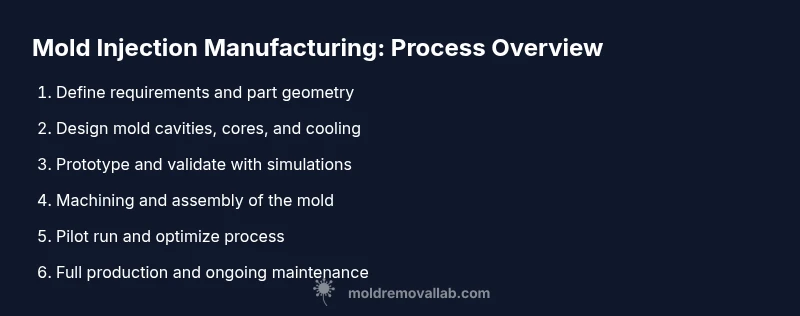
Mold Injection Manufacturing: The Complete How-To Guide
Explore mold injection manufacturing from design to production. Learn essential components, material choices, prototyping, machining, QA, and maintenance to produce reliable injection molds and parts.


This guide shows you how to plan and execute mold injection manufacturing for precise plastic parts. You’ll learn mold design basics, material choices, tolerances, and the sequence of production steps, plus safety and maintenance practices. Key prerequisites include CAD models, a machining-ready mold, validated process windows, and appropriate PPE for operators.
What is mold injection manufacturing?
In the context of plastics production, mold injection manufacturing refers to the end-to-end process of designing, building, and using molds to shape molten polymer into final parts. The word 'mold' here means a hardened tool that defines geometry, features, and surface finish. Mold injection manufacturing blends mechanical design, materials science, and process engineering to produce repeatable parts with tight tolerances. According to Mold Removal Lab, proper mold design is foundational to product reliability and worker safety in manufacturing environments. By focusing on robust draft angles, balanced gating, and efficient cooling, facilities can reduce cycle times and scrap rates. In addition, disciplined maintenance and calibration help prevent tool wear that can degrade part quality. Across industries—from automotive components to household goods—the same principles apply: a well-designed mold, supported by validated process windows, will yield consistent parts and fewer defects.
Key components of an injection mold
An injection mold comprises several core elements that work together to create a finished part:
- Mold base: the supporting frame that holds all components together.
- Cavities and cores: define the external and internal geometry of the part.
- Inserts and sliders: allow complex features and undercuts.
- Runner and gate system: channels that guide molten polymer into the cavities.
- Cooling channels: manage heat to control cycle time and part quality.
- Ejectors: push finished parts out of the mold without damage.
- Alignment features: ensure precise mating of mold halves during operation.
Each component must be designed with manufacturability in mind, balancing rigidity, ease of maintenance, and cost. Early decisions about part geometry influence tooling complexity and production yield.
Design considerations and tolerances
Designing for mold injection manufacturing requires careful attention to tolerances, draft, parting line placement, and gas venting. Shrinkage and warpage must be anticipated for the chosen material and molding conditions. Draft angles help parts release cleanly; improper drafts can cause sticking or flashing. Gate location and size affect fill balance and tensile strength, while cooling channel placement determines cycle time and uniform cooling.
Process windows—comprising melt temperature, injection speed, and packing pressure—define the acceptable range for producing consistent parts. Validating these windows through simulations and pilot runs reduces the risk of early tool wear and production scrap. Remember to document all dimensions and tolerances in a clear print set so machinists and suppliers interpret them the same way.
Material selection and tooling options
Choosing the right tooling material is critical for tool life and part quality. Tool steels (e.g., high-hardness steels) offer wear resistance for high-volume production, while aluminum molds are economical for short runs and rapid prototyping. Inserts and coatings can extend life in challenging applications, and hardened plates help with wear on high-usage molds. Material compatibility with the chosen polymer is essential to prevent chemical attack and degradation over time. Additionally, consider corrosion resistance and ease of maintenance when selecting cooling system components and surface finishes. A well-chosen material set reduces downtime and improves repeatability across batches.
Prototyping, validation, and simulations
Before committing to full-scale production, prototype components and validate the mold design through simulations and physical tests. 3D-printed prototype inserts or full-scale soft molds help verify geometry, draft, and ejector clearances. Mold flow analysis software predicts fill patterns, air traps, and cooling needs, enabling design tweaks before machining begins. Conduct tolerance stack-ups and fit checks with the intended production resin to confirm functional performance. Document results and adjust the design iteratively to minimize risk during first runs.
Machining, assembly, and QA
Machining a mold requires high-precision CNC milling, wire EDM, and careful finishing processes to achieve exact cavity and core features. Surface preparation, including polishing of critical interfaces, reduces wear and improves finish. During assembly, verify alignment pins, springs, and ejector systems, then perform a dry run to check movement and clearance. QA checks should include dimensional verification against the CAD model, cavity balance tests, and a pilot molding run with the target resin. Any misalignment or unexpected flash should trigger a retroactive design review before production.
Process optimization and maintenance
Once the mold is in production, monitor cycle times, shot consistency, and part quality to optimize the process window. Regular maintenance—cleaning, lubrication, and inspection of cooling channels and ejectors—extends tool life and reduces downtime. Establish a preventive maintenance schedule and a change-control process to document tweaks in temperature, pressure, or cycle length. Invest in data logging to identify correlations between process variations and part quality. A well-maintained mold not only improves yield but also reduces the cost per part over the life of the tool.
Safety, maintenance, and compliance
Mold injection manufacturing involves heavy machinery, high-temperature processes, and sharp tooling. Prioritize worker safety with proper PPE, machine guarding, and robust ventilation. Implement lockout-tagout procedures and ensure training on emergency shutoffs. Keep work areas clean to minimize slip hazards from lubricants and coolants. Compliance with industry standards for tooling and material handling helps protect workers and maintain quality across shifts.
Tools & Materials
- CAD/CAM software(For mold geometry and tooling integration)
- CAM programming workstation(Plan toolpaths and tolerances; simulate before machining)
- CNC milling machine(Critical for cavity and core machining with high surface finish)
- Wire EDM and/or spark erosion equipment(Precise cavity and insert shaping for complex geometries)
- 3D printer(Prototype inserts and quick-fit checks; not a substitute for metal tooling)
- Precision measuring tools(Calipers, micrometers, height gauges for tight tolerances)
- Go/no-go gauges and pin gauges(Inspect ejector gaps, cavities, and core alignments)
- Mold base plates and inserts(Framework and modular components for quick assembly)
- Cooling system components(Cooling channels, manifolds, fittings; essential for cycle time)
- Protective equipment and ventilation(PPE, respirators if heat or fumes are present; proper shop ventilation)
- Cleaning solvents and degreasers(Maintain mold surfaces and prevent build-up)
Steps
Estimated time: 6-8 weeks
- 1
Define requirements and specs
Gather part geometry, tolerances, material, expected production volume, and surface finish goals. Establish the parting line and draft requirements early to simplify mold design. Confirm compatibility with the chosen polymer and resin system.
Tip: Create a clear Z-axis tolerance stack and lock in a first-shot acceptance criteria before design work begins. - 2
Create CAD model of mold and assemblies
Develop a complete CAD model of the mold base, cavities, cores, inserts, and sliders. Include gating, runners, and cooling channels in the model. Validate interference and maintainability within the assembly.
Tip: Use feature-based modeling to enable fast updates if design changes occur downstream. - 3
Plan machining and cooling
Define tool paths for milling and wire EDM, allocate inserts, and design cooling channels for uniform heat transfer. Specify surface finishes and tolerances for each component. Prepare a first article inspection plan.
Tip: Balance cooling to minimize warpage while avoiding excessive cycle times. - 4
Prototype and validate with simulations
Run mold flow analysis and prototype tests to verify fill, air traps, and shrinkage. Adjust geometry as needed before committing to full-scale production tooling. Document results and decisions.
Tip: Simulations save time and money by predicting problem areas early. - 5
Machine, assemble, and dry run
Machine cavities and cores, assemble the mold, and perform dry runs with no resin to verify movement, clearance, and alignment. Correct any binding or misalignment before first resin-filled test.
Tip: Do a cold and warm dry run to catch thermal expansion issues. - 6
Pilot production and QA
Run a pilot with the target resin, measure part consistency, adjust process windows, and update documentation. Apply any changes to production SOPs and training materials for operators.
Tip: Maintain a change log to track parameter shifts and their impact on quality.
FAQ
What is mold injection manufacturing?
Mold injection manufacturing is the process of designing and producing injection molds that shape molten polymer into final parts. It combines mechanical design, materials science, and process engineering to achieve repeatable, high-quality results.
Mold injection manufacturing is about designing and making injection molds to shape plastic parts reliably.
What materials are commonly used for molds?
Common mold materials include tool steels for durability and aluminum for lower-cost prototypes or short runs. Inserts and coatings can extend tool life and improve wear resistance.
Tool steels and aluminum are typical mold materials, with inserts and coatings to boost durability.
How long does it take to design a mold?
Design time varies with complexity and run length, but expect several weeks for design, prototyping, and validation before machining.
Designing a mold usually takes several weeks, depending on complexity and testing needs.
What are common mold defects and how can I prevent them?
Common defects include flash, short shots, and warpage. Prevention hinges on proper design, gate location, cooling, maintenance, and validation runs.
Common defects are preventable with careful design, cooling, and testing.
Do I need a professional remanufacturing service for molds?
For high-volume production or complex parts, professional remanufacturing and validation services can save time and reduce risk. For small runs, in-house capabilities may suffice with proper training.
For complex or high-volume molds, consider professional services to reduce risk.
What safety precautions are essential in mold manufacturing?
Ensure proper PPE, guardings, ventilation, and training. Follow lockout/tagout procedures and maintain clean workspaces to prevent accidents.
Wear PPE, guard machines, and keep the workspace safe and clean.
Watch Video
The Essentials
- Define clear design goals before modeling
- Use simulations to validate mold behavior
- Choose tooling materials based on volume and wear
- Maintain rigorous QA throughout prototyping and production