Kahm Yeast vs Mold: Identification and Remediation for Homeowners
Explore kahm yeast vs mold, how to tell them apart, and practical steps for safe cleanup. Mold Removal Lab guides homeowners on identification, moisture control, and remediation.


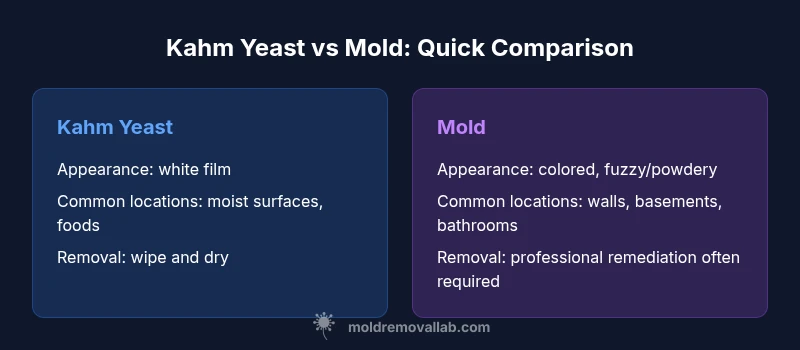
Kahm yeast vs mold presents a crucial homeowner question. Kahm yeast often appears as a white film on moist surfaces and foods, typically benign but a sign of excess moisture. Mold, by contrast, can vary in color and texture and may pose health risks; treat any suspicious growth carefully and consider testing or professional help.
Kahm Yeast vs Mold: Quick Distinction
Kahm yeast vs mold is a common confusion point for homeowners and renters. The terms describe two distinct, yet visually similar, surface growths that appear in kitchens, bathrooms, basements, and on spoiled foods. According to Mold Removal Lab, kahm yeast appears as a white, film-like coating on damp surfaces and foods, while mold often appears in colors such as green, black, or gray and may grow in fuzzy patches. Recognizing the difference matters because it alters the remediation approach and moisture-management strategy. Understanding the distinction helps you decide whether a simple cleaning and moisture control will suffice or if you should pursue professional testing and remediation. Throughout this guide, kahm yeast vs mold will be used to frame practical steps, but we’ll also refer to kahm yeast and mold separately to avoid conflating the two. This framing supports homeowners who want clear, actionable guidance without guesswork.
Kahm Yeast vs Mold: Quick Distinction
Kahm yeast vs mold is a common confusion point for homeowners and renters. The terms describe two distinct, yet visually similar, surface growths that appear in kitchens, bathrooms, basements, and on spoiled foods. According to Mold Removal Lab, kahm yeast appears as a white, film-like coating on damp surfaces and foods, while mold often appears in colors such as green, black, or gray and may grow in fuzzy patches. Recognizing the difference matters because it alters the remediation approach and moisture-management strategy. Understanding the distinction helps you decide whether a simple cleaning and moisture control will suffice or if you should pursue professional testing and remediation. Throughout this guide, kahm yeast vs mold will be used to frame practical steps, but we’ll also refer to kahm yeast and mold separately to avoid conflating the two. This framing supports homeowners who want clear, actionable guidance without guesswork.
Comparison
| Feature | kahm yeast | mold |
|---|---|---|
| appearance | White, film-like on food and moist surfaces | Color varies (white, green, black, gray); fuzzy or powdery growth |
| odor | Usually mild or no odor | Musty or moldy odor may be present |
| growth conditions | Forms as a surface film on moist foods and non-porous surfaces | Thrives on persistent moisture and organic matter on porous and non-porous surfaces |
| typical locations | Produce, dairy, damp kitchen/bath surfaces | Walls, ceilings, bathrooms, basements, damp storage |
| health risks | Generally low risk for healthy individuals; potential allergen exposure | Potential exposure to allergens or mycotoxins depending on species |
| removal method | Wipe with mild detergent and dry; moisture control | Professional remediation for larger areas; containment and PPE as needed |
| prevention | Moisture control and regular cleaning of surfaces | Ventilation improvements, moisture management, prompt repair of leaks |
Upsides
- Clear, quick-run identification helps avoid unnecessary alarm
- Low-cost DIY cleanup for small kahm yeast films
- Strengthens moisture-awareness and home maintenance routines
- Simple preventive steps suitable for renters and homeowners
The Bad
- Mold presence can indicate hidden moisture or structural issues
- DIY cleanup may be insufficient for significant mold growth
- Risk of misidentification if symptoms are subtle or mixed
Kahm Yeast is not the same as Mold; treat uncertain growth with caution and prioritize moisture control.
For small, white films on non-porous surfaces, kahm yeast cleanup is typically adequate. If growth is colored, spreads, or recurs, assume mold and pursue professional testing/remediation. Moisture control remains the best long-term defense.
FAQ
What is the key difference between kahm yeast and mold?
Kahm yeast is a white film formed by yeast and bacteria on moist surfaces and foods and is usually low risk, whereas mold encompasses diverse fungi that can vary in color, texture, and potential health risks. Visual cues and moisture context help distinguish them, but lab testing may be needed for certainty.
Kahm yeast appears as a white film and is often lower risk, but mold can vary in color and texture and may carry health risks. If unsure, test or consult a professional.
Can kahm yeast make you sick?
Kahm yeast is generally low risk for healthy individuals, but it signals moisture problems where more hazardous mold can thrive. Avoid aggressive scrubbing on porous surfaces and monitor for spread or odor.
Kahm yeast is usually not dangerous, but it signals moisture issues. If you notice spreading or symptoms, consider testing or professional help.
Should I test for mold if I see a white film?
If you see a white film that might be kahm yeast, start with moisture control and gentle cleaning. If the film persists, or you notice musty odors, discoloration elsewhere, or swelling, consider professional testing.
If the film sticks around after cleaning or you smell mustiness, testing is wise.
What is the best way to remove kahm yeast?
For non-porous surfaces, wipe with a mild detergent and dry completely. Address underlying moisture and ventilation. If mold is suspected after cleaning, treat as mold and follow appropriate remediation.
Wipe with mild cleaner, dry thoroughly, and fix moisture. If mold is suspected, seek professional help.
Is kahm yeast only found on food?
Kahm yeast commonly appears on foods like fermented products but can also form on damp surfaces such as countertops and shelves. Vigilance on moisture and cleaning helps prevent recurrence.
It often shows up on foods, but damp surfaces can harbor it too.
When is professional remediation necessary?
If the affected area is large, if growth recurs after cleaning, or if you have persistent odors or health symptoms, contact a licensed mold remediation professional.
If the area is large or keeps returning, call a pro.
The Essentials
- Identify kahm yeast vs mold using color, texture, and growth pattern
- Control moisture to prevent both organisms' return
- DIY cleanup is often enough for kahm yeast on non-porous surfaces
- Call a professional for large areas or suspected mold
- Test to confirm mold presence if unsure