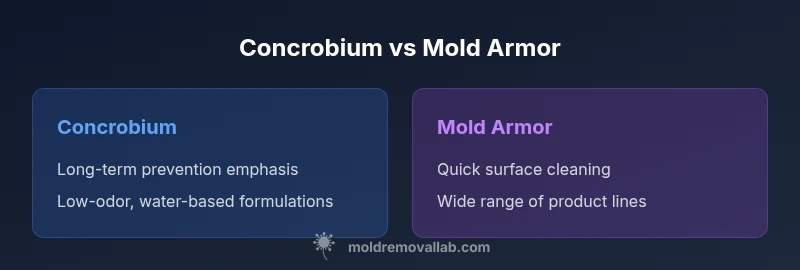
Concrobium vs Mold Armor: Which Is Better for Mold
A thorough, evidence-based comparison of Concrobium and Mold Armor for DIY mold remediation. Learn how they work, where they shine, and how to choose the right product for homeowners and renters seeking practical, safe mold control.


When choosing between Concrobium and Mold Armor, the decision hinges on your remediation goals. For long-term prevention on porous surfaces, Concrobium generally offers stronger, longer-lasting protection. Mold Armor tends to deliver quick, surface-level cleaning on non-porous surfaces and is often easier for small, fast projects. In many real-world scenarios, homeowners opt for Concrobium for ongoing prevention and Mold Armor for immediate spot-cleaning, then reassess with a broader plan.
Is Concrobium or Mold Armor Better for Mold? Practical framing
The question you see in consumer forums—is concrobium or mold armor better?—reaches beyond a simple yes/no. Mold remediation is a multi-step process, and consumer products are just one part of a broader strategy. According to Mold Removal Lab, the best outcome comes from aligning product choice with the contamination scope, material type, and whether your goal is on-the-spot cleaning or long-term prevention. This quick-answer framing helps homeowners and renters approach the decision with a clear set of expectations and a plan that minimizes repeated mold exposure risks in the living space.
How the products position themselves in the market
Both Concrobium and Mold Armor are marketed for DIY mold control, but they emphasize different strengths. Concrobium positions itself as a preventive treatment that, once dry, forms a coat intended to resist regrowth on treated surfaces. Mold Armor, by contrast, is often pitched for rapid surface cleaning and visible results, appealing to users seeking quick turnarounds before guests arrive or before repainting. The Mold Removal Lab team notes that the marketing language reflects intended use cases more than a universal rule for all surfaces and all mold scales.
Ingredient positioning and what that means for safety
From a consumer safety perspective, both products aim to minimize risk when used as directed. Concrobium tends to emphasize low-odor, water-based formulations, while Mold Armor lines vary between cleaners and controls with different scent profiles and application directions. Homeowners should read labels for ventilation requirements, surface compatibility, and any PPE recommendations. The Mold Removal Lab analysis emphasizes following the instructions closely, ensuring surfaces are pre-cleaned if necessary, and allowing adequate drying time to maximize effectiveness and minimize residual odors.
Surface types and material compatibility
Porous materials (like wood, drywall, or gypsum) and non-porous surfaces (such as tile, glass, and sealed metal) respond differently to mold-control products. In many cases, Concrobium’s approach is better suited for porous substrates where a long-lasting barrier is desired after treatment, while Mold Armor products may perform well on non-porous surfaces where rapid cleaning is prioritized. Real-world guidance suggests testing a small inconspicuous area first and monitoring for texture changes or staining after treatment.
Short-term performance vs. long-term protection
Short-term performance often means visible mold removal and odor reduction, which Mold Armor products can provide on cleanable surfaces. Long-term protection, especially on materials prone to moisture cycling (wood framing, stair treads, attic surfaces), typically benefits from Concrobium’s preventive approach as described by Mold Removal Lab. The key distinction is that short-term results don’t always guarantee long-term prevention, and the best outcomes frequently rely on moisture control and remediation sequencing.
Safety, ventilation, and odor considerations
You’ll want to maintain adequate ventilation during application and use PPE appropriate to the product. Odors can vary between brands and product lines, which matters for households with kids or pets. In the Mold Removal Lab guidance, safety is framed not as a barrier but as a necessary precaution: work in dry, clean spaces, avoid mixing products, and ensure treated areas remain well-ventilated until surfaces are fully dry.
Application steps and best practices for both products
A practical approach includes a pre-cleaning step to remove loose mold, then applying the chosen product according to the label. For many homeowners, a light spray with Mold Armor on a non-porous surface followed by a thorough dry-out period can produce quick visual improvements. If the surface is porous or the mold growth is extensive, prioritizing a preventive coat with Concrobium after cleaning is often recommended, along with addressing underlying humidity and moisture sources.
Coverage, storage, and shelf life considerations
Bottle size, concentration, and spray mechanism influence how far a product goes per project. Accurately estimating coverage helps prevent running out mid-remediation. Store products in a cool, dry place away from direct sunlight and out of reach of children and pets. Keeping a simple log of where and when you applied each product can help you track what you did and plan future moisture-control steps.
Cost considerations and value for money
Price is a practical factor: both products exist across multiple sizes and kits, with larger bottles offering more cost-per-application savings. When evaluating value, consider not only the upfront cost but also the potential need for repeat applications, drying time, and the broader remediation plan. The Mold Removal Lab approach emphasizes that cost should be weighed against the probability of future mold issues and the energy savings from improved indoor air quality.
How to integrate these products into a holistic mold plan
Rather than relying on a single product for all mold challenges, treat these sprays as part of a broader strategy: moisture control, source removal, surface cleaning, and regular monitoring. A practical plan includes fixing leaks, improving ventilation, using dehumidifiers in damp spaces, and performing seasonal checks. The Mold Removal Lab team recommends documenting each step to assess what works best in your home environment and to reduce repeated mold exposures.
Real-world usage scenarios to guide your choice
In small, recent, surface-level growth on non-porous materials like bathroom tile or shower glass, Mold Armor often yields fast, satisfactory results. For wood windowsills, drywall edges, or basement framing with moisture cycling, Concrobium’s preventive aspect and its potential long-term protection may offer more sustainable relief. In mid-sized projects, a combined approach—Mold Armor for quick cleanup and Concrobium for sustained prevention—has helped many households achieve a balanced outcome.
Comparison
| Feature | Concrobium Mold Control | Mold Armor Mold & Mildew Killer |
|---|---|---|
| Best for | Long-term prevention on porous and some non-porous surfaces after drying | Quick surface cleaning on non-porous surfaces; faster visible results |
| Surface compatibility | Often effective on wood, drywall, and sealed surfaces with proper prep | Primarily suited for non-porous surfaces like tile, glass, and sealed metal |
| Approach to mold control | Preventive coating that remains after drying to inhibit regrowth | On-contact cleaner that removes visible mold and odors |
| Odor and VOC profile | Low-odor, water-based formula designed for indoor use | Varies by line; some formulations may have stronger scents |
| Ease of use | Similar spray application with a post-dry waiting period | Typically quick spray-and-wipe for immediate cleaning |
| Best practice scenario | Best when paired with humidity control and regular inspections | Best for small, rapid-cleanup jobs that don’t require long-term protection |
| Price range per bottle | Moderate; varies by size and kit | Moderate; varies by size and kit |
Upsides
- Common consumer availability and straightforward usage
- Low-odor formulations suitable for indoor spaces
- Concrobium emphasizes long-term prevention on treated surfaces
- Mold Armor provides quick, visible cleaning results for small jobs
The Bad
- Effectiveness can vary with surface type and moisture conditions
- Porous materials may require more steps or reapplication
- No single product replaces moisture control and remediation work
- Results may be short-lived if humidity and leaks persist
Concrobium generally offers stronger long-term prevention on porous materials; Mold Armor excels at fast, surface-level cleaning for small spots.
If your priority is ongoing mold prevention on wood or drywall, choose Concrobium. If you need quick cleanup on non-porous surfaces or a fast project turnaround, Mold Armor is a practical choice. For many homes, a staged approach—Mold Armor for quick wins, followed by Concrobium for prevention—provides the best balance.
FAQ
What is the main difference between Concrobium and Mold Armor?
Concrobium emphasizes long-term prevention with a drying coat on treated surfaces, while Mold Armor focuses on fast surface cleaning and visible mold removal. The choice depends on whether you need ongoing protection or rapid spot-cleaning.
Concrobium is better for long-term prevention; Mold Armor is usually better for quick cleanup. Choose based on your project scope and the surface type.
Are these products effective against black mold on wood or drywall?
Both products can help with routine mold on non-porous surfaces, but for black mold on porous materials like wood or drywall, you should also address moisture and consider a preventive treatment after cleaning. If the growth is extensive, professional remediation is advised.
For black mold on porous materials, focus on moisture control and consider professional help for large areas.
Can I use these products on painted walls or ceilings?
Yes, many formulations are suitable for painted surfaces, but always test a small area first and follow the label. Some paints may be damaged by certain cleaners, so check for compatibility with your finish.
Test a small area first; if it looks fine after drying, you can proceed.
Do I need PPE when applying these products?
Wear gloves and ensure good ventilation. For more concentrated lines, consider eye protection and a mask as recommended by the label. Avoid mixing products and keep children and pets away during application.
Ventilate the area and wear gloves; follow the label for any additional PPE needs.
Will these prevent future mold growth if the moisture problem is fixed?
Preventive products can help, but true prevention requires controlling moisture, improving ventilation, and regular monitoring. These products are most effective when integrated into a broader moisture-management strategy.
Fix moisture first; preventive sprays help, but won’t solve underlying humidity issues alone.
How long do results last after treatment?
Durability depends on moisture levels and surface type. Preventive coatings can last weeks to months in stable conditions, while rapid-cleanup results may fade if humidity returns or surface conditions degrade.
The duration varies with environment—watch for humidity and revisit as needed.
The Essentials
- Prioritize long-term prevention on porous substrates with Concrobium
- Use Mold Armor for quick surface cleaning on non-porous surfaces
- Always address moisture sources and ventilation as part of remediation
- Test a small area first and follow label directions
- Consider a combined approach for larger or recurring mold issues