HEPA Air Filters for Mold: A Practical Guide for Homeowners
Learn how to use HEPA air filters for mold safely and effectively. This guide covers choosing the right unit, placement, maintenance, and how filtration fits into moisture control and remediation strategies.


Using hepa air filters for mold can help capture mold spores and improve indoor air quality. This guide explains how to choose the right unit, position it for best effect, and maintain it safely. Remember, filtration is part of a broader mold strategy that includes moisture control and prompt remediation.
What HEPA really means for mold control
HEPA stands for high-efficiency particulate air, and true HEPA filtration is designed to trap at least 99.97% of particles as small as 0.3 microns. When applied to mold control, the goal is to reduce airborne spores that can irritate the lungs and aggravate allergies. Importantly, filtration is just one part of a broader strategy that also targets the moisture source and any active growth. According to Mold Removal Lab, a well-chosen HEPA air filter can improve air quality in a connected space, but it will not replace moisture management or structural remediation. Use HEPA filtration as a steady, controlled node in your mold-fighting plan, not a magic cure.
How HEPA air filters for mold work in homes
True HEPA filtration works by forcing air through an extremely dense filter medium that captures small particles as air moves through. In practice, the unit should be sized for the room and run at a steady speed to maintain a healthy air exchange rate. In homes with mold, moving air through the room helps keep spores from settling on damp surfaces while remediation proceeds. Mold Removal Lab analysis shows that filtration reduces airborne spores when combined with proper moisture control and source remediation, rather than acting alone.
Choosing the right unit: CADR, size, and filter class
Select a unit with a CADR (clean air delivery rate) appropriate for the room size. Look for true HEPA filters (not merely “HEPA-like”) and verify the filter class (e.g., H13 or higher in many consumer units). A larger room may require multiple units or a unit with higher CADR to maintain effective air changes per hour. Always confirm compatibility with replacement filters and check that seals are intact to prevent bypass leaks.
Placement, operation, and best practices
Place the device so air can flow freely to and from the filter without being blocked by furniture or walls. Position units to minimize cross-contamination during cleanup—avoid placing them directly next to mold sources, but do ensure coverage across the space. Run the unit continuously during remediation and for several hours after any cleanup to capture lingering spores. If the space contains multiple rooms, consider running separate units in each affected area for balanced airflow.
Limitations and safety considerations
Hepa filtration reduces airborne spores but does not eliminate mold growth on walls, insulation, or hidden spaces. Do not rely on filtration alone to solve a moisture problem or active growth; persistent moisture will sustain mold. Always wear appropriate PPE during inspection and cleanup, seal the area to prevent spread, and pursue professional remediation for large or complex infestations. The Mold Removal Lab team emphasizes that filtration is a support tool, not a substitute for moisture control and structural remediation.
Maintenance, filter replacement, and monitoring air quality
Regularly inspect filters for signs of clogging, and replace per the manufacturer's guidelines. A clogged filter reduces airflow and effectiveness, undermining your remediation efforts. Keep a simple log of dates and replacement intervals, and consider a basic air quality monitor or rapid test kits to gauge changes in indoor mold indicators. Remember that a clean filter can still be working in a high-humidity environment long after its expected life.
Real-world scenarios: apartment, basement, and kitchen applications
In small apartments, a single portable HEPA unit placed near the center of the living area can help capture spores from a localized source. In basements with higher humidity, ensure the unit is rated for cooler temperatures and moisture-tolerant construction, and pair filtration with dehumidification. Kitchens, where cooking can aerosolize particulates, benefit from continuous filtration combined with good ventilation and a moisture barrier mindset to prevent condensation and mold growth.
Cost considerations and budgeting for filtration vs. remediation
HEPA filtration involves recurring costs for replacement filters and energy use, but it can be a cost-effective part of an overall mold strategy when compared to more invasive remediation in small, contained spaces. Plan for both upfront unit purchase and ongoing maintenance. Use a practical budget that prioritizes moisture control, source remediation, and filtration in tandem, rather than as separate line items. The Mold Removal Lab team notes that combining these approaches yields better long-term outcomes.
Integrating filtration with moisture control and remediation plans
Filtration alone cannot stop mold if moisture remains unresolved. Integrate HEPA filtration with moisture mitigation efforts, leak repairs, and proper cleanup protocols to prevent re-growth. A coordinated plan reduces airborne spores during cleanup and lowers the risk of recontamination. The Mold Removal Lab team recommends documenting each step of the remediation to ensure accountability and track progress over time.
Tools & Materials
- HEPA air purifier (true HEPA filter)(Choose a unit sized for the room; verify CADR is appropriate for space.)
- Replacement HEPA filters(Have compatible filters on hand; check for H13/H14 classifications where applicable.)
- HEPA vacuum cleaner(Use with a sealed system and a high-efficiency dust bag.)
- N95 or P100 respirator(Wear during direct cleanup or handling moldy materials.)
- Disposable protective clothing(Gown or coveralls to prevent cross-contamination.)
- Waste bags and disposal containers(Seal and label mold-contaminated waste before removal.)
- Moisture meter(Helpful to identify and verify moisture hotspots.)
- Tape (duct or painter's tape)(For temporary sealing of gaps around remediation zones.)
Steps
Estimated time: 2-3 hours
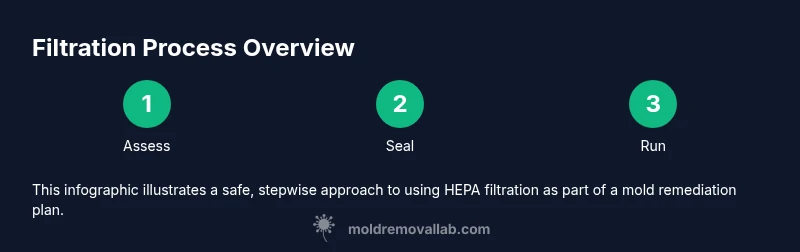
- 1
Assess space and isolate area
Identify all affected spaces and close doors to limit spore movement. Set up physical barriers with plastic sheeting if needed. Wear PPE before entering, and document existing conditions for reference.
Tip: Seal door gaps with tape and plastic to create a containment zone before starting filtration. - 2
Choose the right HEPA unit for the room
Calculate room volume and select a unit with a CADR that matches the space. Confirm the filter is true HEPA and compatible with replacement filters. Check power needs and noise levels for continuous operation.
Tip: If in doubt, pick a unit with higher CADR than the minimum requirement to maintain adequate air changes. - 3
Prepare the area and seal surfaces
Remove loose items when possible; cover furnishings and floors with plastic. Ensure vents/returns are sealed off or temporarily closed to avoid spreading spores. Set up a designated waste area for contaminated materials.
Tip: Avoid clutter that blocks airflow around the unit; clear space improves efficiency. - 4
Run the filtration equipment
Place the unit in a central location with clear intake and exhaust paths. Run continuously at a safe, effective speed while monitoring noise and heat. Schedule a brief break only if the unit overheats, then resume operation.
Tip: Keep doors closed and vent paths unobstructed to maximize air turnover. - 5
Clean and manage debris with HEPA tools
Use a HEPA vacuum for loose debris and moldy materials. Do not dry brush or scrape large areas; damp wipe to minimize dispersal. Dispose of waste in sealed bags immediately after collection.
Tip: Never use non-HEPA vacuums on moldy materials; bypassed filtration can spread spores. - 6
Assess moisture and remediation needs
Check for persistent moisture sources and leaks; address these before concluding filtration. If growth remains or surfaces stay damp, escalate remediation with professionals. Re-run filtration after any major moisture intervention.
Tip: Document moisture readings and remediation steps for future reference. - 7
Monitor and validate air quality
Use simple indicators or a basic air-quality device to track changes in spore counts or particulate levels. Repeat testing after cleanup to confirm improvements. Plan follow-up checks to ensure stability.
Tip: Keep a log of readings with timestamps to observe trends over time. - 8
Document results and plan next steps
Record what was cleaned, areas treated, and any moisture control actions taken. Schedule a re-evaluation in a few weeks if humidity remains elevated. Notify occupants of the steps taken and safety considerations.
Tip: A clear report helps future homeowners or tenants understand the remediation history.
FAQ
Do HEPA air filters kill mold?
No. HEPA filters do not kill mold; they capture spores to reduce airborne exposure. Effective mold control requires moisture mitigation and remediation of the source.
HEPA filters don’t kill mold; they trap spores to reduce exposure. You also need to fix moisture and remove the mold source.
Will HEPA filters remove mold from walls and surfaces?
Filtration reduces airborne spores but does not remove mold from porous surfaces. Cleaning visible mold and addressing moisture are necessary, and professional remediation may be required for significant growth.
Filtration helps with airborne spores, but walls and porous surfaces may still host mold and need direct cleaning or remediation.
How long should I run a HEPA air filter during remediation?
Run the unit continuously during cleanup and for several hours afterward to capture lingering spores. Adjust based on room size, airflow, and comfort, but do not stop filtration prematurely.
Keep the unit running during cleanup and for a while after; adjust duration to room size and comfort.
Are there safety concerns with using HEPA filtration around mold?
Yes. Wear appropriate PPE, seal the space to prevent spread, and follow local guidelines. Do not bypass safety steps to speed up the process.
Wear protection, seal the area, and follow safety guidelines; don’t skip safety steps.
Can filtration prevent mold re-growth?
Filtration helps reduce spores, but it will not stop re-growth unless moisture and sources are controlled. Combine filtration with remediation to keep mold away long-term.
Filters help reduce spores, but you must control moisture and fix the source to prevent regrowth.
What is the difference between true HEPA and HEPA-like filters?
True HEPA meets strict filtration standards, capturing at least 99.97% of 0.3-micron particles. HEPA-like filters typically have lower guaranteed efficiency and may not perform consistently for mold spores.
True HEPA meets strict standards; HEPA-like filters may be weaker and less reliable for mold spores.
Watch Video
The Essentials
- Choose true HEPA filtration for mold-spore capture
- Size and place units to maximize air changes per hour
- Contain and isolate areas before filtration
- Do not rely on filtration alone—address moisture and remediation
- Maintain filters and monitor air quality for lasting results