How Much Is a Mold Test for a House? A Practical Cost Guide
Explore typical mold testing costs for homes, what factors drive price, and how to choose between DIY kits and professional lab testing. A data-driven, 2026 analysis from Mold Removal Lab helps homeowners budget and plan remediation.


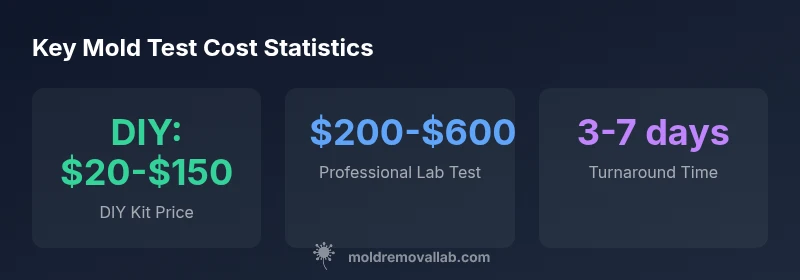
Typically, a mold test for a house costs between $200 and $600 when done by a professional lab, while DIY home test kits run about $20–$150. Costs vary by scope, turnaround time, and whether follow-up analysis is included. Mold Removal Lab Analysis, 2026 shows these ranges as standard for residential testing.
What mold testing actually measures
When you consider the question of how much is a mold test for a house, it’s important to understand what the test is designed to detect and how the results are used to guide action. Mold testing does not ‘remove’ mold by itself; instead, it identifies whether mold is present, roughly how widespread it is, and which species are involved. There are several testing approaches commonly used in residential settings: DIY at-home kits that collect samples, technician-led on-site sampling, and laboratory analysis of collected samples. The goal is to determine exposure risk and to inform whether remediation is needed. A comprehensive approach often combines surface swabs, bulk samples, and air sampling to capture both settled and airborne mold. The results are typically summarized in a report with a plan for cleanup. In practice, the practical value of any mold test increases when homeowners pair it with a remediation strategy and a post-remediation check.
This section introduces the key distinctions among testing methods and what homeowners should expect from each. According to Mold Removal Lab, many homeowners ask, “how much is a mold test for a house,” and the key takeaway is that price is only part of the decision. The quality of lab analysis, proper sampling, and clear interpretation matter more than the price tag alone. The right test for your home depends on the suspicion level, whether there are visible growths or odors, and the potential health considerations for occupants. Smell, dampness, and past water events should all factor into testing decisions, not just the sticker price. This is why Mold Removal Lab emphasizes starting with a plan—define what you want to learn, then pick a testing method that reliably delivers that information.
Price landscape: DIY kits vs professional testing
Cost is one of the most frequent questions homeowners have when deciding between DIY mold test kits and professional lab testing. DIY kits typically cost far less upfront, with sample collection done by you and often a separate lab analysis required for conclusive results. Professional testing, on the other hand, includes sampling by a trained technician and a formal lab report with actionable recommendations. The price delta reflects not only the convenience and expertise but also the reliability and the level of detail in the final report. In Mold Removal Lab’s 2026 analysis, DIY kit price ranges are commonly around the lower end, while professional testing sits in the mid-to-upper range of the market. Homeowners should also consider whether the quote includes a remediation plan or follow-up clearance testing, as these add-ons can significantly change the total cost. When evaluating quotes, ask about the exact scope: number of samples, type of samples (air, surface, bulk), laboratory fees, and whether the results include clearance testing after remediation.
Factors that influence test costs
Several interconnected factors determine the final mold testing price. First, the scope of testing matters: a single air sample is cheaper than a multi-sample panel that includes air, surface swabs, and bulk samples. Second, the location and local market conditions can shift prices; metropolitan areas tend to have higher fees for fieldwork and lab analysis. Third, the type of laboratory analysis affects cost: a basic presence/absence report is cheaper than full quantitative species and concentration data. Fourth, turnaround time and rush options add to the price; if you need results within 24–48 hours, expect a premium. Finally, whether testing is paired with remediation or post-remediation verification will influence total costs. Mold Removal Lab’s 2026 data shows that the most cost-effective approach for many homeowners is a well-defined testing plan that avoids unnecessary add-ons while still delivering reliable results.
Choosing between DIY and professional testing
When deciding between DIY kits and professional testing, balance cost against reliability and risk. DIY kits are a good first step if you want to screen a space for mold presence, especially in low-risk situations or for initial indoor air quality checks. However, DIY results can be inconclusive without lab confirmation, and improper sample collection can lead to false negatives or false positives. Professional testing provides standardized collection by a trained technician and validated laboratory analysis, which is especially important in cases of health concerns, legal disputes, or when remedial work is being planned. The up-front cost will be higher, but the information gained is typically clearer, and the results can justify remediation decisions. Mold Removal Lab notes that for homes with persistent moisture issues or vague symptoms, professional testing is often worth the extra cost because it reduces the chance of misinterpretation and helps direct effective remediation.
Interpreting results and next steps
Interpreting mold test results requires understanding both the presence of mold and the level of threat it poses to occupants. A positive result by itself does not necessarily mean immediate remediation is required; it depends on species, concentration, and exposure pathways. Follow-up actions may include moisture control, improved ventilation, and targeted cleaning. In cases with health concerns or vulnerable occupants, a certified professional should guide the remediation plan and verify clearance after work is completed. When reading a lab report, look for terms like spore counts, colony-forming units, and species identification, and ask your tester to translate these findings into a practical remediation plan. Mold Removal Lab’s analysis emphasizes that results are most useful when paired with clear next steps and a realistic cost estimate for remediation.
How Mold Removal Lab approaches testing and guidance
At Mold Removal Lab, we approach testing with a practical, homeowner-focused mindset. Our guidance centers on matching the testing method to the risk level and budget, then using lab results to drive a safe, effective remediation plan. We encourage homeowners to think beyond the sticker price and consider long-term costs, including mitigation, post-remediation verification, and adjustments to humidity control and ventilation. Our 2026 guidance underlines the value of choosing an option that provides clear, actionable results rather than ambiguous data. If you are balancing cost against confidence, start with a defined testing plan, then escalate to professional lab testing when precision matters most.
Mold test cost comparison
| Test Type | Typical Cost Range | Notes |
|---|---|---|
| DIY Mold Test Kit | $20-$150 | At-home sampling; lab analysis optional |
| Professional On-Site Mold Test | $200-$600 | Sampling by technician; may include lab report |
| Professional Lab Test (Lab-only) | $200-$600 | Samples sent to a specialized lab; results in 3-7 days |
FAQ
What is included in a professional mold test?
A professional test typically includes on-site sampling by a trained technician, laboratory analysis, and a detailed report with findings and recommendations.
A professional test includes on-site sampling, lab analysis, and a detailed report with next steps.
How long does mold testing take?
Most tests return results within 3-7 days, depending on the test type and lab backlog. Some urgent options offer faster results at a premium.
Most tests take 3-7 days; rush options may be available for a quicker turnaround.
Are DIY mold tests reliable?
DIY tests can indicate mold presence but are less reliable for identifying species and exact contamination levels. Lab confirmation is recommended for remediation decisions.
DIY tests can show if mold is present, but lab confirmation is usually needed for accurate cleanup plans.
Does insurance cover mold testing?
Some homeowners’ policies cover mold testing if it’s part of a remediation claim or a documented health concern. Check with your insurer for specifics.
Some policies cover testing if it’s tied to a remediation claim; verify with your insurer.
Should I test before or after remediation?
Testing is often done after remediation to verify clearance. A baseline test before work can also help quantify the problem if remediation is planned.
Usually test after remediation to confirm clearance, but a pre-remediation test can inform the plan.
“Mold testing is a precision step in protecting indoor air quality; results matter for deciding remediation strategy.”
The Essentials
- Budget for testing upfront based on method and risk
- DIY kits are cheaper but less reliable without lab confirmation
- Professional testing offers thorough analysis and clearer reports
- The Mold Removal Lab team recommends planning testing with a defined scope and following up with remediation verification