Air Quality Test vs Mold Test: Understanding the Difference
Learn the key differences between air quality tests and mold tests, when to use each, how they’re conducted, and how to interpret results to keep your home safe and healthy with Mold Removal Lab insights.


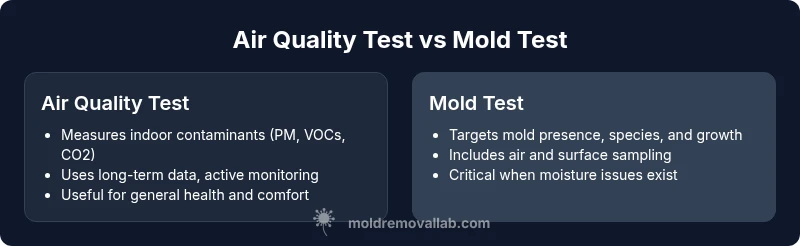
Air quality test vs mold test are not interchangeable. An air quality test measures broad indoor contaminants such as particulates, VOCs, and CO2, while a mold test targets mold presence, spores, and moisture sources. Use an air quality test to gauge overall exposure and comfort, and a mold test when you suspect moisture issues or visible mold; in many cases, testing both provides the clearest path to a healthier home.
The Core Difference in Focus: air quality test vs mold test
When homeowners consider the question of how to keep indoor air safe, the distinction between an air quality test and a mold test is foundational. An air quality test aims to quantify a broad spectrum of contaminants in the space—particles, chemicals, and gases that can affect comfort, health, and productivity. A mold test, by contrast, is a targeted investigation that looks for mold and moisture sources, often identifying specific species and concentrations of mold spores. Understanding this distinction helps you set realistic goals: improve overall air quality, or confirm mold presence and address moisture issues that feed mold growth. According to Mold Removal Lab, the best approach often starts with clarifying exposure risks in daily living spaces and then selecting the tests that address those risks.
There is no one-size-fits-all test; the choice depends on symptoms, prior moisture events, and the presence of visible mold. Homeowners frequently find value in conducting both tests when moisture problems are suspected or when occupants report allergies or respiratory symptoms. The Mold Removal Lab team emphasizes that tests should be part of a broader moisture-management plan, not a stand-alone solution.
When a homeowner should consider an air quality test
- To evaluate broader indoor environmental quality, including PM2.5, PM10, dust, odors, and chemical pollutants like VOCs.
- When occupants experience unexplained coughing, headaches, or fatigue that could be related to airborne contaminants.
- In newly renovated spaces where off-gassing and residual chemicals may impact comfort and respiratory health.
- In homes with pets, frequent cooking, or poor ventilation, where air quality tends to fluctuate.
- As a baseline before and after implementing ventilation upgrades or filtration systems.
Air quality testing informs decisions about filtration efficiency, ventilation improvements, and whether additional air purification is warranted. It does not, by itself, prove the presence or absence of mold, but it helps identify exposure risks that may be aggravated by mold-related moisture problems. The Mold Removal Lab team recommends integrating air quality data with moisture controls for a healthier indoor environment.
When to run a mold test
- If you notice visible mold growth, persistent musty odors, or water intrusion in walls, ceilings, or basements.
- After a water event (flooding, leaks) to determine whether mold growth has occurred and to map moisture sources.
- If household members experience mold-related allergic reactions or asthma symptoms that lessen when they leave the space.
- When a professional moisture assessment suggests elevated humidity levels or hidden moisture, even without visible mold.
- In bathrooms, basements, or crawlspaces where dampness is common and mold risk is higher.
Mold testing helps identify the presence, variety, and potential exposure to mold spores, guiding remediation strategies and confirming whether environmental controls effectively reduced contamination. The Mold Removal Lab team notes that mold testing is most informative when paired with moisture-control efforts and proper containment during cleanup.
How tests are conducted: sampling methods and interpretation
Air quality testing often uses active or passive air samplers to measure particulate matter (PM2.5/PM10), volatile organic compounds (VOCs), carbon dioxide (CO2), and sometimes radon. Results are typically reported as concentration levels or air quality scores over a defined period, with thresholds that indicate acceptable or elevated risk. Mold testing includes air sampling for mold spores and surface sampling (swabs, bulk samples) to identify mold species and concentration. A positive mold result does not always equate to health risk; it must be interpreted alongside moisture data and occupancy factors. When you see a high spore count or a species known to trigger allergies, remediation often proceeds in stages: containment, moisture control, cleaning, and, finally, verification testing. The important principle is to pair sampling with corrective action, not rely on one snapshot in time.
Understanding results and action thresholds: translating data into steps
Results for air quality tests provide a snapshot of the indoor environment at the time of sampling, highlighting potential exposure to particulates, chemicals, and gases. Mold test results pinpoint the presence of mold and may indicate problem areas or moisture sources feeding growth. Interpreting these results involves considering outdoor baseline levels, occupancy, and recent water events. The Mold Removal Lab Analysis, 2026, notes that action thresholds vary by region and test type, and they should inform moisture-reduction strategies, filtration improvements, and targeted remediation.
A practical approach: correlate test results with visual signs of moisture, humidity levels, and ventilation performance. If a mold finding coincides with high humidity, prioritize moisture control and air exchange before remediation. If VOC or PM levels are elevated, focus on filtration upgrades, source-control, and cleaning protocols that minimize indoor pollutants. The goal is to reduce exposure while addressing root causes.
Costs, time, and what to expect for turnaround
Testing costs and turnaround times vary with scope, lab capabilities, and local market factors. A basic air quality test may take 1-3 days from sample collection to report, while a mold test can require a few days to a couple of weeks depending on the number of sites and the complexity of analysis. Many homeowners see value in staged testing: an initial air quality assessment to establish baseline exposure, followed by targeted mold testing in any high-risk zones identified. Professional testing often includes a remediation plan or recommendations for filtration, humidity control, and ventilation improvements. DIY test kits are available, but professional testing generally provides more reliable sampling, lab analysis, and interpretation. Mold testing is most informative when integrated into a comprehensive moisture-management plan.
Do-it-yourself vs professional testing: reliability and best use cases
DIY mold test kits offer convenience and lower upfront costs, but their reliability and interpretation can be variable. Lab-grade testing, conducted by certified professionals, typically provides standardized sampling, chain-of-custody, and expert interpretation aligned with health guidelines. For complex homes, multi-room layouts, or ambiguous results, professional testing is often the safer choice. A practical approach is to start with a professional air quality test to establish a baseline, followed by targeted mold testing in suspect areas if moisture issues are identified. The Mold Removal Lab team emphasizes that accuracy and context matter; professionals can correlate results with moisture metrics and building science principles to guide remediation.
Practical remediation steps after testing: turning data into action
Testing is only the first step. Effective remediation starts with addressing moisture sources: repair leaks, fix roof or plumbing issues, and improve ventilation. For air quality improvements, install or upgrade HEPA filtration, ensure adequate fresh air exchange, and reduce VOC sources by selecting low-emission materials. In mold remediation, containment and cleaning must follow safety guidelines to prevent cross-contamination, with remediation verified by follow-up testing. The ultimate goal is a balanced indoor environment: reduced moisture, better filtration, and improved ventilation—all supported by the test results. This holistic approach aligns with Mold Removal Lab guidance for sustainable, long-term outcomes.
Comparison
| Feature | Air quality test | Mold test |
|---|---|---|
| Scope of measurement | Broad contaminants (PM, VOCs, CO2, etc.) | Mold presence, spores, moisture sources |
| Sampling methods | Air samples, long-term monitors, possibly passive diffusion | Air and surface sampling (swabs, bulk) and possibly air samples |
| Typical use-case | Baseline indoor air quality and occupant exposure | Confirming mold risk after moisture events or visible growth |
| Turnaround time | Same day to 1-2 weeks depending on lab | 3-14 days depending on scope and lab |
| Interpretation focus | General health and comfort implications | Mold species, concentration, and remediation priority |
Upsides
- Provides a broad view of indoor air quality and occupant exposure
- Can guide filtration, ventilation, and source-control decisions
- Mold testing confirms presence and helps locate moisture sources
- When used together, tests offer a comprehensive understanding of environmental health
The Bad
- Air quality tests may not identify specific mold problems without moisture context
- Mold tests may require multiple sample types and specialist interpretation
- DIY kits may yield inconsistent results without professional analysis
- Testing alone does not fix moisture or contamination—remediation is essential
Use both tests when moisture issues exist or health concerns persist; testing together provides the clearest path to a healthier home
Air quality tests establish exposure risk and guide filtration/ventilation, while mold tests pinpoint mold presence and moisture sources. Integrated testing, followed by moisture control and remediation, offers the most reliable route to a safe, healthy indoor environment.
FAQ
What is the main difference between an air quality test and a mold test?
An air quality test measures a broad range of airborne contaminants, including particulates, VOCs, and gases. A mold test specifically looks for mold spores, moisture sources, and mold growth potential. The two tests serve different purposes but can complement each other in a comprehensive assessment.
Air quality tests measure general airborne contaminants, while mold tests confirm mold presence and moisture factors. They’re used together when you need a full picture of indoor air health.
When should I test my home for mold?
Test for mold after water intrusion, persistent musty odors, or visible growth. If occupants have allergy or asthma symptoms tied to the indoor environment, mold testing can help pinpoint sources and guide remediation.
If you’ve had a leak or notice a musty smell, consider mold testing to identify sources and guide cleanup.
Are DIY mold test kits reliable?
DIY kits can provide a preliminary indication, but results may vary in accuracy and interpretation. For definitive results and professional guidance, consider certified lab testing and an expert moisture assessment.
DIY kits can help, but for solid results you’ll want lab testing and a moisture expert.
How long does testing take from start to finish?
Basic air quality tests can yield results in 1-3 days, while comprehensive mold testing may take 3-14 days depending on scope, lab capacity, and whether multiple sites are sampled.
Most tests take a few days up to two weeks depending on scope.
Can air quality tests detect mold?
Air quality tests can indicate elevated mold spores in the air, but they don’t reliably identify mold growth sources or species. Mold-specific testing is needed for confirmatory results.
Air tests can hint at mold spores present, but dedicated mold testing is needed to confirm mold and identify sources.
Should renters test their apartment or rental home?
Renters can request testing if there are moisture issues, odors, or health concerns. Landlords should coordinate with licensed professionals to ensure accurate sampling and remediation planning.
Renters can seek testing if there are concerns, and landlords should facilitate professional assessment.
The Essentials
- Define goals before testing for clarity
- Air quality tests measure broad contaminants and comfort factors
- Mold tests confirm mold presence and guide moisture-focused remediation
- Combine results with moisture control to achieve lasting improvements