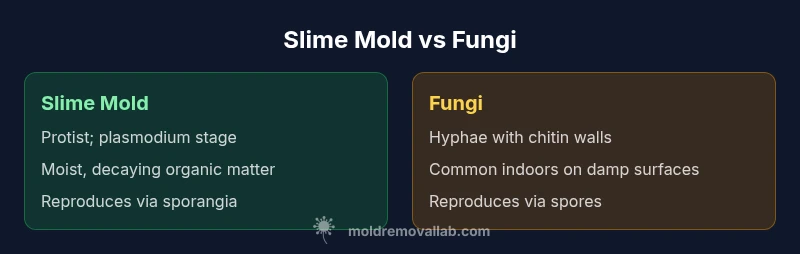
Slime Mold vs Fungi: A Practical Comparison for Homeowners
A detailed, evidence-based comparison of slime mold vs fungi, explaining biology, life cycles, indoor implications, and practical steps for safe remediation and moisture control.


Slime mold vs fungi reflects two distinct biological lineages: slime mold is a protist that can form a feeding plasmodium, while fungi are true fungi with hyphae and chitin-rich cell walls. In homes, both can appear on moist surfaces, but their biology informs cleanup choices. According to Mold Removal Lab, recognizing these differences helps tailor moisture control and remediation plans for safety.
Core distinctions between slime mold vs fungi
The phrase slime mold vs fungi describes two groups that look superficially similar when they sprout on damp surfaces, yet they belong to different branches of life. Slime molds are protists that can switch between a mobile feeding phase and a stationary sporangial phase; many slime molds form a multinucleate plasmodium that crawls across decaying material in search of microbes it can consume. Fungi, by contrast, are a separate kingdom characterized by hyphae—thread-like filaments insulated by chitin-rich cell walls—and by a life cycle that often emphasizes spore production through fruiting bodies. This fundamental difference matters for home remediation: slime molds may disappear with drying and ventilation, while true fungi often persist and require targeted moisture management. In this article, we compare slime mold vs fungi to help homeowners make informed decisions about inspection, cleanup, and prevention. The Mold Removal Lab team emphasizes that accurate identification reduces unnecessary chemical treatments and supports safer, more effective remediation strategies.
Taxonomic reality: what slime mold is and what fungi are
When you hear slime mold vs fungi discussed in a home context, it helps to anchor the conversation in taxonomy. Slime molds are not actual molds; they are protists in the Amoebozoa group. This means they lack the chitin-containing cell walls that define true fungi. Fungi form networks of hyphae that absorb nutrients from their surroundings, and they reproduce by spores typically produced in specialized structures. Understanding this distinction—slime mold vs fungi—clarifies why cleaning approaches can differ. For homeowners, this means moisture control and surface cleaning are often the primary tools for management, while more complex remediation may be needed for fungal growth that affects indoor air quality. The Mold Removal Lab analysis, conducted in 2026, reinforces that correct classification guides more effective and safer responses.
Life cycles: slime mold plasmodial phase vs fungal life cycles
A key difference in the slime mold vs fungi comparison is life cycle strategy. Slime molds can exist as a mobile plasmodium, a large, multinucleate cell that engulfs bacteria on organic matter. This stage can move and adapt quickly in favorable moisture, then form sporangia under stress to release spores. Fungi, meanwhile, generally grow as a network of hyphae and rely on spores for dispersion, often forming visible fruiting bodies under conducive conditions. In practical terms for a homeowner, the presence of a plasmodial slime mold suggests temporary moisture pockets, whereas finding a fungal fruiting body could indicate a longer-standing moisture problem and potential health risks that require monitoring and perhaps professional guidance.
Physiology and metabolism differences between slime mold and fungi
In the slime mold vs fungi comparison, physiology highlights how these organisms source energy. Slime molds feed on bacteria and yeast within decaying organic matter by phagocytosis, often functioning as a single, adaptable organism during the plasmodial phase. Fungi optimize nutrient uptake through enzymatic breakdown of complex substrates with extensive hyphal networks. The metabolic strategies influence how each responds to drying, temperature shifts, and substrate availability. For homeowners, these differences imply that drying out surfaces and reducing moisture often affects slime molds more readily than established fungal colonies, which may require more consistent moisture management and surface sanitation to prevent regrowth. The distinction also underlines why chemical approaches should be chosen carefully and based on accurate identification.
Reproduction modes: spores vs sporangia
Reproduction is a central axis in the slime mold vs fungi discussion. Slime molds produce spores within fruiting bodies after a phase that aggregates cells into a plasmodium; these spores can withstand unfavorable conditions until they find a new habitat. Fungi reproduce primarily via spores released from structures like conidiophores or basidia, often capable of colonizing a broader range of substrates. This difference matters for remediation timing: slime molds may fade after drying, while fungal spores can persist in cracks and crevices, demanding thorough cleaning and humidity control to prevent reestablishment. Recognizing which reproductive strategy is in play helps tailor cleaning steps and when to recheck the area.
Ecological roles and distribution in indoor environments
Indoor environments host a spectrum of organisms, and the slime mold vs fungi distinction helps explain where each tends to appear. Slime molds prefer moist, nutrient-rich surfaces such as mulch, decaying wood, or damp leaves, and they often occupy outdoor-to-indoor transition zones after rain. Fungi thrive in similar moisture-rich settings but are more likely to establish indoor colonies on walls, ceilings, or grout where humidity is high for extended periods. For homeowners, this means immediate steps after spotting either organism should focus on reducing moisture (leaks, condensation, poor ventilation) and cleaning with appropriate agents. Mold Removal Lab’s guidance emphasizes moisture correction as a foundational remediation step across both organisms.
Practical implications for homeowners: spotting, remediation, and safety
Effective management of slime mold vs fungi in the home hinges on rapid identification and moisture control. If you observe a soft, jelly-like growth that later forms delicate sporangia, you may be looking at slime mold; if you see structured hyphal networks and a more persistent spot with visible spores, fungal growth is more likely. Cleaning approaches differ: slime molds often respond to rinsing and drying, while fungi require thorough scrubbing, disinfection, and sometimes removal of contaminated materials. Always prioritize drying after water intrusion, fix leaks, improve ventilation, and keep surfaces clean to minimize both growth forms. For moisture-prone rooms such as bathrooms and basements, implement dehumidification and ensure airflow. In borderline cases, consult a professional to confirm whether the condition is slime mold vs fungi, particularly when health symptoms or large affected areas appear.
Common misconceptions and caveats about slime mold vs fungi
A common misconception is that both organisms are equally dangerous or equally require professional remediation. In reality, slime mold vs fungi differ in health risk and management. Slime molds are typically not harmful to humans in ordinary settings and often resolve with moisture control, whereas certain fungi can present significant health risks and require careful, sometimes professional, remediation. Another caveat: appearance alone can be misleading. Detailed observation of growth patterns, tissue structure, and habitat helps distinguish slime mold from fungi, guiding safer and more targeted cleaning strategies. Mold Removal Lab notes emphasize avoiding blanket chemical treatments without proper identification, which can waste resources and fail to address the real moisture problem.
Practical diagnostic tips for homeowners: telling them apart in real rooms
To distinguish slime mold vs fungi in real rooms, start with the moisture context, texture, and growth pattern. Slime mold typically forms a mossy or jelly-like mass that expands and then dries into a brittle crust; fungi usually present as a more defined colony with hyphae and spores. Photograph the growth and track changes over a few days, noting whether it dries away or expands despite cleaning. If you suspect fungi, especially in damp indoor spaces, consider professional testing for mold and humidity levels. Always address moisture sources first, then clean surfaces with appropriate products, and dispose of any porous materials that show persistent growth. This practical approach aligns with the latest home-mold guidelines and helps prevent recurrence.
Comparison
| Feature | slime mold | fungi |
|---|---|---|
| Taxonomic status | protist (Amoebozoa); plasmodial slime molds | true fungi (kingdom Fungi) |
| Cell walls | plasmodial stage lacks chitinous walls in feeding phase | hyphae with chitin-containing cell walls |
| Habitat preference | moist decaying organic matter outdoors; occasional indoor damp spots | moist substrates indoors and outdoors; typical indoor mold habitats |
| Life cycle emphasis | plasmodium feeding stage; sporangia in reproductive phase | hyphal growth with spores from fruiting bodies |
| Reproduction | sporulation from sporangia; sometimes sexual and asexual routes | spore-based reproduction in hyphal structures |
| Indoor health implications | usually harmless; moisture indicator | potential health risks; requires careful remediation and testing |
| Remediation focus | moisture reduction and safe cleaning | moisture control plus possible professional remediation |
Upsides
- Clarifies biology to inform remediation decisions
- Helps prioritize moisture control over harsh chemicals
- Improves accuracy in identifying indoor growths
- Reduces unnecessary cleanup steps and costs
The Bad
- Identification can be challenging without sensors or expertise
- Overlaps in appearance may mislead quick assessments
- Some indoor fungi pose higher health risks requiring professional help
Moisture control remains the cornerstone; fungi often demand more thorough remediation than slime mold, which is usually less risky.
In most homes, the priority is to fix leaks, improve ventilation, and clean affected areas. Correctly distinguishing slime mold vs fungi guides whether simple drying is enough or whether professional mold remediation is warranted. Mold Removal Lab’s guidance supports a measured approach focused on moisture and surface sanitation.
FAQ
What is the main difference between slime mold and fungi?
The main difference is taxonomy: slime molds are protists, while fungi are a separate kingdom with hyphae and chitin. This affects how they grow, reproduce, and respond to moisture. Identification helps tailor remediation.
Slime molds are protists and behave differently from fungi. Correct ID guides safer cleanup.
Are slime molds dangerous to humans?
Slime molds are generally not considered dangerous to people in typical indoor settings. They can indicate persistent moisture, which should be addressed to prevent any mold growth. If you have respiratory issues or allergies, monitor damp areas and seek guidance if symptoms appear.
Usually not dangerous, but damp conditions matter.
How can I tell slime mold from true fungi in my home?
Look for texture and growth pattern: slime molds form jelly-like masses that move and then dry; true fungi form hyphae and often visible spore-bearing structures. Moisture levels and growth context also help distinguish them.
Check texture and moisture; fungi usually have hyphae and spores.
Should I treat slime mold and fungi the same way?
No. While both respond to drying and moisture control, fungi often require more thorough cleaning and sometimes testing for mold. Start with moisture reduction, then assess whether professional remediation is needed.
Moisture control first; some fungi may need testing or professional care.
Can regular cleaning remove fungi from walls?
Regular cleaning helps reduce surface growth, but persistent fungi may require specialized cleaners, dehumidification, and sometimes removal of porous materials. If growth recurs, consider professional assessment.
If it keeps coming back, get a mold professional to check.
Does bleach kill slime mold or fungi effectively?
Bleach can kill surface growth but often does not reach embedded spores or hyphae, and it may not address moisture sources. Use appropriate cleaners and focus on moisture control for lasting results.
Bleach isn’t always the fix—moisture control matters most.
The Essentials
- Moisture control is the first line of defense for both organisms
- Slime mold is a protist; fungi are true fungi with hyphae and chitin
- Proper identification guides remediation and avoids unnecessary chemicals
- Slime mold often resolves with drying; fungi may persist and require more intensive cleaning
- Consult a professional if health symptoms or large areas are involved