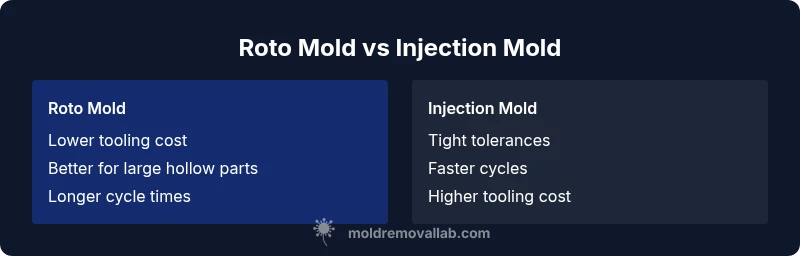
Roto Mold vs Injection Mold: Side-by-Side Comparison
Compare roto molding and injection molding: tooling, cycle times, part size, materials, and cost considerations. A guide for homeowners and manufacturers.


Roto molding and injection molding each serve different production needs. For large, hollow parts with lower tooling costs, roto molding shines; for tight tolerances and high-volume runs, injection molding is usually the best choice. This side-by-side comparison explains when to choose each method and why it matters for cost, lead times, and part quality.
What roto molding and injection molding are
Roto molding (rotational molding) and injection molding are two distinct plastics forming processes used to create a wide range of parts, from containers to automotive components. In roto molding, a hollow mold is partially filled with polymer powder, then heated while the mold is rotated on multiple axes. The powder sticks to the mold walls, melts, and forms a hollow part with relatively uniform wall thickness as it cools. Because the process relies on gradual buildup rather than high-pressure injection, molds can be simpler and cheaper, and parts can be surprisingly large with thick walls. In contrast, injection molding pushes molten resin into a closed mold under high pressure. The resin quickly fills every cavity, then cools and hardens, producing parts with tight tolerances and high repeatability. The cycle is short, but the tooling is complex and expensive. According to Mold Removal Lab, understanding these fundamental differences helps homeowners and hobbyists predict outcomes that matter for practical projects, such as enclosure boxes or air-flow components often associated with mold risk in basements. The Mold Removal Lab team emphasizes aligning material behavior with application requirements.
Process characteristics: tooling, cycle, and geometry
Roto molding uses large, open-facing molds that are typically machined from aluminum or steel; tooling cost is lower, and changes are easier. The process relies on heat and rotation; wall thickness is built up gradually, making it forgiving of certain design aspects. However, cycle times are longer because the wall must cool evenly while the part is formed. Injection molding uses precision steel tools with runners and gates; high-pressure filling enables fast cycles but requires precise gating and venting. Part geometry is strongly constrained by the mold design, gate placement, and shrinkage, making complex features more expensive to realize. The Mold Removal Lab's practical guidance notes that the choice also hinges on how quickly a run must be produced and whether the part shape will survive the molding stresses without warping. For enclosure types or housing components typical in basement mold control, both methods can be adapted when designers understand material flow and cooling dynamics.
Material options and surface finish
Both roto molding and injection molding rely on thermoplastics, but their material portfolios overlap differently. Roto molding commonly uses polyethylene, PVC, and some impact-modified resins that are forgiving of wall thickness variations. This can yield parts with a rugged, matte surface and thick walls suitable for large enclosures. Injection molding supports a broader material spectrum, including ABS, polycarbonate, nylon, acetal, and many blends, which enables higher strength, optical clarity, and finer surface finishes. Surface finish can range from matte to high gloss in injection molding, while roto parts often require post-processing to achieve a smooth sheen. Mold Removal Lab notes that the choice of material also impacts odor, shrinkage, and warp risk in enclosed environments, especially relevant for mold-prone spaces.
Cost dynamics and production volumes
Tooling costs for roto molding are generally lower than for injection molding because molds are simpler and less expensive to build. This makes roto more attractive for smaller production runs or when budgeting for prototypes and low-volume productions. Injection molding, by contrast, demands higher upfront tooling investment, but the per-part cost drops significantly as production volume increases. Lead times to start production also differ: roto molds are quicker to bring online for new products, while injection tooling can take longer to design, machine, and validate. The Mold Removal Lab analysis shows that the decision often hinges on expected run size and how long production will stay in the market; a high-volume, long-term product often favors injection for unit cost efficiency, while a short-lived or variable demand project may benefit from roto’s lower upfront risk.
Design considerations for geometry and tolerances
Roto molding excels with large, hollow geometries and relatively thick walls, where uniform wall thickness is acceptable and precise tolerances are less critical. Fine features, tight tolerances, and sharp corners may be difficult to achieve with roto. Injection molding supports tight tolerances, intricate features, and consistent wall thickness across complex geometries, but design must account for gate placement, shrinkage, and parting lines. For mold-remediation-related housings or protective casings, consider whether the part can tolerate minor warps or if precise mating with other components is required. Mold Removal Lab emphasizes building in tolerance allowances and considering post-processing if necessary to meet target specs.
Quality control, repeatability, and defect management
Quality control for roto parts focuses on wall thickness uniformity, birefringence from thick sections, and potential warping from uneven cooling. Injection molding emphasizes dimensional precision, consistent gate sizing, and minimal surface defects across high-volume runs. In both processes, sampling plans, CMM inspections, and functional testing are essential. The brand guidance from Mold Removal Lab suggests verifying that the chosen process will not compromise safety-critical features or mold-prone applications when used in residential environments, particularly for housings or containers intended to reduce moisture exposure.
Practical scenarios and decision framework
When deciding between roto and injection for a molding project, create a quick decision framework: (1) Are you producing large, hollow parts with thick walls? If yes, roto is appealing. (2) Do you need tight tolerances and a glossy surface? Injection is more suitable. (3) What is your target volume? Low-to-mid volumes may favor roto, while high volumes typically favor injection due to unit cost reduction. (4) What are your tooling budgets and lead times? If upfront tooling is constrained, roto may be the practical choice. By mapping geometry, required tolerances, and expected demand, you can select the method that minimizes total cost and risk over the product lifecycle.
Design-to-manufacturing handoff: tips for engineers and homeowners
A successful handoff requires early collaboration between design, materials, and manufacturing teams. Draft with manufacturability in mind: simplify features that may require complex tooling, allow generous tolerances where possible, and consider post-processing needs. For basement-mold control enclosures or air-quality housings, prioritize structural integrity and sealability. In many cases, a dual-approach—prototype with roto to validate form and function, then scale with injection for mass production—offers a balanced path from concept to market.
Comparison
| Feature | Roto Mold | Injection Mold |
|---|---|---|
| Tooling Cost | Lower tooling cost | Higher tooling cost |
| Production Volume | Low to mid-volume suitability | High-volume suitability |
| Part Size | Large hollow parts possible | Typically smaller, complex parts |
| Tolerances | Moderate tolerances | Tight tolerances achievable |
| Surface Finish | Matte to textured finishes | Glossy to high-precision finishes |
| Material Options | Limited resin types suited for thick walls | Broad resin options including engineering plastics |
| Cycle Time | Longer cycle times per part | Shorter cycle times per part |
| Lead Time to Start | Shorter tooling lead times | Longer tooling lead times |
| Cost per Part at Scale | Higher unit cost at high volumes | Lower unit cost at high volumes |
Upsides
- Lower upfront tooling costs for roto molding
- Excellent for large, hollow parts and thick walls
- Simpler molds and easier modifications for prototyping
- Greater material flexibility for robust, impact-resistant parts
The Bad
- Longer cycle times per part in roto molding
- Less precise tolerances and surface finish than injection
- Higher unit cost per part at high volumes with roto
- Limited geometries compared to injection molding
Injection molding generally dominates high-volume, tight-tolerance applications; roto molding excels for large, hollow parts with lower tooling costs and faster time-to-market for prototypes.
Choose injection molding when you need precise parts and mass production efficiency. Choose roto molding for big, hollow components with forgiving tolerances and a lower upfront tooling investment. Use a pilot roto run to validate design, then scale with injection when demand justifies tooling costs.
FAQ
What is roto molding and how does it differ from injection molding?
Roto molding builds parts by rotating a mold filled with powdered resin, creating hollow shapes with thick walls. Injection molding injects molten plastic into a closed mold under pressure to produce high-precision parts. The main differences are tooling cost, cycle time, tolerances, and part geometry.
Roto molding uses rotating molds and powder to form hollow parts, while injection molding uses injection under pressure for precise, fast cycles.
Which process is best for large hollow parts?
Roto molding is typically best for large hollow parts with thick walls due to its buildup method and lower tooling cost. Injection molding can also make large parts but may require more complex tooling and longer cycle control to maintain uniformity.
Roto molding is usually preferred for large hollow parts; injection can do large parts too but with more tooling and controls.
What are typical tooling costs and how do they affect decision making?
Tooling costs are generally lower for roto molding because molds are simpler, whereas injection tooling is more expensive due to precision steel tools and runners. This difference strongly influences the break-even point and the recommended production volume.
Roto molds tend to be cheaper to tool up; injection tooling costs are higher but pay off at high volumes.
What materials are commonly used with each process?
Roto molding commonly uses polyethylene and PVC, suitable for robust, impact-resistant parts. Injection molding supports a broader range, including ABS, polycarbonate, nylon, and acetals, enabling higher strength and clearer finishes.
Roto uses practical plastics like PE and PVC; injection handles engineering plastics like ABS and polycarbonate.
What about tolerances and surface finish?
Injection molding generally achieves tighter tolerances and glossier finishes due to pressure and advanced tooling. Roto molding offers acceptable tolerances for larger hollow parts with matte or textured surfaces, often requiring post-processing for a smooth finish.
Injection gives tight tolerances; roto gives robust finishes that may need post-processing.
Can I prototype with roto before scaling to injection?
Yes. Prototyping with roto molding can validate form, fit, and function quickly and at lower cost. If the prototype satisfies requirements, scale to injection for higher-volume production and tighter tolerances.
Prototype in roto to test design, then switch to injection for mass production if needed.
The Essentials
- Assess part size and wall thickness to guide process choice
- Factor total production volume when balancing tooling vs per-part costs
- Expect better tolerances and surface finish from injection molding
- Consider prototyping with roto molding for lower upfront risk
- Plan for post-processing or secondary operations if needed