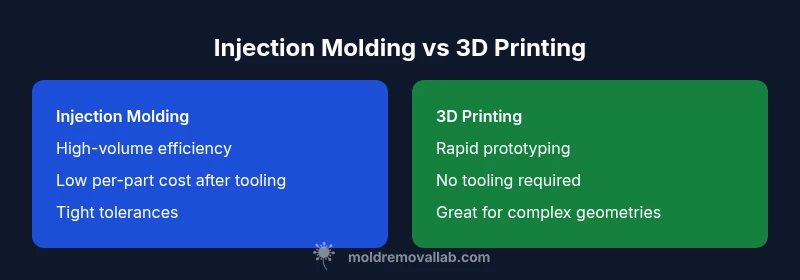
Injection Mold vs 3D Print: An Analytical Comparison
A thorough comparison of injection molding and 3D printing, covering production volume, tolerances, costs, design freedom, and decision criteria to help engineers and makers choose the right method.


Injection mold vs 3d print: for high-volume production, injection molding offers lower per-part costs after tooling, excellent repeatability, and fast cycle times. For rapid prototyping, customization, and low-volume runs, 3D printing enables faster design iteration with minimal upfront tooling. The best choice depends on scale, tolerance requirements, material options, and project timeline.
Injection mold vs 3d print: Core Differences
In the world of plastic manufacturing, two dominant paths exist: traditional injection molding and modern 3D printing. Injection molding uses heated plastic fed into a metal mold to form high-volume, repeatable parts. 3D printing builds parts layer by layer from a digital model, enabling rapid prototyping and customized geometries. When you compare the two, the most influential factors are production volume, part complexity, tolerances, and total lifecycle costs. According to Mold Removal Lab, the choice should align with the project lifecycle rather than a single part feature. This means considering the entire journey from prototyping to end-use production, not just the initial build.
Key Differences at a Glance
- Production scale: Injection molding excels at large runs; 3D printing shines for prototyping and small-batch production.
- Tooling and setup: Molds require upfront tooling, while 3D printing needs no dedicated tooling for initial parts.
- Tolerance and finish: Molded parts tend to have tighter tolerances with consistent finish; 3D printed parts may require post-processing for precision and surface quality.
- Material options: Injection molding covers a broad set of plastics; 3D printing expands across plastics, composites, and ceramics, depending on the process.
- Lead time: Getting the first part can be faster with 3D printing for designs under evolving requirements; injection molding needs time for mold fabrication.
In practice, many teams use a hybrid approach: design validation with 3D printed prototypes, then switch to injection molding for scalable production. The Mold Removal Lab team emphasizes evaluating the project’s life cycle to avoid overcommitting to tooling before proofing the concept.
Materials, Process Basics
Injection molding relies on high-precision aluminum or steel molds that define the part geometry. The process pushes molten plastic into the cavities, where it cools and solidifies rapidly. Material choices are driven by engineering demands such as strength, flammability, and temperature resistance. 3D printing encompasses several technologies, including fused deposition modeling (FDM), selective laser sintering (SLS), and stereolithography (SLA). Each has distinct strengths: FDM is cost-effective for basic plastics; SLS enables functional, durable parts; SLA offers high detail for prototypes. When comparing these, consider anisotropy (directional strength) and post-processing needs that can influence end-use performance.
Dimensional Tolerances and Surface Finish
Injection molded parts typically achieve tight tolerances and smooth finishes with little post-processing, especially after calibration and quality control. Tolerances are predictable across large volumes, making them suitable for parts that require interchangeability. 3D printed parts can achieve good detail, but tolerances and surface finish depend on the process, material, and printer calibration. Post-processing like sanding, sealing, or coating may be necessary to achieve production-ready dimensions or cosmetic quality. For functional tests, it’s common to prototype with 3D printing and then validate toward molding after design refinements.
Lead Time and Production Scale
Lead time matters: 3D printing often delivers parts in days or weeks, enabling rapid iteration and design verification. Injection molding requires mold fabrication and tooling setup that can take weeks to months, depending on complexity and production volume. Once the mold is ready, cycle times can be extremely fast, and the cost per part generally decreases with higher volumes. If you’re aiming for a long production run, the upfront investment in tooling can be worthwhile; for quick-turnaround projects, printing first is typically preferred.
Cost Considerations Across the Lifecycle
Tooling is the dominant cost driver for injection molding. The upfront expense can be significant, but unit costs drop as volume increases, often making it the most economical choice for large runs. 3D printing eliminates tooling costs and reduces risk for new designs, but material and machine usage can accumulate with higher volumes, potentially narrowing the price gap over time. A practical approach is to start with prototyping on a 3D printer, validate the design, and then transition to molding for production volumes. Mold enthusiasts and product teams frequently use this staged strategy to balance cost and speed.
Design Freedom and Constraints
Injection molding imposes design constraints such as parting lines, undercuts, and gate locations. Clever mold design can overcome many limitations, but certain geometries may drive mold complexity and cost. 3D printing offers greater freedom for complex internal channels, lattice structures, or intricate features that would be expensive or impossible to realize with traditional molds. However, geometric features in 3D printed parts may require support structures or post-processing, and some printers struggle with very small features or overhangs.
Environmental Impact and Sustainability
Both processes have environmental considerations. Injection molding typically uses energy-intensive tooling and production, but high-volume efficiency can offset energy use per part. 3D printing often generates less waste for certain geometries, since material is added rather than shaved away; however, support materials and post-processing waste can offset benefits. Material choice influences recyclability and end-of-life options. If sustainability is a priority, compare not just part cost but lifecycle impact—energy use, waste generation, and recyclability—across your intended production volume.
Practical Decision Flow for Your Project
- Define the production volume and target unit cost. 2) List required tolerances and surface finish. 3) Assess design complexity and potential for iterative changes. 4) Consider lead times and budget constraints. 5) Run a small prototyping loop with 3D printing before committing to tooling. 6) If volumes will be high, obtain quotes for injection molding tooling and per-part costs. A disciplined decision flow helps you avoid overinvesting in tooling before validating the concept. Mold Removal Lab stresses that the lifecycle view—prototype, test, then scale—drives the best outcomes.
Real-World Scenarios and Use Cases
- Consumer electronics housings with moderate complexity: start with 3D printed prototypes to validate fit and ergonomics, then move to injection molding for production.
- Medical devices with stringent tolerances: early prototypes may be printed; final parts should be molded when regulatory approvals and high-volume demand justify tooling.
- Automotive components requiring high strength and repeatability: molding tends to be preferred for long-term durability and cost efficiency at scale. In all cases, use 3D printing for fast design exploration and to reduce risk before tooling investments. The Mold Removal Lab team highlights the importance of validating performance and safety across the lifecycle.
Common Pitfalls and Troubleshooting
- Over-reliance on one process for all parts: not all geometries or materials suit molding or printing equally.
- Underestimating post-processing needs: 3D printed parts may require finishing, assembly considerations, or coating to meet stringent specs.
- Skipping design for manufacturability (DFM): ensure that the chosen process aligns with manufacturing capabilities and supply chain constraints.
- Inadequate testing: early prototypes should be tested under realistic conditions to verify tolerances and performance. A structured testing plan reduces risk when scaling up.
Summary of Practical Guidance
The injection mold vs 3d print decision boils down to volume, tolerance, and timeline. For high-volume manufacturing with tight tolerances, injection molding is typically cost-efficient over time, while 3D printing shines for rapid prototyping, customization, and low-volume production. When in doubt, adopt a staged workflow: prototype with 3D printing, refine the design, then transition to molding for scale. This approach aligns with best practices recommended by industry experts, including the Mold Removal Lab team.
Comparison
| Feature | Injection Molding | 3D Printing |
|---|---|---|
| Production Volume | Excellent at high-volume production with low per-part cost after tooling | Best for low-to-mid-volume production and rapid iteration |
| Lead Time to First Part | Longer due to mold fabrication and tooling | Shorter and often measured in days to weeks |
| Tooling/Setup Cost | High upfront tooling investment | No tooling required; device and printer costs dominate |
| Material Options | Wide range of engineering thermoplastics and elastomers via molding | Broad material palette across polymers, composites, and resins, depending on process |
| Dimensional Tolerances | Tight, repeatable tolerances across batches | Tolerances vary by process; may require calibration and post-processing |
| Surface Finish | Smooth, consistent finishes with minimal post-processing | Layer lines and post-processing may be needed for cosmetic or functional quality |
| End-Use Strength | Very strong parts with known long-term performance when properly designed | Functional parts possible, but anisotropy and strength depend on process and orientation |
| Design Freedom | Constrained by mold geometry and tooling | Greater freedom for complex geometries and rapid iterations |
| Waste and Material Efficiency | High efficiency per part at scale but waste in mold creation | Material waste is process-dependent; some printers optimize material use |
| Total Cost of Ownership | Lower per-part cost at scale, amortizing tooling | Lower upfront cost; higher per-part cost for large volumes without tooling |
Upsides
- Injection molding offers very high unit production efficiency at scale
- 3D printing enables rapid prototyping and design iterations
- No tooling required for 3D printing, reducing upfront risk
- Injection molding provides consistent part quality across batches
- Hybrid workflows can leverage both methods where appropriate
The Bad
- High initial tooling costs and long lead times for molding
- 3D printed parts may require post-processing and may have anisotropic strength
- 3D printing per-part cost can rise with volume without tooling
- Mold design imposes constraints like gating and parting lines
Injection molding is generally better for high-volume, consistent parts; 3D printing excels in rapid prototyping and low-volume runs.
Choose injection molding when production volumes justify tooling and you need tight tolerances. Use 3D printing for fast iterations, customization, and early validation before committing to tooling.
FAQ
What scenarios favor injection molding over 3D printing?
Injection molding is favored when you require high-volume production with tight tolerances and consistent quality. If demand is steady and volume justifies tooling, molding becomes cost-effective over time. For rapid iterations or small runs, 3D printing is typically preferred to minimize upfront risk.
Injection molding is best for large runs with tight tolerances; use 3D printing for fast prototyping and small batches.
Can 3D printed parts be used for functional end-use applications?
Yes, 3D printed parts can be used for functional end-use when appropriate materials and process parameters are chosen. However, strength, temperature resistance, and long-term durability should be validated for the specific application. In many cases, prototypes are printed first, then optimized for molding if needed.
3D printed parts can be end-use under the right material and design, but validate performance first.
How do tolerances compare between injection molding and 3D printing?
Injection molding typically yields tighter, more consistent tolerances across large volumes. 3D printing tolerances vary by technology and material, and may require post-processing to meet stringent specs. For critical fits, start with printing for validation and move to molding for production.
Molding usually gives tighter tolerances; printing varies by process and often needs finishing.
How does lead time differ for prototyping versus production?
3D printing delivers parts quickly for prototyping and design verification. Injection molding requires lead time for mold fabrication, which delays the first part but offers lower unit costs in high volumes. Plan a phased approach to balance speed and scale.
Printing is fast to prototype; molding takes longer upfront but pays off at scale.
What materials can be used in injection molding?
Injection molding supports a wide range of thermoplastics and some elastomers, chosen for mechanical, thermal, or chemical properties. Material availability and mold design influence performance. Always verify compatibility with molding equipment and regulatory requirements if applicable.
A broad range of plastics can be molded; verify material compatibility and specs.
Are there hybrid approaches that combine both methods?
Yes. A common strategy is to prototype with 3D printed parts and then transition to injection molding for production. Some teams also use overmolding or insert molding to combine the strengths of both processes. Hybrid workflows can optimize for speed, cost, and performance.
Hybrid approaches blend rapid prototyping with scalable production.
The Essentials
- Assess production volume before choosing a path
- Prototype with 3D printing to de-risk design changes
- Factor tooling costs into long-term cost/per part for molding
- Consider post-processing needs for 3D printed parts
- Use a staged approach: prototype, validate, then scale