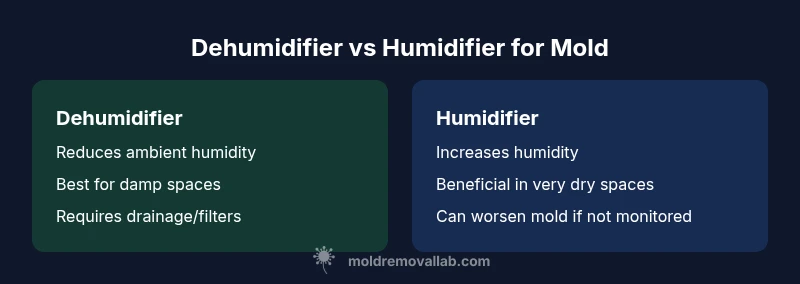
Dehumidifier vs Humidifier for Mold: A Practical Comparison
Compare dehumidifiers and humidifiers for mold control. Learn when each device helps, risks of misuse, and practical guidance from Mold Removal Lab to prevent damp, mold-prone conditions.


When mold is the concern, the practical choice often comes down to humidity control: dehumidifier vs humidifier for mold. In damp spaces, reducing moisture is the safer bet, while adding moisture can create new mold opportunities. Mold Removal Lab's analysis emphasizes moisture management as the first line of defense, followed by targeted remediation and ventilation. For most homes, prioritize dehumidification to slow mold growth, using humidification only in dry rooms or when moisture is unexpectedly low.
Understanding dehumidifier vs humidifier for mold in homes
In the ongoing fight against indoor mold, the core question often comes down to how moisture is managed inside living spaces. The phrase dehumidifier vs humidifier for mold captures a fundamental choice: one device removes excess moisture, while the other adds humidity. In many homes, the worst mold problems start in damp areas like basements, laundry rooms, and bathrooms where moisture lingers after precipitation or heavy use. According to Mold Removal Lab, moisture control is the first and most important step in mold prevention, more impactful than air fresheners or cleaners alone. This article lays out the science, the practical differences, and a decision framework you can apply in your house. By understanding how each device affects humidity and moisture sources, homeowners can reduce mold risk with smarter, lower-risk setups.
text
Comparison
| Feature | dehumidifier | humidifier |
|---|---|---|
| Effect on ambient humidity | reduces ambient humidity in damp spaces | increases humidity in dry spaces or if overused |
| Mold risk reduction potential | high when used in damp environments with moisture sources | low if used in already damp spaces and humidity is not controlled |
| Maintenance needs | drainage, filter cleaning, periodic coil cleaning | refill water reservoir, regular cleaning to prevent mineral buildup |
| Energy usage pattern | depends on capacity; can be energy-intensive in large basements | generally lower energy use per gallon added, but overall depends on run time |
| Best for | damp basements, bathrooms with recurring moisture | dry rooms to improve comfort; not ideal where dampness exists |
| Typical cost range | varies by model, often mid-range for capacity | varies by model, generally lower upfront cost than high-capacity dehumidifiers |
Upsides
- Effective moisture control in damp spaces to slow mold growth
- Can protect building materials and reduce musty odors
- Wide model variety and easy consumer access
- Some models include energy-saving features and auto-defrost
The Bad
- Humidifiers can worsen mold risk if used in damp areas or without humidity monitoring
- Over-drying can cause discomfort in living spaces
- Portable units require space and drainage planning in smaller rooms
- Energy use can be noticeable in large homes if running continuously
Dehumidifier generally outperforms humidifier for mold-prone spaces; humidifiers have niche comfort roles in very dry environments.
For mold prevention, prioritize dehumidification in damp areas and use humidification sparingly. Pair humidity control with ventilation and moisture barriers for best results.
FAQ
What is the primary difference between a dehumidifier and a humidifier in mold prevention?
A dehumidifier removes excess moisture from the air, reducing mold growth potential. A humidifier adds moisture and can worsen mold conditions if used in damp spaces or without humidity monitoring.
Dehumidifiers lower humidity to slow mold growth, while humidifiers raise humidity and should be used cautiously when mold risk is present.
Can I run a dehumidifier and humidifier together?
Yes, but only if you carefully monitor indoor humidity. Running both without real-time feedback can create unsafe humidity levels and may not solve mold problems.
You can run both, but watch humidity with a meter to avoid over- or under-humidifying.
What humidity range is considered safe to prevent mold?
The goal is a balanced humidity that discourages mold growth while maintaining comfort. Use a hygrometer to guide operation and avoid persistent damp conditions.
Keep humidity balanced and monitor with a meter to stay out of damp zones.
Are there silent models suitable for bedrooms?
Yes, many units offer quiet operation suitable for bedrooms. Look for low decibel ratings and smart features that pause during sleep.
Yes, pick models designed for silent operation and night mode.
What maintenance does a dehumidifier require?
Regularly empty or drain the reservoir, clean or replace filters, and periodically clean coils to maintain efficiency.
Clean the filter, empty the water, and check the coils from time to time.
Do dehumidifiers remove existing mold?
Dehumidifiers slow mold spread by reducing humidity but do not remove existing mold. Surface cleaning and professional remediation may be necessary for noticeable growth.
They slow mold spread but don’t replace proper mold remediation.
The Essentials
- Start with a moisture assessment of each space
- Prefer dehumidification in damp rooms to reduce mold risk
- Use humidification only when humidity is clearly too low and monitored
- Combine with ventilation and moisture barriers for best results
- Monitor with a hygrometer and adjust equipment accordingly