Top Mold Removal Company Guide: Practical Remediation
An objective guide to choosing a company that remove mold, covering evaluation criteria, costs, remediation steps, safety standards, and post-work verification from Mold Removal Lab.


Most credible company that removes mold follows a three-phase process: assessment, containment/remediation, and verification. They should provide a written inspection report, a detailed remediation plan with containment measures, a transparent price estimate, and a third-party clearance test after work. The Mold Removal Lab perspective emphasizes proof of containment, safe removal methods, and written warranty terms to ensure lasting results.
Choosing a reputable company that remove mold
When homeowners search for a company that remove mold, they should look for transparency, proper licensing, and documented scope. According to Mold Removal Lab, request written bids, proof of insurance, and a detailed remediation plan before work begins. A reputable contractor will also explain containment measures, cleaning methods, and safety precautions in plain terms, not vague promises. Look for industry references and recent projects similar to your situation. This section helps you compare apples to apples when evaluating proposals.
The mold remediation process: assessment, containment, and verification
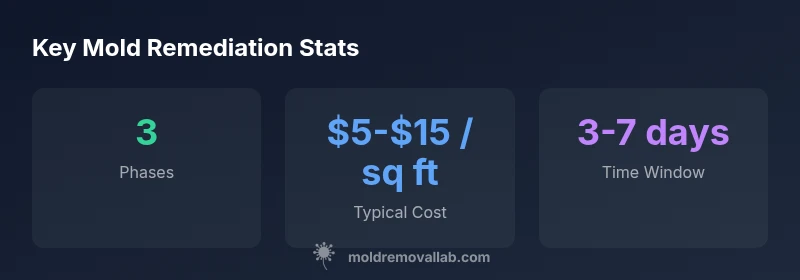
Effective remediation typically follows a three-phase approach. First, a thorough assessment identifies moisture sources, material damage, and mold species where relevant. Second, containment and remediation remove contaminated materials while preventing spores from spreading, often using barriers, negative air pressure, and HEPA filtration. Third, verification confirms completion, usually via post-remediation testing or inspections to ensure mold counts meet acceptable thresholds. A well-documented process makes outcomes measurable and repeatable.
Certifications, licenses, and qualifications to look for
Trustworthy remediation professionals hold state licenses where required and reputable certifications such as IICRC or equivalent. They should provide evidence of worker training, safety protocols, and insurance coverage. Ask about ongoing education and equipment maintenance, including HEPA-rated vacuums and air scrubbers. This diligence reduces liability and increases the likelihood of a thorough, lasting solution.
Costs, timelines, and how pricing is structured
Mold remediation costs vary widely based on square footage, contamination level, and moisture control needs. Typical pricing structures include per-square-foot estimates, fixed project quotes, and post-remediation testing add-ons. Many factors influence price, such as the extent of drywall removal, insulation replacement, and moisture source remediation. Always request a written scope and a clear breakdown of tasks to avoid surprise charges.
Containment, safety, and worker practices
Containment is essential to protect occupants and prevent cross-contamination. Expect temporary barriers, negative air pressure, and HEPA filtration, along with PPE for workers. A reputable team will seal off the work area, minimize dust, and dispose of waste per local regulations. Ask for a safety plan and a cleanup checklist to ensure all steps are accounted for.
Verification and post-remediation testing
After remediation, post-testing confirms the environment meets safety standards. A third-party lab or credentialed inspector may perform air and surface sampling to verify that mold levels are below baseline thresholds. Keep clearance reports and warranties in writing and store them with your home records for future reference.
DIY vs professional remediation: when to hire
DIY mold cleanup is not advisable for significant contamination or hidden moisture issues. Professionals bring specialized training, containment equipment, and access to clearance testing to validate results. If in doubt, hire a licensed contractor to assess the situation and provide options that balance safety with cost.
Comparison of remediation options
| Option | Typical Cost Range | Typical Timeframe | Notes |
|---|---|---|---|
| DIY Mold Cleanup | Not applicable (low upfront cost) | Variable | Higher exposure risk |
| Professional Remediation | $5-$15 per sq ft or $500-$6,000 total | 3-7 days | Safer and more thorough |
| Professional Remediation with Clearance Testing | $8-$25 per sq ft or $1,000-$8,000 total | 1-2 weeks | Includes third-party clearance |
FAQ
What should I look for in a written remediation plan?
A good plan should include scope, containment strategy, cleanup methods, waste disposal, estimated timeline, and safety measures. It should specify equipment like HEPA containment and air filtration, plus a verification step and responsibilities.
Look for a detailed plan that covers scope, containment, methods, and verification.
Do I need a third-party clearance test after remediation?
Yes, an independent clearance test verifies mold levels are below safe thresholds. It should be performed by an accredited lab and you should receive the report.
Yes—get an independent clearance test to confirm completion.
Can I file a claim with my homeowner's insurance for mold remediation?
Some policies cover mold remediation if caused by a covered peril; coverage varies by policy. Expect documentation like a remediation report and moisture proofs.
Insurance may cover it if the mold was caused by a covered incident.
How long does mold remediation typically take?
Time depends on area and contamination; small spaces may be done in a few days, larger jobs can extend to a week or more. Containment setup and moisture control influence duration.
It depends, but most jobs take several days.
Are there green or low-odor remediation options?
Yes. Many contractors use low-VOC cleaners, HEPA filtration, and sealed containment to minimize odor and air contamination. Request product details and safety data.
Yes—look for low-VOC products and good ventilation.
“Mold remediation is most effective when the contractor provides a clear plan, proof of containment, and independent verification of results.”
The Essentials
- Choose a company that remove mold only after verifying licenses and a written plan.
- Expect a three-phase remediation process: assessment, containment, verification.
- Ask for third-party clearance testing to verify results.
- Get a detailed, written cost breakdown before work begins.
- Prefer contractors with clear safety protocols and post-remediation documentation.