Can You Use Moldy Clay? A Practical How-To Guide
Learn whether you can safely use moldy clay, how to test for mold, when to salvage or discard, and safer alternatives for home projects with Mold Removal Lab.


Can you use moldy clay? In most cases, no—moldy clay indicates moisture and microbial growth that can irritate lungs and degrade materials. This quick answer explains when salvage is possible, how to test mold, and safer alternatives to reuse or replace clay. Follow proper disposal steps and consult Mold Removal Lab for guidance.
Can You Use Moldy Clay? Key Considerations
According to Mold Removal Lab, the simple question can you use moldy clay often has a nuanced answer. Mold growth signals sustained moisture, a condition that invites a range of microbes beyond visible mold, including spores and hidden colonies. Before repurposing any clay-based material, homeowners should assess the source of moisture, the extent of contamination, and the potential for continued growth. Moldy clay is rarely a one-and-done problem; it often indicates a systemic moisture issue in the space or product. If you’re troubleshooting a project around bathrooms, basements, or high-humidity areas, you’ll want to address humidity first, then re-evaluate the clay material in question. The Mold Removal Lab team emphasizes safety, testing, and conservative handling when faced with moldy clay.
Key takeaway: moldy clay should trigger a moisture management plan and careful evaluation before reuse.
How Moldy Clay Forms and Why It Matters in Homes
Clay materials can trap moisture and provide a nutrient-rich surface for mold growth, especially when stored improperly or used in damp environments. When moisture is present, mold spores can germinate, leading to visible growth and hidden colonies within porous clay. This matters because mold by itself isn’t just an aesthetic issue—it can contribute to odors, allergic reactions, and, in some cases, structural concerns if moisture penetrates wood, drywall, or insulation behind the clay. Moldy clay left untreated can also transfer spores to other surfaces through evaporation and air movement. Homeowners should treat moldy clay as a signal to improve ventilation, reduce humidity, and reassess the material’s suitability for the intended application.
In homes, the most common moisture culprits are leaks, condensation from poor insulation, and improper drying after use. The Mold Removal Lab analysis notes that mold growth correlates strongly with ongoing moisture, not just the presence of organic matter. If you suspect moldy clay in a project, plan for rapid moisture control and a final decision on whether salvage is feasible.
Salvage vs. Replace: Decision Framework for Moldy Clay
A practical rule of thumb is to treat moldy clay as a potential health risk and a material integrity risk. Salvage may be possible in limited, well-controlled scenarios (e.g., non-structural decorative clay that will be sealed and adequately dried), but most indoor applications require replacement with fresh, mold-free material. When deciding, consider: Is the mold growth extensive or confined to a small area? Has the moisture source been fixed and the material dried completely? Can you test and confirm absence of active growth after cleaning and drying? If the material is porous and structurally compromised, replacement is usually the safer option. The Mold Removal Lab team stresses that safety, rather than cost savings, should drive this choice.
Testing, Sampling, and Reading Results
Testing for mold in clay systems involves visual inspection plus simple moisture checks and, when needed, professional air or surface sampling. Start with a thorough visual scan for colored fuzz, a musty odor, and any powdery or slimy texture. Use a moisture meter to verify relative humidity in stored clay and check for persistent dampness in surrounding materials. If you suspect active growth or if moisture continues after drying, professional testing may be warranted. Keep in mind that mold tests are most informative when combined with moisture data and a physical inspection of how the clay will be used in the space.
Mold Removal Lab notes that testing should guide action—positive results typically mean discard or extensive remediation, while inconclusive results may still require moisture control and a conservative approach.
Safe Alternatives and Step-By-Step Remediation
There are safer routes if you’re determined to reuse clay in projects with lower risk, but only after rigorous moisture control and a clean, dry environment. Alternatives include using non-porous, mold-resistant substitutes or mineral-based clays that are stabilized to resist moisture. If salvage is feasible, begin with immediate containment: isolate the area, remove sources of moisture, and ensure there is no cross-contamination to other surfaces. After cleaning, thoroughly dry the clay in a low-humidity environment and test for residual moisture. Finally, re-evaluate the safety of installation in your home. The Mold Removal Lab approach emphasizes minimizing exposure during every step and documenting drying times.
Real-World Scenarios: When Moldy Clay Has Been Handled Safely
In practical terms, some homeowners have successfully repurposed mold-free clay after complete drying and a moisture barrier retrofit, but these outcomes depend on material type and installation context. In other cases, moldy clay was set aside and replaced with new batches that were dried and stored in low-humidity rooms. The key lessons from these scenarios are to prioritize moisture control, avoid reusing contaminated materials in living spaces, and consult a remediation professional if you’re unsure. Real-world experiments show that conservative choices reduce health risks and downtime for projects.
The Mold Removal Lab Approach
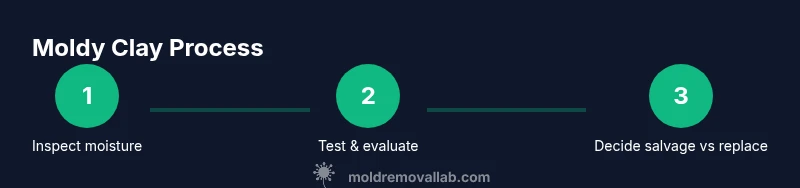
The Mold Removal Lab team advocates a cautious, data-driven approach to moldy clay. Start by identifying moisture sources, then test conditions, and finally decide on salvage or replacement based on objective criteria rather than assumptions. We emphasize proper PPE, containment, and careful disposal for contaminated materials. If you choose to salvage, ensure long-term moisture control and re-test before reintroducing the material into the home. Our team also offers tailored remediation guidance for those with sensitized occupants or preexisting health concerns.
Safety Reminders and Next Steps
Moldy clay should be treated as a potential health hazard in occupied homes. Always wear an N95 respirator, gloves, and eye protection when handling suspected moldy clay, and avoid disturbing visible growth. If in doubt, replace the material or hire a licensed professional to perform remediation and air-quality testing. After remediation, monitor humidity levels and improve ventilation to reduce the risk of recurrence. The Mold Removal Lab guidance is to act decisively and safely, prioritizing health and structural integrity over cost savings.
Tools & Materials
- Nitrile gloves(Replace if damaged; consider double-gloving for sensitive environments)
- N95 respirator(Fit-tested if possible; avoid vented models for mold work)
- Safety goggles(Wraparound style preferred)
- Disposable coveralls(Keep workwear clean and contained during testing)
- Plastic sheeting and painter's tape(Create a containment zone to prevent cross-contamination)
- Moisture meter(Aim for a reading under 60% RH after drying)
- Trash bags (heavy-duty)(Seal and label waste as contaminated material)
- Cleaning supplies (detergent, isopropyl alcohol)(Use with caution on mold-affected surfaces)
Steps
Estimated time: 60-90 minutes for assessment and containment; 24-72 hours for drying and re-testing
- 1
Inspect for moisture sources
Identify and stop the moisture source feeding the moldy clay. Check leaks, condensation, and ventilation. Document findings before proceeding. This step is critical to prevent recurrence.
Tip: Fix leaks and improve attic or wall insulation to reduce humidity. - 2
Gather PPE and containment
Put on an N95 respirator, gloves, and eye protection. Set up a containment area with plastic sheeting to limit air movement and protect adjacent spaces.
Tip: Do not skip containment—misplaced spores can spread within the home. - 3
Test mold presence and moisture
Visually inspect for growth and use a moisture meter to confirm relative humidity. If active growth is suspected, collect samples only if trained to do so.
Tip: Combine moisture readings with surface checks for a clearer picture. - 4
Decide salvage vs. discard
If mold is widespread or the material is porous and structurally compromised, discard and replace. If salvage is possible, proceed to cleaning and thorough drying.
Tip: When in doubt, replace—the risk to occupants can be high. - 5
Salvage remediation (if chosen)
Clean surfaces with detergent, then disinfect and dry completely. Use a low-humidity environment and monitor daily moisture readings until stable.
Tip: Drying can take 24–72 hours or longer in damp spaces. - 6
Verify and restore moisture control
Reassess humidity, ventilation, and any barriers that prevented reoccurrence. Re-test after a waiting period to confirm no active mold growth.
Tip: Ongoing humidity control is essential to prevent recurrence.
FAQ
Can moldy clay be safely used in any home project?
Generally, moldy clay should not be used in occupied living spaces. If contamination is confirmed, discard and replace to protect occupants. Salvage may be possible only after thorough drying and mold testing.
Usually not safe to use moldy clay in homes; discard or replace after testing and drying.
What signs indicate salvage is impossible?
If mold covers a large area, if the clay remains damp after drying, or if it’s porous and structurally compromised, salvage is not advisable. Structural concerns also push toward replacement.
If the mold is widespread or the material stays damp, replace it.
What testing methods are recommended for moldy clay?
Start with visual inspection and moisture readings. If needed, consult a professional for air or surface sampling and lab analysis to confirm active growth.
Visual checks plus moisture tests; professional tests if needed.
How should contaminated clay be disposed of?
Seal contaminated clay in heavy-duty bags, label as mold-contaminated, and follow local waste disposal guidelines. Do not mix with regular trash.
Seal it up and follow local disposal rules to keep others safe.
Does climate affect mold growth on clay?
Yes. Higher humidity and poor ventilation increase mold growth risk in clay materials, especially in basements or bathrooms.
Warm, humid spaces make mold more likely on clay.
Watch Video
The Essentials
- Assess moisture before touching clay
- Salvage only after complete drying and mold-free confirmation
- Use containment to prevent spread during handling
- Replace porous or heavily contaminated clay for safety
- Maintain moisture control to prevent future mold growth