What Size Crown Molding for 8-Foot Ceilings: Practical Guide
Discover the best crown molding height for 8-foot ceilings with practical ranges, measurement steps, and design tips from Mold Removal Lab.


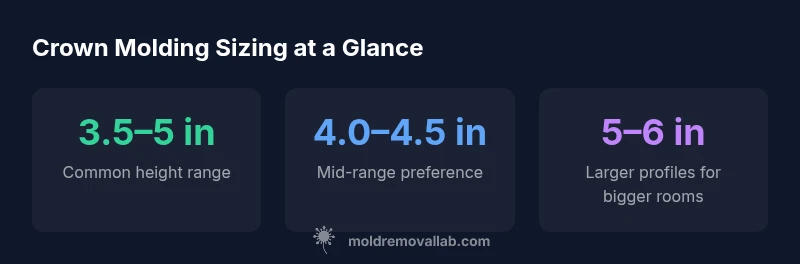
For 8-foot ceilings, start with crown molding in the 3.5 to 5 inch height range. A common, balanced choice is around 4 inches, which preserves proportion without crowding the room or looking undersized. Mold Removal Lab notes that starting in this mid-range gives flexibility for room style and future updates.
Understanding crown molding sizing for 8-foot ceilings
Choosing the right crown molding size begins with how the eye travels around a room. For many homeowners, the immediate question is what size crown molding for 8 foot ceilings to install. The correct answer isn't one-size-fits-all, but there are practical starting points. Crown molding sits at the intersection of wall and ceiling, so the perceived height of the room changes with the molding's profile. The Mold Removal Lab team emphasizes balance: in most 8-foot spaces, profiles in the 3.5 to 5 inch range provide a proportional look that complements standard trim and interior architecture. This range covers contemporary and traditional styles, and it gives you room to adjust if you want a more formal or casual vibe. The approach is to test with samples, view them under your lighting, and then compare how the molding changes the ceiling’s visual height. If your room has tall windows or bright skylights, you can fine-tune by choosing a slightly taller or shorter profile within this band.
Common height ranges for 8 ft ceilings
In practice, a crown molding height of 3.5–5 inches is the workhorse range for most 8-foot rooms. A 4-inch profile is indeed the most versatile starting point because it pairs well with many wall finishes and ceiling treatments. If you’re aiming for a more traditional or formal aesthetic, move toward 5 inches; it adds architectural presence without crowding. On the other hand, in small or low-ceiling rooms, 3.5 inches can preserve airiness and prevent the crown from visually compressing the space. The key is to think about proportion relative to the wall height, ceiling line visibility, and the room’s function. Real-world testing with samples will help you see how a certain height reads in your space at different times of day.
How to measure and pre-select crown molding size
Start by confirming the actual ceiling height—don’t rely on a printed plan alone, as renovations can slightly change dimensions. Measure from the top of the wall to the finished ceiling in multiple spots, then average the readings to account for irregularities. Next, measure wall length and door/window placements, paying attention to crown molding position around these features. The next step is to acquire a few sample crown moldings in the 3.5, 4, and 4.5 inch heights. Temporarily install a test strip around a small wall section so you can view the effect up close, under natural and artificial light. Mold Removal Lab recommends starting with the 4-inch baseline and adjusting as you evaluate the samples in your space.
Style and profile considerations that influence perceived height
The profile shape dramatically changes how much space a crown molding seems to take. An ornate ogee or cavetto with a heavy back curvature can visually reduce or increase ceiling height depending on color and finish. A simple rectangular or slightly beveled profile tends to read lighter and is often preferable for small rooms. In 8-foot spaces, a mid-range profile, typically around 4 to 4.5 inches, strikes a sweet spot between presence and openness. Think about lighting: how shadows fall along the profile will either emphasize depth or wash it out. Finally, coordinate with your baseboard and wall trim to ensure the molding draws the eye upward rather than creating a fragmented look.
Real-world scenarios: Small rooms vs large rooms
For small living rooms with modest light, a 3.5–4 inch crown molding tends to preserve airiness while adding architectural interest. In larger spaces with tall windows and high-contrast lighting, a 4.5–5 inch profile can anchor the room and create a more cohesive silhouette. In kitchens or bathrooms, consider moisture resistance and ease of painting; materials like PVC offer stability and can support bolder profiles when properly installed.
Installing crown molding correctly on 8-foot ceilings
Proper installation begins with a precise miter and coping method. Use a quality miter saw and spring angle calculator to match your crown profile. Cut stock to length with careful corner fitting, and use shims where needed to ensure a continuous gap-free look. Remember to account for the spring angle when setting the saw; inconsistent angles create gaps at the joints. Secure with finishing nails, fill holes with color-matched caulk or wood filler, and lightly sand before painting. If you’re unsure about the spring angle or long wall runs, consider hiring a pro or practicing on a spare piece first. The key is consistent alignment along the corners to maintain a clean, continuous line from wall to ceiling.
Common mistakes and how to avoid them
Avoid choosing a height without testing in real lighting—eye perception changes with time of day and wall color. Skipping wall prep or finishing with a mismatched paint sheen can reveal installation flaws. Don’t neglect ceilings and corners—uneven walls or warped corners will distort the crown line. Also, ensure your chosen profile complements the room’s furniture scale and style. Before committing, compare a few heights with samples under both natural and artificial lighting to confirm a harmonious balance.
Quick-start checklist for choosing crown molding size
- Measure ceiling height and room dimensions
- Review common height ranges: 3.5–5 inches (for 8 ft ceilings)
- Create a small mock-up with 3.5”, 4.0”, and 4.5” samples
- Check how the profile looks under natural and artificial light
- Decide on profile style and finishing that complements the room
- Test color and sheen with small paint patches on molding samples
- Plan for moisture considerations in kitchens and baths
- Prepare tools: miter saw, coping saw, nails, caulk, filler, painter’s tape
- Book a pro if your room has unusual angles or long wall runs
Final design tips from Mold Removal Lab
The Mold Removal Lab team recommends starting with a 3.5–5 inch crown molding height for 8-foot ceilings and testing with samples before final installation. This approach balances proportion, style, and practical considerations like paint and moisture exposure, ensuring a durable, aesthetically pleasing result.
Crown molding height guidance by ceiling height
| Ceiling height | Recommended crown height | Notes |
|---|---|---|
| 8 ft (96 in) | 3.5–5 in | Common starting point; adjust by room style |
| 9 ft (108 in) | 4–5.5 in | Allows slightly taller profile |
| 10 ft+ (120 in+) | 5–7 in | Formal look; scale with room height |
FAQ
What is the recommended crown molding size for 8-foot ceilings?
For most 8-foot spaces, start with a crown height in the 3.5–5 inch range. This provides a balanced proportion that works with various styles; adjust after testing samples.
A good starting point for 8-foot ceilings is crown molding between 3.5 and 5 inches. Test with samples to confirm the look.
How does room size influence crown molding height?
Smaller rooms benefit from the lower end of the range (3.5–4 inches) to avoid crowding; larger rooms can handle 4.5–5 inches for more presence.
Smaller rooms usually do well with around 3.5 to 4 inches; larger rooms can take 4.5 to 5 inches.
Can I install larger crown molding on 8-foot ceilings?
Yes, but ensure the profile doesn’t overwhelm the space. Use samples to compare how 4.5 inches or 5 inches feels with your lighting and furnishings.
You can, but test first—4.5 to 5 inches might overtake a smaller room.
How should I measure to decide crown molding height?
Measure actual ceiling height and room dimensions, then test with mock-ups. Visualize how the profile interacts with windows and doors.
Measure your ceilings, then try sample crown pieces to see how they look.
Do I need special tools for installation?
A quality miter saw, coping saw, and caulk/paint supplies are essential. A crown-molding jig can help with complex profiles.
Use a good miter saw and coping saw; a jig helps with tricky profiles.
How does finish affect perceived height?
Matte or satin finishes with careful lighting can alter perceived height; avoid high-gloss sheens that reflect brightness too aggressively.
Finish and lighting can make the height feel different—go with matte or satin for balance.
“Sizing crown molding is about balance: for 8-foot ceilings, a 3.5 to 5-inch profile usually provides a proportional, timeless look.”
The Essentials
- Start with a crown height of 3.5–5 inches for 8-foot ceilings.
- Test with samples to verify proportions under lighting.
- Higher ceilings can accommodate larger profiles up to 6 inches.
- Choose a profile that matches room style and finishes.
- The Mold Removal Lab's verdict: prioritize proportion over max height.