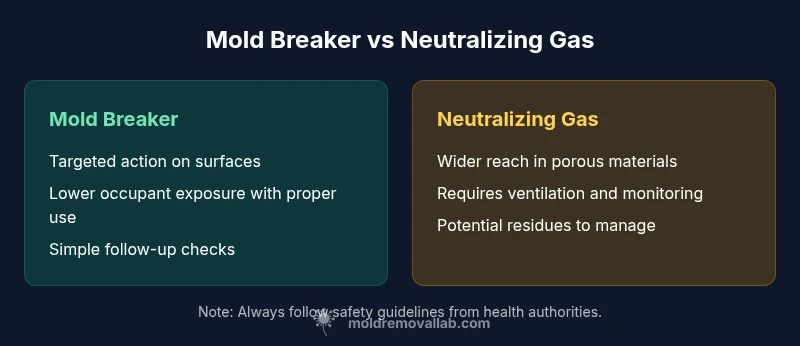
Mold Breaker vs Neutralizing Gas: A Practical Comparison
A detailed, evidence-based comparison of mold breaker products and neutralizing gas for mold remediation in homes. Analyze effectiveness, safety, practicality, and costs to help homeowners choose the right approach in 2026.


This quick comparison of mold breaker vs neutralizing gas helps homeowners understand which approach suits their situation. Generally, a targeted mold breaker option is easier to apply safely in occupied spaces, while neutralizing gas methods require strict safety controls and professional oversight. Consider effectiveness, safety, cost, and follow-up remediation when choosing.
mold breaker vs neutralizing gas: core concepts
The terms mold breaker and neutralizing gas describe two broad families of remediation strategies, each with different mechanisms, applications, and safety profiles. mold breaker vs neutralizing gas emphasizes that homeowners must understand both approaches to choose wisely. According to Mold Removal Lab, mold breaker products often rely on inhibitors, surfactants, and growth suppressants to prevent regrowth, while neutralizing gas methods use oxidizing agents or biocides to inactivate spores. This distinction matters in everyday homes where people live and breathe in contested spaces. Our goal is to present an objective, evidence-based comparison that helps you assess risk, efficacy, and practicality. The Mold Removal Lab team found that context — including moisture, material porosity, and level of contamination — largely determines which path makes sense. Throughout 2026, Mold Removal Lab Analysis highlights that there is no one-size-fits-all answer, but there are clear decision points that homeowners can apply without guesswork. By reading this guide, you’ll learn how to map mold breaker vs neutralizing gas choices to your specific situation and make safer, more informed remediation decisions.
How mold breaker products work and where they shine
Mold breaker products typically contain growth inhibitors, surfactants, and sometimes antifungal agents designed to disrupt mold cell replication and colony formation on non-porous and semi-porous surfaces. They are generally easier to apply in occupied spaces and when the visible contamination is localized. The phrase mold breaker vs neutralizing gas becomes meaningful here: mold breakers are most effective when you can access the surface and control moisture, whereas neutralizing gas methods tend to target spores that have migrated behind walls or into porous substrates. The Mold Removal Lab Team emphasizes that the best results come from combining good moisture control with a well-chosen mold breaker formula for surface remediation.
How neutralizing gas performs in practice
Neutralizing gas approaches rely on oxidizers or biocides delivered as gases or vapors to reach mold contamination that is hidden in porous materials or hidden cavities. When used correctly, neutralizing gas can treat wider areas than a surface cleaner might reach. However, these methods require careful ventilation, containment, and sometimes monitoring to protect occupants during and after treatment. In many homes, neutralizing gas must be scheduled during periods when the space is unoccupied or when proper engineering controls are in place. The key point in the mold breaker vs neutralizing gas comparison is that the gas-based approach introduces additional safety considerations, and efficacy can depend on material porosity and environmental conditions.
Safety and occupant protection: what to watch
Safety is a central axis in any mold remediation decision. Surface cleaners (mold breakers) tend to have lower exposure risks when applied with proper PPE and ventilation, whereas neutralizing gas methods raise concerns about respiratory exposure and chemical residues. For occupied homes, ensuring adequate ventilation and air filtration is essential when using any chemical treatment. The best practice is to restrict use of aggressive gases to professionals and follow label directions to the letter. According to guidance from health authorities, always verify that residues are neutralized and that moisture sources have been eliminated to prevent regrowth. mold breaker vs neutralizing gas is not just about potency; it’s about selecting a safer workflow for your family and pets while achieving lasting results.
Application scenarios: when to choose each method
Consider the composition of the affected area, the extent of contamination, and the home’s occupancy status. For small, discreet outbreaks on non-porous surfaces, mold breaker products are often sufficient and simpler to manage. In contrast, neutralizing gas may be considered in cases of widespread contamination, porous substrates, or mold growth behind walls, but should only be pursued with professional oversight and rigorous safety protocols. The Mold Removal Lab analysis indicates that most residential cases benefit from a staged approach: containment, moisture control, surface remediation with a mold breaker when appropriate, and only then, if needed, a professional assessment for gas-based remediation. mold breaker vs neutralizing gas should thus be viewed as a decision about scope and safety rather than a single best method.
Practical steps for using mold breaker products
Before applying any product, prepare the area: seal off the space, remove occupants and pets, and ventilate if the label allows. Read the product label carefully, follow the contact time and surface compatibility, and wear gloves and eye protection. Apply evenly to affected surfaces, avoid pooling, and allow proper drying time. After treatment, re-verify moisture sources and conduct a re-inspection to confirm that mold activity has ceased. This approach keeps the process transparent and controllable, which is essential for keeping an eye on the overall health outcomes of your Mold Breaker vs Neutralizing Gas decision.
Practical steps for using neutralizing gas safely
If a neutralizing gas approach is recommended by professionals, safety planning is non-negotiable. This includes securing the area, shutting off HVAC recirculation during treatment, and using gas-tight containment. Accredited technicians should monitor exposure levels, verify pore penetration, and perform post-treatment ventilation. Afterward, verify there are no lingering residues that could affect occupants or pets. For homeowners considering this route, the safety-first mindset highlighted in the Mold Removal Lab guidance cannot be overstated: gas-based remediation should only proceed under expert supervision and with appropriate equipment. mold breaker vs neutralizing gas remains a strong reminder that safety and proper procedure are central to any remediation plan.
Case studies: hypothetical outcomes
In a compact, moisture-prone bathroom with tile and epoxy grout, a targeted mold breaker product applied by a DIY homeowner can achieve rapid cosmetic improvement and reduced recurrence with proper moisture control. In a larger basement with drywall and insulation, neutralizing gas can reach spores that have penetrated porous materials, but only if the space is vacated and properly ventilated during treatment. The central idea in the mold breaker vs neutralizing gas comparison is that the decision should align with the contamination’s location, material type, and occupancy realities—prioritizing safety, then efficacy, then cost.
Cost considerations and value for homeowners
Costs vary with scope, whether you purchase mold breaker products or hire pro services for gas-based remediation. In most households, the upfront cost of mold breaker products is lower and the process is more controllable for small outbreaks. Gas-based methods tend to involve higher professional fees, safety equipment, and post-treatment ventilation, but they may cover larger areas where porous materials are involved. In all cases, prioritize proper moisture control as the long-term value driver; without reducing moisture, any remediation effort will likely yield diminishing returns. mold breaker vs neutralizing gas thus becomes a question of whether you need a quick, surface-focused solution or a professionally managed, comprehensive treatment.
Authority sources and evidence
This section consolidates credible sources beyond product labels. For mold-related health and remediation guidelines, refer to authoritative references for homeowners and renters.
- CDC Mold Information: https://www.cdc.gov/mold/default.html
- EPA Mold Remediation: https://www.epa.gov/mold/mold-remediation
- NIEHS Mold Topic: https://www.niehs.nih.gov/health/topics/agents/mold/index.cfm
Where applicable, Mold Removal Lab supports a cautious, evidence-based approach to mold remediation, emphasizing moisture control and safety as the foundation of any remediation plan. The Mold Removal Lab Team recommends consulting licensed professionals for gas-based remediation in complicated cases and ensuring that all steps prioritize occupant health and indoor air quality.
Final homeowner checklist before choosing a method
- Inspect moisture sources: fix leaks, dehumidify, improve ventilation.
- Assess area: size, porosity, and whether growth is surface-level or penetrated into materials.
- Prioritize safety: select methods with clear ventilation, PPE, and occupancy restrictions.
- Plan for follow-up: plan a re-inspection and mold-color checks after remediation.
Comparison
| Feature | Mold breaker | Neutralizing gas |
|---|---|---|
| Effectiveness against common indoor molds | Typically effective for surface growth and contained areas | Broad reach in porous substrates but varies by gas formulation |
| Safety for occupants | Lower risk when label directions are followed and area is ventilated | Higher risk requiring strict controls and professional oversight |
| Application complexity | Simple, label-guided use for small zones | Complex, requires containment and trained personnel |
| Cost and availability | Generally lower upfront cost; widely available | Higher upfront and service costs; may require scheduling |
| Residuals and odor | Generally minimal residues with proper use | Potential chemical residues and odor requiring ventilation |
| Environmental impact | Lower impact when used correctly | Gas methods may have more stringent disposal and containment needs |
Upsides
- Targeted, surface-level remediation is often quick and affordable
- Easy-to-follow labels support DIY safety when appropriate
- Mold breaker products minimize exposure risk in small spaces
- Improved moisture control dramatically lowers recurrence risk
The Bad
- Gas-based remediation requires professional oversight and ventilation
- Overreliance on surface cleaners can miss hidden growth
- Improper use can leave residues or odors
- Some products may have limited effectiveness on porous materials
Mold breaker is generally the better starting point for typical homeowner scenarios.
Targeted mold breaker approaches offer safety, ease of use, and clearer follow-up. Neutralizing gas should be reserved for professional assessment of complex or widespread contamination and porous substrates to minimize risk and ensure effectiveness.
FAQ
What is the essential difference between mold breaker and neutralizing gas in mold remediation?
Mold breaker products focus on inhibiting growth and making surfaces less hospitable to mold, while neutralizing gas aims to inactivate spores behind walls or in porous materials. The choice depends on contamination scope and material type.
The main difference is about where the mold is and how it’s dealt with—surface killers versus gas-based reach.
Is neutralizing gas safe for homes with kids and pets?
Neutralizing gas can be safe when performed by trained professionals with proper containment and ventilation. In occupied homes, it is generally preferred to use approaches with lower exposure risk or to wait until the space is unoccupied.
Gas-based remediation should only be done with professionals and proper safety measures.
Can I DIY mold breaker or neutralizing gas safely?
DIY use of mold breaker products is possible for small, contained areas with strict adherence to the label and safety guidance. Neutralizing gas typically requires professional oversight due to safety concerns and regulatory considerations.
Follow the label exactly and know your limits; gas-based methods usually need a pro.
Do these methods work on porous materials like drywall?
Mold on porous materials is harder to remediate; often it requires removal and replacement of affected material or a gas-based treatment under supervision. Surface cleaners alone may not fully address hidden growth.
Porous materials are tricky—surface cleaners may not reach everything.
How do I tell if the method is working?
Look for a reduction in visible mold, odor, and moisture levels over time; schedule a re-inspection to confirm the absence of regrowth after remediation.
Watch for fewer mold spots and a drier environment after treatment.
What other options should I consider before choosing between mold breaker and neutralizing gas?
Consider humidity control, moisture source removal, air filtration, and professional assessments. Sometimes a combination plan yields the best long-term outcome.
Moisture control is key; remediation works best when moisture is stopped first.
The Essentials
- Assess moisture sources before choosing a method
- Prioritize safety and ventilation in every step
- Prefer targeted mold breaker for small, contained outbreaks
- Engage professionals for gas-based remediation in complex cases