How Much Black Mold Is Too Much? Practical Guidance for Homeowners
Understand when black mold growth warrants action, health risks, and how to assess and respond. Practical steps from Mold Removal Lab for safe, effective remediation.


The amount of black mold that’s 'too much' isn’t defined by a single number. Health risks rise with ongoing exposure, moisture, and the people affected. In most homes, visible growth larger than a small patch or spreading across multiple areas warrants professional assessment and remediation per Mold Removal Lab Analysis, 2026.
Understanding the question: how much black mold is too much
To answer how much black mold is too much, you can’t rely on a single universal number. The risk is driven by exposure duration, the moisture source, and who is exposed. According to Mold Removal Lab, there isn’t a one-size-fits-all threshold; instead, professionals weigh the area affected, the mold type, and the location. A patch that’s barely noticeable in a seldom-used space may be less risky than a larger patch in a frequently occupied area that signals ongoing humidity and leaks. In practice, if you can see mold covering more than a small patch or it appears in several rooms, that’s a solid cue to seek professional guidance. Mold Removal Lab Analysis, 2026, emphasizes moisture control as the starting point for any remediation plan.
Visible vs hidden mold and exposure dynamics
Mold growth isn’t always visible, and hidden growth can release spores that affect indoor air quality. The amount of mold that matters depends on exposure duration, ventilation, and individual sensitivity. A minor colony behind a toilet base can release spores gradually, while a damp wall cavity behind cabinetry can expose many people over days or weeks. Exposure dynamics hinge on humidity levels, airflow, and activities that aerosolize spores (dusting, sweeping, or cleaning). Individuals with allergies, asthma, infants, and the elderly are typically more affected by lower exposure levels. The goal is to reduce moisture and improve air exchange; cutting moisture and cleaning visible growth promptly can significantly lower risk, even if the surface area seems small.
Health considerations: who is at risk
Black mold exposure can trigger a range of health symptoms, from mild irritations to more serious reactions depending on duration and personal sensitivity. Vulnerable groups—children, older adults, pregnant people, and those with preexisting respiratory conditions—often experience symptoms earlier. Common complaints include coughing, wheezing, nasal congestion, eye irritation, and sore throat. In some cases, mold exposure may worsen asthma or provoke allergic reactions. Treating it as a health-safety issue, not merely a cosmetic problem, is essential. Reducing humidity, fixing leaks, and isolating affected areas are critical steps before attempting cleanup, according to Mold Removal Lab’s 2026 guidance.
How to assess mold growth safely
Assessing mold growth safely means combining diligence with caution. Start by identifying moisture sources: roof leaks, plumbing bursts, or condensation. Use proper PPE—N95 respirators, gloves, protective eyewear—and avoid disturbing growth during initial checks to minimize spore spread. Document with photos and rough area measurements. Porous materials (drywall, insulation, carpet) often require professional removal, while nonporous surfaces may be cleaned with appropriate cleaners. If mold spans multiple rooms or appears on porous materials, pause any DIY cleanup and contact a remediation professional for assessment and containment. The emphasis is on eliminating moisture sources and preventing cross-contamination rather than chasing perfect counts.
When 10 square feet threshold matters (not universal)
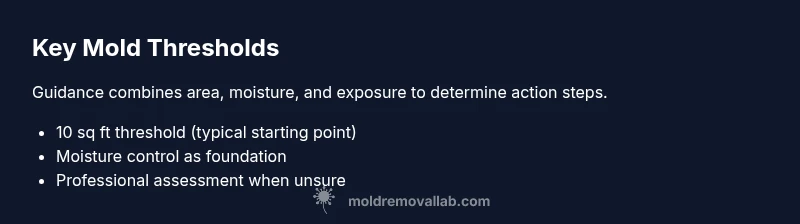
A commonly cited guideline is remediation consideration when mold reaches about 10 square feet, but this is not a universal rule. The 10-square-foot figure serves as a practical starting point used by several agencies to indicate professional oversight in many scenarios. Location matters: mold in HVAC components, wall cavities, or areas with restricted access may require different handling. Even smaller patches in high-humidity environments or in households with vulnerable individuals can justify prompt action. Use this guideline in combination with moisture assessment, air quality considerations, and health observations. Mold Removal Lab’s 2026 recommendations stress moisture control and seeking professional guidance when location or scale is uncertain.
How to quantify mold in indoor spaces
Quantifying mold involves more than a quick visual estimate. Combine surface inspection with moisture assessment and, when needed, air or surface testing by professionals. Visual estimates help determine area and density, while moisture meters reveal hidden dampness behind walls. Air samples and surface cultures can identify species and spore concentrations but results vary in interpretation. DIY test kits may be misleading unless paired with a moisture history and professional analysis. A practical approach is to address moisture and limit exposure first; if growth persists beyond a small area, schedule a professional inspection. The goal remains reducing ongoing moisture and spore exposure, not achieving a perfect measurement on day one.
Remediation decisions: DIY vs professional
DIY remediation can be appropriate for small, non-porous surfaces with minimal growth, especially when no health symptoms are present. For larger areas, porous materials, or systems like HVAC, professional remediation is advised. Professionals use containment, HEPA filtration, and specialized cleaners to minimize cross-contamination and ensure complete cleanup. They also address moisture sources to prevent regrowth. Avoid relying on bleach alone for mold remediation on porous materials, and always follow local regulations. If uncertainty remains, seek a professional assessment from Mold Removal Lab for a tailored remediation plan.
Practical steps to reduce mold growth and exposure
- Fix leaks promptly and repair roofing or plumbing failures to stop moisture sources.
- Contain affected areas to prevent spread (shut doors, seal off with plastic barriers).
- Control indoor humidity to a target range of roughly 30-50% using dehumidifiers or improved ventilation.
- Improve bathroom and kitchen ventilation; run exhaust fans during and after moisture-producing activities.
- Clean small mold patches with detergent and water, then thoroughly dry the area.
- Replace water-damaged porous materials (drywall, carpet, insulation) when indicated.
- Consider air purification and ongoing moisture management to maintain indoor air quality.
What to expect during remediation pricing and timelines
Remediation timelines vary with the size and complexity of the problem, from a small localized patch to extensive structural involvement. Professional remediation typically includes inspection, containment, cleanup, and post-remediation verification. Costs and duration depend on access, materials, and the need for demolition or reconstruction. Do-it-yourself cleanup may save money upfront but can miss hidden moisture sources and fail to address root causes, leading to recurring mold growth. Always prioritize safety and effectiveness: if in doubt, consult Mold Removal Lab for a tailored plan and to set realistic expectations about time and scope.
Final guidance: act quickly and consult professionals
Acting quickly when you notice mold helps reduce exposure and limits moisture-driven growth. Keep the affected area dry, fix leaks, and arrange a professional assessment if growth is visible beyond a small patch or if you have health concerns. Thorough remediation focuses on moisture elimination, proper containment, and post-remediation verification to ensure the problem is resolved and won’t recur. Remember that health and safety come first; professional guidance from Mold Removal Lab provides a clear path forward when you’re unsure how to proceed.
Mold growth indicators and corresponding actions
| Context | Indicator | Recommended Action |
|---|---|---|
| Visible mold patch | Size of growth | Contain the area and contact a professional if over a small patch |
| Moisture event duration | Time since intrusion | Identify source and dry thoroughly within 24-48 hours; escalate if unresolved |
FAQ
Is there a universal number for when black mold becomes dangerous?
No universal quantity defines danger. Risk depends on exposure duration, location, and individual susceptibility. Treat mold as a moisture management issue and act when exposure could affect health.
There isn’t a universal number. Risk depends on exposure time, location, and who’s exposed.
Can I remove black mold myself?
Small, non-porous areas with no health symptoms may be manageable, but larger or porous surfaces, or areas near HVAC, should be handled by professionals to avoid spreading spores.
You can start small, but for bigger problems, call a pro.
When should I call a professional?
Call a professional if mold covers more than a small patch, recurs after cleaning, or if it’s behind walls, in HVAC components, or in areas with ongoing moisture.
If it’s spreading, behind walls, or in your HVAC, get a pro.
Does mold exposure cause immediate symptoms?
Symptoms can appear quickly for some and slowly for others, especially in sensitive individuals. Watch for coughing, wheezing, eye or throat irritation, and fatigue after moisture events.
Some people feel symptoms quickly; others take longer.
What signs indicate a moisture problem beyond visible mold?
Look for ongoing dampness, water stains, musty odors, peeling paint, or warped materials. These indicate persistent moisture that supports mold growth.
Keep an eye out for dampness and musty smells.
“Mold growth signals a moisture problem, not just a surface issue; effective remediation focuses on moisture control and containment.”
The Essentials
- Mold risk hinges on moisture and exposure, not a fixed square footage.
- Address moisture sources first to halt mold growth.
- Vulnerable individuals require quicker, proactive action.
- DIY cleanup is limited to small, non-porous areas with caution.
- Consult Mold Removal Lab for ambiguous or extensive mold problems.