Injection Molding Plastics: A Practical Comparison Guide
This article offers an objective, data-informed injection molding plastics comparison across PP, HDPE, ABS, PC, and nylon, covering properties, processing, cost ranges, and best-use guidelines.


In this injection molding plastics comparison, no single material fits every project. Polypropylene (PP) offers low cost and chemical resistance, ABS blends toughness with easy processing, PC delivers clarity and heat resistance, HDPE provides chemical resistance with impact strength, and nylon adds high mechanical strength at elevated temperatures. The best choice depends on strength, temperature, and budget.
Introduction: Why material choice matters in injection molding
Choosing the right plastic for an injection molding project is about more than just stiffness or color. It involves balancing mechanical performance, thermal stability, chemical exposure, manufacturability, and lifecycle costs. For homeowners and professionals alike, the goal is to predict how a part will behave in production and in its service environment. According to Mold Removal Lab, selecting materials that resist moisture, allow easy cleaning, and maintain dimensional stability is crucial when parts inhabit damp or contaminated spaces. The broader value of a sound plastics choice is reduced risk: fewer reworks, fewer defects, and longer-lasting parts. This section sets the stage for a practical, data-informed comparison of five common polymers used in injection molding and how they stack up in real-world scenarios.
Polypropylene (PP): The Budget Workhorse
PP is the most widely used polyolefin in consumer and industrial parts because it blends low cost with reasonable chemical resistance and good processability. Typical strengths include lightweight performance, excellent resistance to moisture, and compatibility with a broad range of slip and color additives. PP’s crystallinity gives it a favorable balance between stiffness and toughness, which translates into parts that survive repeated assembly and disassembly steps. From a manufacturing perspective, PP is forgiving on molds and coolants, enabling shorter cycle times in many applications. For applications exposed to mild solvents or cleaning agents, PP remains a robust baseline material, especially when cost control is a priority.
High-Density Polyethylene (HDPE) and Other Polyolefins
HDPE is a close cousin to PP but typically offers higher impact resistance and better chemical resistance in some environments. It remains easy to process in standard injection molding setups and can be formulated with fillers or colorants without excessive viscosity increases. Other polyolefins—such as copolymers—can tailor clarity, flexibility, or stiffness to match part requirements. In practice, HDPE shines for containers, caps, and fittings that see regular handling and potential chemical exposure. When the service life depends on resistance to solvents or cleaning agents, HDPE often outperforms PP, but at a modestly higher material cost.
Acrylonitrile Butadiene Styrene (ABS): Toughness with Processing Ease
ABS provides a strong balance of impact resistance, toughness, and dimensional stability, making it a common default for consumer electronics enclosures, automotive trims, and durable housings. ABS is known for its good surface finish and relatively forgiving processing window, which helps with complex geometries and thin walls. However, ABS can be more sensitive to high temperatures during molding and may suffer under prolonged heat exposure unless properly stabilized. When surface aesthetics and impact strength matter, ABS remains a strong contender with predictable performance.
Polycarbonate (PC): Clarity and Heat Resistance
PC offers excellent clarity and notable heat resistance, making it ideal for transparent or high-temperature applications such as lenses, housings, and safety components. Its high glass transition temperature enables parts to withstand hot liquids or ambient heat without significant deformation. PC, however, can be more challenging to process due to its higher melt viscosity and tendency to craze or stress-crack in some environments unless properly dried and moisture-controlled. For applications requiring optical clarity and high temperature tolerance, PC is often the material of choice.
Nylon (PA) and Engineering Polymers
Nylon brings superior mechanical strength, abrasion resistance, and elevated temperature capability, which make it well-suited for load-bearing or wear-exposed parts. It, however, can be more moisture sensitive and hygroscopic, leading to dimensional changes if moisture is not controlled during molding and storage. Nylon requires careful drying and sometimes specialized molding conditions, but its performance in automotive, industrial, and hardware applications can justify the added processing considerations. For parts demanding high strength and toughness at temperature, PA stands out among standard injection molding polymers.
Blends and Co-Polymers: PC/ABS, PBT, and FR Options
Blends such as PC/ABS combine the clarity of PC with the processability and toughness of ABS, offering a balanced option for shared requirements. PBT and other co-polymers tailor performance for specific strains such as improved chemical resistance or enhanced heat stability. Flame-retardant (FR) grades provide compliance for safety-critical parts, but they can alter processability and mechanical properties. When selecting a blend or FR grade, you balance safety standards with the practicalities of molding, drying, and post-processing.
Processing Considerations: Melt Flow, Viscosity, and Mold Design
Material choice influences mold design and processing parameters. Higher melt viscosity slows fill and can require different gate sizing and cooling strategies. Materials with low melt flow rates often benefit from pre-drying and temperature control to prevent warpage or sink marks. Conversely, low-viscosity materials can enable complex geometries and faster cycle times but may require more attention to mold wear and part ejection. Effective selection combines material data with practical testing on representative inserts and molds.
Cost, Availability, and Lifecycle Considerations
Material cost is only one part of the equation. Availability of resin grades, supplier reliability, and lead times affect production planning. Long-term lifecycle costs include maintenance of tools, scrap rates, and downstream recycling or disposal costs. A material with a lower upfront price can become more expensive over time if it wears tooling faster or requires more rework. A careful cost/benefit analysis should include market dynamics for the chosen polymer and any blending or stabilization strategies.
Environmental and Sustainability Considerations
Polymer sustainability touches on recyclability, resin traceability, and end-of-life options. PP and HDPE are widely recyclable in many municipal programs, while PC and nylon may require specialized flows. Designers should consider the product’s lifetime environmental footprint, potential recycling pathways, and compatibility with existing circular economy initiatives. Keeping these factors in mind helps ensure a responsible and forward-looking material selection.
Selection Framework: A Step-by-Step Guide
To make a robust decision: 1) Define the primary performance requirements (strength, temperature, chemical exposure). 2) Shortlist candidate polymers based on those requirements. 3) Compare processing needs, tooling impact, and cycle times. 4) Evaluate cost, availability, and supplier support. 5) Validate with small-scale mold tests or pilot runs to confirm fit. 6) Document the rationale to support future changes or redesigns.
Quick Reference: Material At a Glance
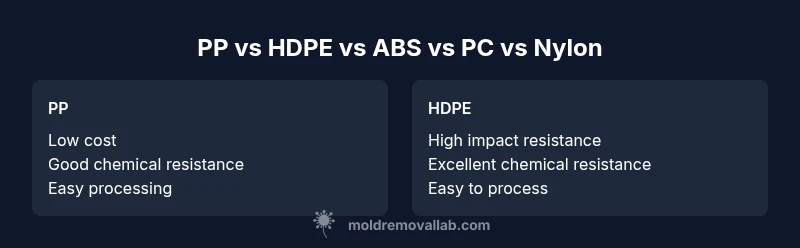
- PP: Low cost, good chemical resistance, easy processing. Best for budget-conscious, moisture-exposed parts.
- HDPE: Higher impact and chemical resistance, easy to process. Great for containers and fittings.
- ABS: Balanced toughness and ease of molding. Ideal for enclosures and cosmetic parts.
- PC: Clarity and heat resistance. Best for optical or high-temp parts.
- Nylon: High strength and wear resistance, moisture sensitive. Use with proper drying and moisture management.
Authority Sources
For further reading and verification, consult authoritative sources: https://www.nist.gov, https://www.fda.gov, and https://pubs.acs.org. These references provide standards and context on material properties and safety considerations relevant to polymer selection in molding applications.
Feature Comparison
| Feature | PP | HDPE | ABS | PC | Nylon (PA) |
|---|---|---|---|---|---|
| Tensile Strength | Low to moderate | Moderate | Moderate to high | High | High |
| Impact Resistance | Moderate | High | High | Moderate | Very High |
| Heat Resistance | Low to moderate | Moderate | Moderate | High | High |
| Chemical Resistance | Good | Excellent | Good | Excellent | Good |
| Ease of Processing | Excellent | Excellent | Good | Moderate | Challenging |
| Cost Range | Low | Moderate | Moderate | High | Moderate |
| Best For | Budget-sensitive parts | Chemical exposure parts | Durable enclosures | Clear/high-temp parts | High-strength, wear parts |
Upsides
- Offers a clear framework to compare common injection molding plastics
- Highlights processing and lifecycle tradeoffs for informed decisions
- Supports design-for-manufacturability by linking properties to tooling
- Guides sustainability considerations and recycling options
The Bad
- Material selection remains a trade-off; specific part testing is still essential
- Blends and FR grades add complexity to processing and testing
- Real-world performance depends on part geometry and environmental exposure
No single polymer dominates; choose by project priorities
For cost-sensitive parts, PP is a strong baseline. For strength and wear, Nylon or PC shines. ABS offers balanced performance, PC suits high-temp/clarity needs, and HDPE covers chemical resistance with good processing. Use a structured evaluation to pick the right material per application.
FAQ
What factors should I consider when choosing an injection molding plastic?
Consider mechanical requirements (strength, stiffness, impact), thermal exposure (temperature range, heat), chemical resistance, moisture sensitivity, processing window, and lifecycle costs. Availability and supplier support also influence lead times and consistency. A structured assessment reduces redesign risk.
Think about strength, heat, chemical exposure, and how easy it is to mold the material. Don’t forget availability and cost over the part’s life.
How does mold design affect material choice?
Mold features such as wall thickness, draft angles, gate location, and cooling channels interact with the resin’s viscosity and shrinkage. Higher viscosity materials may require larger gates or multiple gates and longer cooling, while very flowable resins can reduce core shift but risk splaying if not controlled.
Your mold design and the resin’s flow work together. A mismatch can cause defects or longer cycles.
Which plastic is best for high-temperature applications?
Polycarbonate (PC) and some engineering Nylon grades deliver superior heat resistance. PC also provides optical clarity in many cases, while nylon can tolerate elevated temperatures when properly stabilized and dried. Always verify the exact HDT (heat deflection temperature) for your grade.
For high temps, PC or reinforced nylon are reliable, but check the grade’s heat rating.
Are blends like PC/ABS worth it?
PC/ABS blends balance PC’s heat resistance and ABS’s toughness, often improving process stability and surface finish. They can simplify design decisions when both clarity and impact resistance are needed, but watch for changes in mechanical properties and cost compared with pure resins.
Blends can give you a mix of benefits, but test to confirm they meet your spec.
What about environmental impact and recyclability?
Recyclability varies by resin. PP and HDPE have well-established recycling streams, while PC and nylon may require more specialized processes. Consider part lifecycle, end-of-life plans, and compatibility with your local recycling infrastructure as part of the material decision.
Think about how easy it is to recycle the part at the end of its life.
Can I substitute materials without redesigning my part?
Substitution is possible but risky. Differences in shrinkage, strength, and thermal properties can affect fit, function, and durability. Validation through redesigned tooling, revised processing, and functional testing is essential before production.
Substituting materials needs careful testing to avoid fit and function issues.
The Essentials
- Define performance priorities before material selection
- Match polymer properties to temperature, chemicals, and wear
- Assess processing impact on tooling and cycle times
- Incorporate lifecycle costs and recyclability into the decision