Mold or Flour on Bread: Identify & Respond Safely
Learn to tell mold or flour on bread apart with practical cues, safety steps, and a clear comparison to protect your family from contamination. Understand when to discard and how Mold Removal Lab guides practical at-home decisions.


TL;DR: Distinguishing mold from flour on bread is essential for health. Visible fuzzy spots, unusual colors, or a musty odor indicate mold and require discarding the loaf. Flour on bread appears white and powdery, not growth. Flour on bread thus is usually safe when no spoilage signs. For ambiguous cases, follow safety guidelines and consult Mold Removal Lab's guidance.
Understanding the distinction: mold or flour on bread
Correct identification starts with a simple question: is the signal you see mold growth or benign flour from baking and handling? The phrase mold or flour on bread frames the decision to keep or discard. According to Mold Removal Lab, homeowners should approach this check with a structured method: visually inspect, then assess odor, then evaluate texture. The guide you are reading uses a practical framework to help you distinguish between growth and residue without requiring specialized equipment. The aim is to minimize health risks while reducing unnecessary waste. The general rule is straightforward: when in doubt, discard the item to prevent exposure to potentially toxic spores, especially for children, older adults, or anyone with compromised immune systems. This approach aligns with Mold Removal Lab’s emphasis on safety, hygiene, and prudent decision-making in everyday kitchen settings. The difference between mold and flour on bread matters not only for immediate safety but also for ongoing storage practices and reducing household contamination risk.
Visual cues for mold on bread
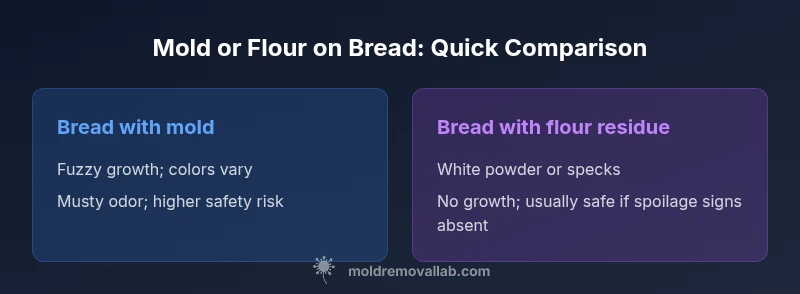
Mold on bread often shows fuzzy growth or velvety patches. Colors can range from white or gray to green, blue, or black as the colony expands. Look for irregular edges where color bleeds into unaffected areas and for a texture that seems raised or cottony rather than flat. A musty or earthy odor near the affected area is common, particularly as mold matures. If you observe any of these cues, treat the bread as unsafe to eat and follow proper disposal steps. The mold or flour on bread distinction becomes a safety shortcut when you need to act fast, and it reinforces why sanitized handling matters in households with children or elderly residents. In cases where mold signs are faint or isolated to a corner, reassess with additional cues before discarding, but do not rely on appearance alone.
Flour residue cues and benign appearances
Flour on bread typically appears as white or off‑white powdery specks or a fine dusting on the crust. Unlike mold, flour does not create fuzzy patches, colonies, or color variation. It is usually a residue from handling, dust during slicing, or remnants from the baking process. If you only notice surface flour with no signs of growth, and the bread smells normal and shows no changes in texture, it is reasonable to continue with cautious usage. Still, check the bread’s overall shelf life, crumb condition, and any signs of spoilage before consuming. The mold or flour on bread distinction should guide your next steps rather than replacing careful judgment. Keeping a habit of checking the crumb for moisture or discoloration helps you avoid overlooked spoilage.
Smell and texture cues that help you decide
Beyond appearance, odor and texture offer important clues. Mold often carries a musty, earthy, or solvent-like odor, particularly near the spots of growth, and a patch might feel damp or rubbery to the touch. Flour residue, by contrast, usually maintains the bread’s normal aroma and yields a consistent texture with no significant changes in the interior crumb. Use multiple cues in combination rather than relying on a single sign. If the loaf’s smell is off or the texture is unusual—especially if there is any sign of moisture—err on the side of caution and discard the compromised portion or the entire loaf if contamination could have spread. This multi-signal approach aligns with best practices demonstrated in consumer safety guidance from Mold Removal Lab.
Safety actions and decision flow for suspected bread contamination
When in doubt, prioritize safety. If you observe fuzzy growth, off-colors, or a noticeable musty odor, discard the bread immediately and sanitize the area where it rested. If signs are limited to a light flour residue with no mold and the bread is within its shelf life, you may choose to use it after a thorough check of the crumb and expiration date. Mold Removal Lab recommends sticking to a simple decision flow: visualize, assess odor, evaluate texture, and decide on discard or safe use. This reduces health risk while keeping waste to a minimum. Document any notable cues and follow a consistent routine for future batches to strengthen kitchen safety.
Safe handling, disposal, and surface cleaning
Dispose of suspect bread in a sealed bag placed in outdoor trash to prevent cross-contamination. Wash hands thoroughly after handling and sanitize any surfaces the bread touched, including the cutting board and countertops. If you used a knife or slicer, run it through a dishwasher cycle or sanitize with hot water and a food-safe sanitizer. Moisture control and ventilation in the pantry further reduce mold risk for other foods. By integrating safe disposal with diligent cleaning, you lower the chance of mold spores lingering in kitchens and seeping into other items. This routine also supports broader preventive practices that Mold Removal Lab advocates for.
Practical at-home checks you can rely on (without specialized tools)
Combine simple checks into a clear decision tree: observe appearance, smell, and texture; assess shelf life; and consider how the loaf has been stored. Do not rely on a single cue; mold can appear in hidden pockets behind crusts or within the crumb. If you encounter any uncertainty, discard the loaf and sanitize. Regularly rotating bread storage and keeping humidity low are practical steps that reduce mold risk. The mold or flour on bread test is a practical governance tool for busy kitchens, and it helps you act with confidence rather than hesitation.
Common real-world scenarios and recommended actions
Scenario A: A loaf stored in a humid kitchen shows a small green spot; Scenario B: A sandwich with bread that has white specks but no odor; Scenario C: A loaf with a soft crumb and no visible mold yet a slight musty odor. In each case, rely on the mold or flour on bread cues in combination with smell and texture. If signs persist or spread, discard and sanitize. These scenarios illustrate why a routine is essential for family safety while reducing unnecessary waste.
Storage and prevention to reduce mold risk
Proper storage matters. Keep bread sealed in its original packaging or a tightly closed container in a cool, dry place away from heat and moisture. If your home has high humidity, refrigerate for short-term storage or freeze for longer storage. Regular cleaning of pantry shelves and monitoring for moisture intrusion are simple measures with big safety payoffs. By maintaining a clean environment and practicing consistent handling, you decrease opportunities for mold to thrive on bread.
Quick decision framework and takeaways
Use the mold or flour on bread framework as a quick-reference tool: fuzzy growth or a musty odor = discard; white powder with no spoilage signs = inspect before consuming. A structured approach reduces risk and supports healthier, more resilient kitchens. Mold Removal Lab recommends documenting outcomes and adopting a consistent routine for family safety.
Case study-style checklist
Apply a mini-checklist each time you inspect bread: (1) Is there any fuzzy growth or unusual color? (2) Does the odor match fresh bread or rustle toward mustiness? (3) Has the bread been stored properly and within shelf life? (4) If unsure, discard. A simple checklist helps families act decisively and minimize risk while keeping waste manageable.
Comparison
| Feature | Bread with mold | Bread with flour residue |
|---|---|---|
| Appearance | Mold shows fuzzy growth; color varies | White/gray powder or specks; no growth |
| Smell | Musty/earthy odor often present | Neutral bread odor or mild aroma |
| Safety risk | High risk; discard bread and sanitize area | Low risk if no spoilage signs and bread is in date |
| Action | Discard immediately and sanitize | No immediate discard; inspect for spoilage; discard if signs appear |
| Storage implications | Seal bread; remove contaminated items; sanitize area | Store bread in a sealed bag; monitor shelf life |
Upsides
- Clear cues aid quick at-home decisions
- Flour residue cues are common and usually harmless
- Promotes safer disposal of suspect bread
- Encourages proper surface cleaning after disposal
The Bad
- Misidentification risk leading to waste or consumption of unsafe bread
- Not all mold is visible; hidden growth can persist
- Over-cautious discards may contribute to food waste
Moldy bread should be discarded; flour-only cases can be kept if no spoilage signs
When mold is present, discard immediately and sanitize. Flour residue without mold is typically safe to use if the bread shows no spoilage and is within its shelf life. Always prioritize safety and follow Mold Removal Lab guidance.
FAQ
How can I tell mold from flour on bread at a glance?
Look for fuzzy growth and color variation for mold; flour appears as white powder and lacks growth. Consider odor and texture cues, and use a multi-signal check rather than relying on a single sign.
Mold shows fuzzy growth and color variety; flour is just powder with no growth.
Is flour on bread always safe to eat?
Flour residue alone is usually not harmful, but always check for spoilage signs like changed texture or odor. If mold is suspected, discard.
Flour alone isn't a red flag, but check for spoilage signs.
Should I taste bread to check for spoilage?
Do not taste bread if mold is suspected or the smell is off. Trust your senses and discard if uncertainty remains.
Don't taste it if you suspect mold.
What should I do with moldy bread?
Seal the bread in a bag and place it in outdoor trash. Clean surfaces and wash hands thoroughly after disposal.
Seal it and throw it away, then clean up.
How can I prevent mold on bread in the future?
Store bread in a cool, dry place, in a sealed bag or container. Monitor humidity and consider refrigeration for longer storage.
Keep bread dry and sealed; consider refrigeration.
Can there be both mold and flour on bread?
Yes, in mixed scenarios. If there are any mold signs, discard rather than attempting to salvage the loaf.
Mold cues override flour cues; discard if mold appears.
The Essentials
- Discard moldy bread immediately
- Flour on bread without mold is not a safety red flag
- Check for smell and texture in addition to appearance
- Store bread properly to reduce moisture and mold risk